Short answer
Feasibility for a commercial rooftop solar investment means building the hourly load profile, setting the self-consumption ratio, checking contract power and the twice-annual-consumption cap, inspecting the roof and structure, and calculating income and costs. In Antalya 1 MWp produces about 1,656 MWh a year (PVGIS); since 1 May 2026, non-residential net metering is hourly.
Key takeaways
- The hourly load profile is at the centre of feasibility; since 1 May 2026, production and consumption are netted hour by hour for non-residential installations (Official Gazette 2 April 2026).
- For installations that received a connection approval letter after 2019, annual production cannot exceed twice the annual total of the associated consumption; industrial facilities can install up to twice the contract power (2022 text).
- Surplus is valued at the tariff's single-rate active energy unit price; the higher the self-consumption, the faster the investment pays back (interpretation).
- In Antalya a 1 MWp rooftop system produces about 1,656 MWh a year per PVGIS; 1 kWp needs about 4.3 m² of panel surface.
- The KOSGEB Green Industry 2023-01 call is repayable and its application window has closed; verify any current call.
A commercial rooftop solar investment is one of the most concrete ways for a business to cut its electricity costs, but the right decision comes only from a serious feasibility study. Feasibility includes building the load profile, setting the self-consumption ratio, checking regulatory limits, inspecting the roof and structure, and calculating income and costs. In this article we offer a step-by-step feasibility framework for industrial, tourism and commercial businesses in Antalya. We do not quote exact amounts, because every business has a different tariff, load and roof.
Feasibility steps for a commercial rooftop solar investment
| Step | Input | Output |
|---|---|---|
| 1. Load profile | Hourly or 15-minute consumption data, latest bill | Daytime consumption curve, peak load |
| 2. Regulatory check | Contract power, subscriber group, connection approval letter (çağrı mektubu) status | Maximum permitted system power |
| 3. Roof and structure | Roof type, area, orientation, tilt, shading | kWp that can be placed |
| 4. Production estimate | PVGIS and shading analysis | Hourly/monthly production |
| 5. Self-consumption analysis | Production and load curve | Self-consumption and surplus ratio |
| 6. Financial model | Quote, tariff, maintenance cost | Payback, cash flow |
Load profile and self-consumption: the heart of feasibility
In a commercial rooftop solar investment, the most critical data is how consumption is distributed through the day. From 1 May 2026, for non-residential renewable licence-exempt installations that received a connection approval letter (çağrı mektubu) after 12 May 2019, production and consumption are netted separately for every hour; EPİAŞ (the Energy Exchange Istanbul, Turkey's electricity market operator) carries out the netting through its Licence-Exempt Generation Module. Consuming energy in the same hour it is produced is therefore decisive for the installation.
On the price side there are two separate values. Energy you avoid buying through self-consumption is worth every component of your tariff. Surplus is valued at the single-rate active electrical energy unit price in the tariff table approved by the EPDK Board (Turkey's Energy Market Regulatory Authority); if there are several tariffs in the group, the lowest is used. This is lower than the total unit charge on the bill. So as the self-consumption ratio rises, the payback of the investment speeds up; this is an interpretation, and the rule it rests on is that payment is based only on the active energy unit price.
In installations built for self-consumption at the same metering point, surplus production left after hourly netting may be treated as free-of-charge generation (Decision 14531, Art. 9/4-b). You need to confirm with the distribution company which class your installation falls into. In Antalya this rule creates an advantageous profile for businesses with a high daytime cooling load, such as wholesale markets, warehouses, hotels and factories. It is especially important for the cooling and air-conditioning load to overlap with summer production; according to PVGIS, 1 kWp produces 168 kWh in July.
Regulatory limits: contract power and the twice rule
Three limits stand out for businesses in licence-exempt generation. The first is capacity: municipalities, industrial facilities and agricultural irrigation facilities can install up to twice their contract power; other persons are limited to their contract power (Art. 5/1/h; 2022 text; there is no finding that this wording changed in the 2026 amendment, but still confirm the current position). The second is the annual production cap: the production of installations that received a connection approval letter after 12 May 2019 in a calendar year cannot exceed twice the total annual consumption of the associated consumption facilities (Art. 26/17).
The third is the contract power floor: for installations that received a connection approval letter after 12 May 2019, the total contract power of the associated consumption facilities cannot be lower than the installed power (there are exceptions; a separate formula applies to municipalities, industry and agricultural irrigation). If the condition is not met, production is treated as a free contribution to YEKDEM (the Renewable Energy Support Mechanism) and no payment is made for it. In addition, when the "paid generation limit" is exceeded, net metering continues, but the surplus is set aside as a quantity payable subject to a system usage charge. These rules are based on texts in force as of October 2026, and the regulation changed three times in 2026; verify the current position before the investment decision. For details, see our summary of the licence-exempt electricity generation regulation.
Roof, structure and shading inspection
On business roofs, feasibility is also an engineering assessment. In industrial estates and OSBs (organised industrial zones) in Antalya, trapezoidal sheet roofs are common; clamp systems are used on these roofs, and the life and load-bearing capacity of the roof sheet are examined. On flat reinforced-concrete roofs, tilted structures or ballast are preferred. In every case the load-bearing capacity of the roof needs to be assessed by a civil engineer; the distribution company and the municipality may ask for a structural suitability certificate.
To estimate the area requirement quickly, you can use this rough measure: a 605 Wp panel is 2278x1134 mm, so it takes up about 2.6 m²; 1 kWp needs about 4.3 m² of panel surface. For 100 kWp, panel surface alone comes to about 430 m²; because of maintenance walkways, ventilation stacks, skylights and shading distances, the whole roof area cannot be given to panels. The roof being a fire-resistant surface and sufficient ventilation being left behind the panels are also requirements of manufacturers' manuals.
Production estimate: Antalya with PVGIS
According to PVGIS 5.3 data (optimum tilt, south orientation, 14% system loss), 1 kWp in central Antalya produces 1,656 kWh a year. That is, 100 kWp comes to about 165.6 MWh, 500 kWp to about 828 MWh and 1 MWp to about 1,656 MWh a year. The values given are 1,649 kWh/kWp for Manavgat, 1,615 for Alanya, 1,664 for Kaş, 1,655 for Korkuteli and 1,719 for Elmalı. Roof orientation, tilt and shading change this value; on a flat roof, the area needed per kWp rises because of shading between panel rows.
The monthly distribution matters too. 1 kWp produces 99 kWh in December and 168 kWh in July; that is, summer production is about 70% higher than winter. In tourism and cooling-heavy businesses, summer consumption is high, so the overlap of production and consumption is natural. For facilities that do not operate in winter, the annual distribution should be assessed differently.
Financial model: what should you account for?
- Investment amount: Panel, inverter, mounting structure, cable, design, application and installation items. Official fees under AEDAŞ's (the regional electricity distribution company's) 2026 tariff are 3,970.8 TL for an application of 50-250 kW and 7,942.8 TL for 250 kW-5 MW (VAT included).
- Avoided energy cost: Self-consumed kWh x tariff (all components). The industrial tariff was raised by 5.8% on 4 April 2026; take the current unit price from the EPDK table.
- Surplus income: Based on the active energy unit price.
- Expenses and renewal: Maintenance, cleaning, insurance, monitoring and inverter replacement (the standard warranty on TommaTech inverters is 5 years).
- Panel degradation: About 0.4% a year under the linear performance warranty.
- Tax: Confirm the VAT position with your accountant; the general rate is 20%.
For the formula and sensitivity examples of the payback calculation, see our article on how to calculate the payback period of solar energy. For financing options, see solar loans and financing. The KOSGEB (Small and Medium Enterprises Development Organisation) Green Industry Support Programme 2023-01 call covered rooftop solar investments by industrial SMEs; the upper limit was 14,000,000 TL and the support rate 60%, but the support is repayable and the application window closed on 30 November 2024. We could not verify an open call today.
Solar Nexo's references at business scale
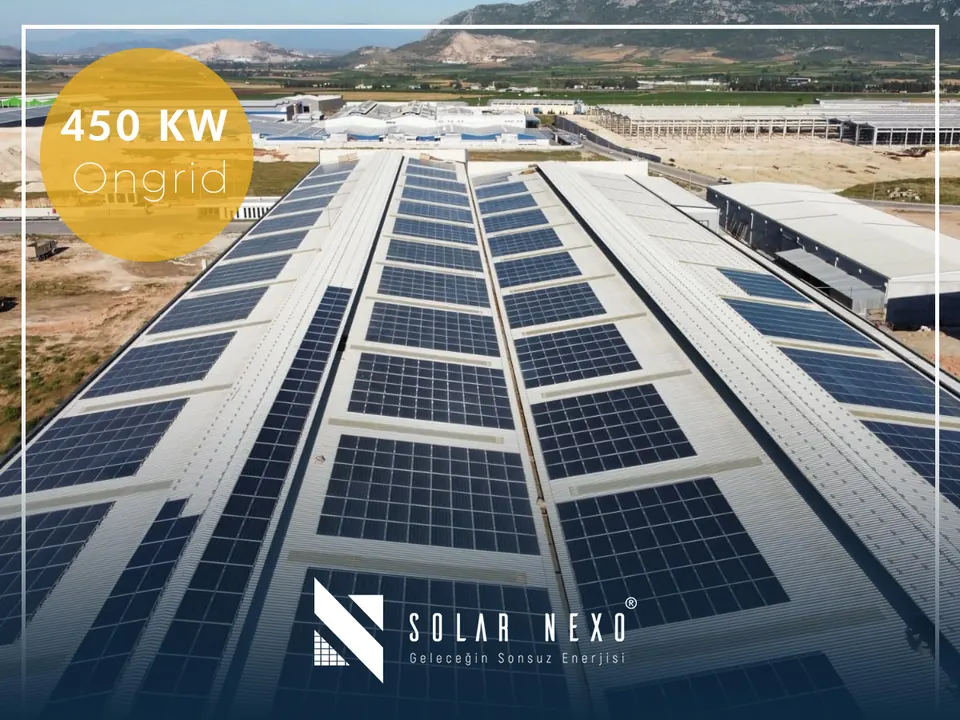
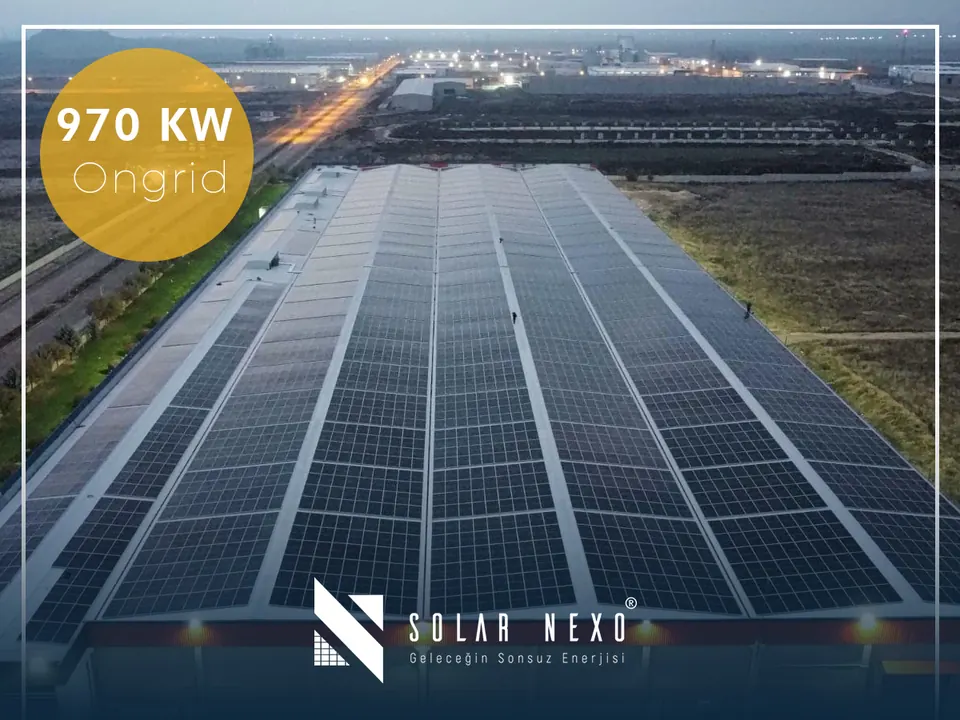
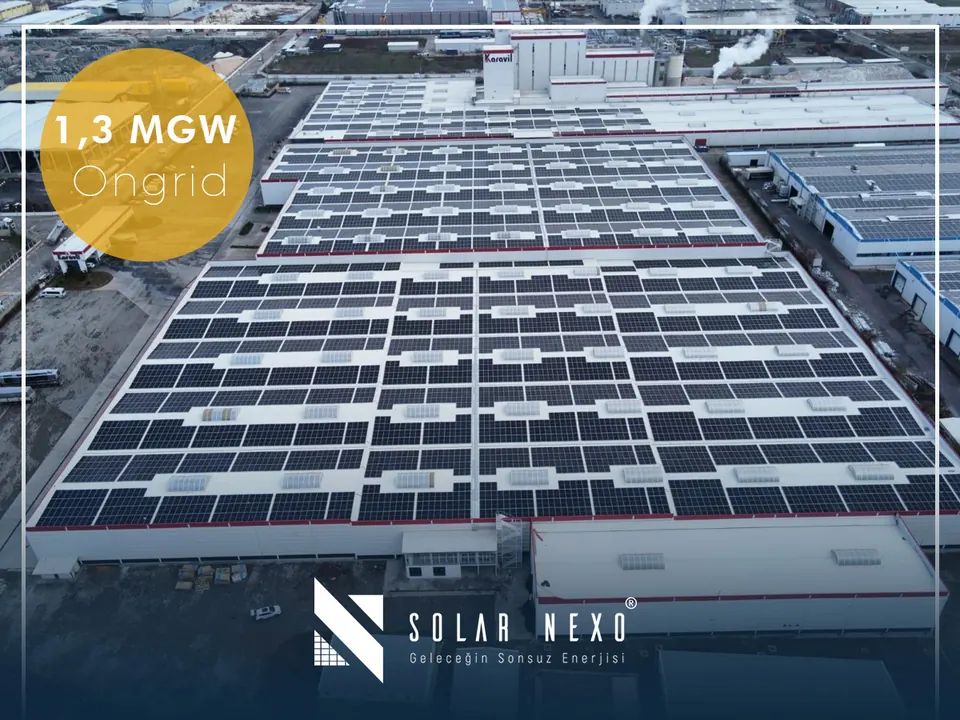
Among the reference projects it lists on its website, Solar Nexo includes business roofs at different scales: a 450 kW on-grid commercial building roof, an 860 kW on-grid industrial roof, a 970 kW on-grid factory roof for self-consumption, a 1.3 MW on-grid industrial rooftop solar plant and a 4.5 MW on-grid large-scale industrial roof. Ground-mounted plants of 680 kW and 2.4 MW are also listed. You can review the details of these projects on the reference projects page. For sector-specific details, see our article on factory rooftop solar in Antalya OSB and Aksu.
During the feasibility process, Solar Nexo examines the roof and electrical infrastructure at a free survey, prepares the project design, supports the application steps, carries out installation and commissioning, and afterwards provides maintenance and 24/7 technical support. If you share your business's load data, we can assess the hourly production-consumption match together.
How many kW do you need for your bill?Use the solar calculator to see system size, number of panels and annual production straight away.Conclusion
The right decision on a commercial rooftop solar investment comes from assessing the hourly load profile, self-consumption ratio, regulatory limits, roof conditions and income-cost calculation together. Antalya's high solar irradiation and summer cooling loads can make this analysis favourable for many businesses, but your own data determines the result. For a preliminary calculation you can use the calculation tool, and for a detailed feasibility you can request Solar Nexo's free site survey.
Frequently asked questions
How is feasibility done for a commercial rooftop solar investment?
First the load profile is built from the business's hourly consumption data. Then regulatory limits such as contract power and the twice rule are checked, the roof and structure are inspected, production is estimated with PVGIS, the self-consumption ratio is calculated and a financial model is built from the quote and tariff data. The result should be read not as a single figure but together with optimistic and cautious scenarios.
Is net metering hourly for businesses?
Yes. From 1 May 2026, for non-residential renewable licence-exempt installations that received a connection approval letter (çağrı mektubu) after 12 May 2019, production and consumption are netted separately for every hour. EPİAŞ carries out the netting through its Licence-Exempt Generation Module. For residential subscriptions net metering is monthly; confirm the current practice with the distribution company, because the rules changed several times in 2026.
How large a rooftop solar system can a business install?
Industrial facilities, municipalities and agricultural irrigation facilities can install up to twice their contract power; other persons are limited to their contract power (2022 text). In addition, annual production cannot exceed twice the associated consumption. Because these limits change often, verify the current regulation with the distribution company before applying; the deciding data is your subscription's contract power.
Does surplus electricity earn income for a business?
Surplus is valued at the tariff's single-rate active energy unit price, which is lower than the total unit charge on the bill. In installations built for self-consumption at the same metering point, surplus left after hourly netting may be treated as free of charge. The installation's class should therefore be confirmed and a design that prioritises self-consumption should be made.
How do I know if the roof is sufficient for a commercial rooftop solar plant?
Roof type, area, orientation, tilt, shading and load-bearing capacity are examined together. 1 kWp needs about 4.3 m² of panel surface; however, maintenance walkways and protrusions prevent you from using the whole area. Load-bearing capacity should be assessed by a civil engineer, and the distribution company and the municipality may ask for a structural suitability certificate. This inspection is carried out at the survey.
Does KOSGEB provide support for rooftop solar?
The KOSGEB Green Industry Support Programme 2023-01 call covered rooftop solar investments by industrial SMEs; however, the support is repayable and the application window of 8 December 2023 to 30 November 2024 has closed. No new open call has been verified today. You should check the current position on KOSGEB's official website.
At what scale does Solar Nexo share references for business roofs?
Solar Nexo's website lists on-grid references from a 450 kW commercial building roof to a 4.5 MW large-scale industrial roof; for example a 970 kW factory roof for self-consumption, an 860 kW industrial roof and a 1.3 MW industrial rooftop solar plant. Details are on the reference projects page; each project was designed for its own conditions.
Sources
- Amendment to the Regulation on Unlicensed Electricity Generation, Official Gazette 2 April 2026
- EPDK Board Decision 14531, Net Metering Procedures and Principles, Official Gazette 5 May 2026
- Text of the amendment to the Regulation on Unlicensed Electricity Generation, Official Gazette 11 August 2022
- PVGIS - European Commission JRC
- AEDAŞ licence-exempt generation applications and 2026 fees
- KOSGEB Green Industry Support Programme
Want a clear calculation for your roof?
The Solar Nexo team carries out a free site survey at your address in Antalya and designs the system that suits your roof, consumption and budget.