Short answer
In an Antalya OSB (organised industrial zone) solar investment, a factory's daytime consumption coincides with rooftop panel production, so the self-consumption rate can be high. The central Antalya PVGIS value is 1,656 kWh/kWp. As of October 2026, hourly netting applies to non-residential facilities and annual production cannot exceed twice consumption; roof structure and connection conditions are decisive in feasibility.
Key takeaways
- According to PVGIS 5.3, annual specific production for central Antalya is 1,656 kWh/kWp; for a 500 kWp system that is about 828,000 kWh.
- Since 1 May 2026, netting has been hourly for non-residential facilities.
- Annual production cannot exceed twice the associated consumption (for those who received a connection approval letter after 2019).
- Only the single-rate active energy unit price is paid for surplus; as the self-consumption rate rises, payback shortens (interpretation).
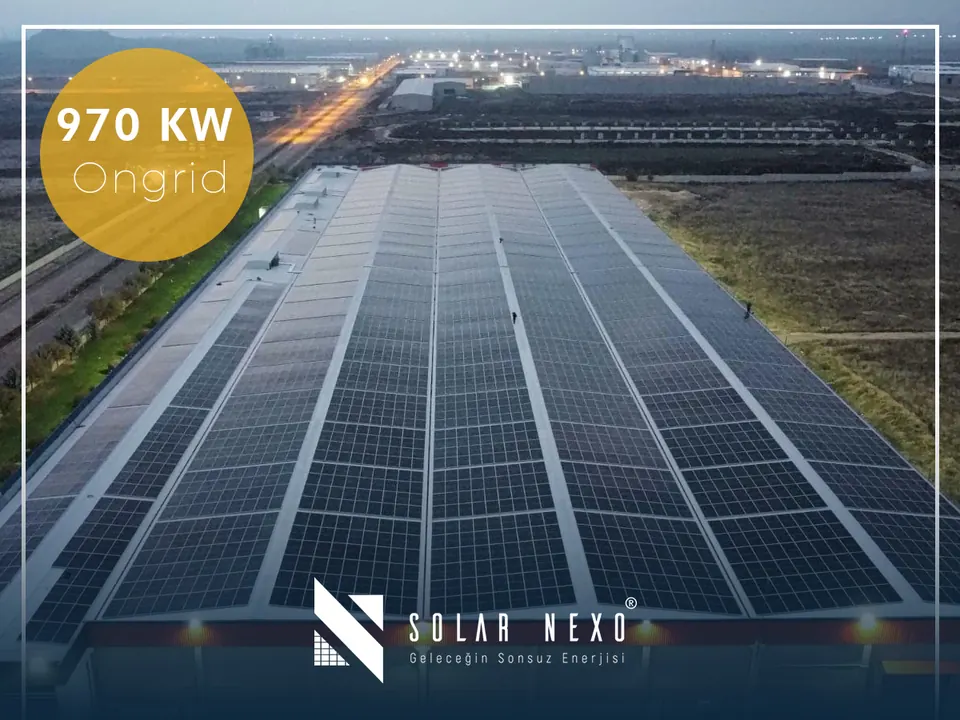
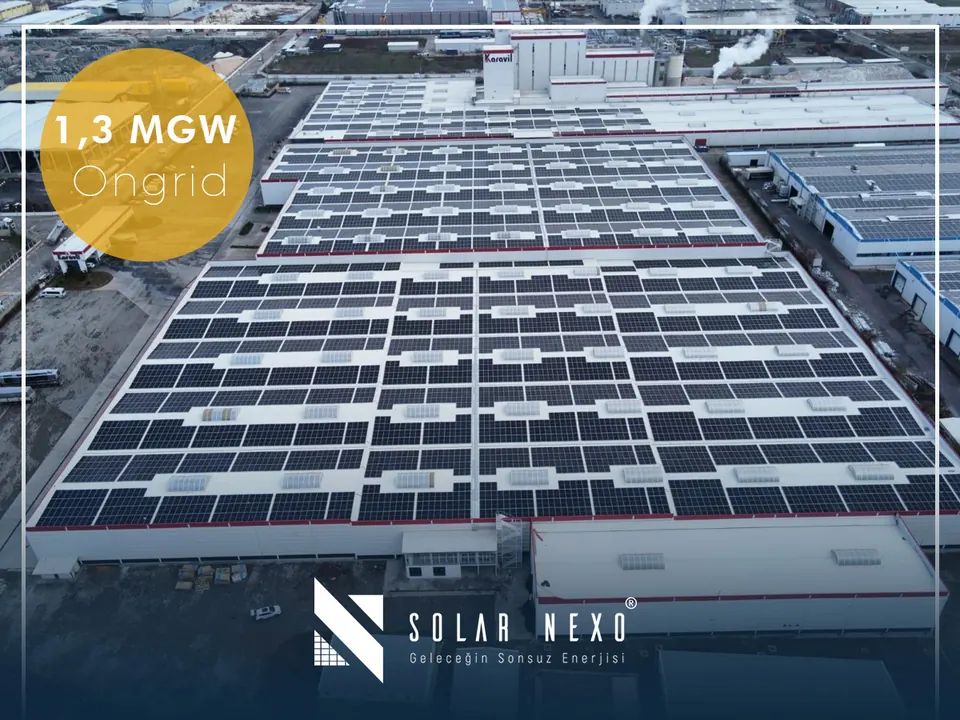
- Solar Nexo's website lists industrial roof references of 970 kW, 1.3 MW, 860 kW and 4.5 MW.
For a business evaluating an Antalya OSB (organised industrial zone) solar investment, the basic question is: how well does the factory's daytime electricity consumption coincide with the rooftop panels' production? In industrial facilities, machines, ventilation, compressors and cooling generally run on the daytime shift. This makes rooftop solar one of the most suitable applications in terms of self-consumption. In industrial sites in Antalya OSB, Aksu and the surrounding area, wide flat or gently sloping trapezoidal roofs hold this potential.
This article is a guide for businesses planning a factory rooftop solar project: load profile, roof and structure, regulation, the treatment of surplus and the project process. The figures are examples; for every facility, feasibility is done with consumption data and roof measurement.
Why does factory rooftop solar match the daytime load?
Solar production peaks around midday and falls to zero in the evening. The consumption curve of a factory working one or two shifts is also high by day. The greater the overlap, the more of the energy produced is used directly at the facility; no payment is made to the grid for this energy. According to PVGIS 5.3, annual specific production in central Antalya is 1,656 kWh/kWp; in the summer months it reaches its highest values at 168 kWh/kWp in July and 167 in August. Because cooling and air-conditioning loads also rise in the summer season, production and consumption move in the same direction.
An example calculation: a 500 kWp roof system produces about 828,000 kWh per year with the central Antalya value (500 × 1,656). This assumes optimal tilt and south orientation. On a flat roof, depending on arranging panels on a tilted structure, the shading distance left between them and the mounting system, real production may deviate from this value.
Roof type and structure: trapezoidal, sandwich panel, reinforced concrete
The common roof types in factories around Antalya OSB and Aksu are trapezoidal sheet, sandwich panel and flat reinforced-concrete roofs. Each needs a different mounting method and structural assessment:
| Roof type | Mounting approach | Point to watch |
|---|---|---|
| Trapezoidal sheet | Clamp or screwed connection, rail system | Sealing, age of the roof covering |
| Sandwich panel | Special clamp or connection to the support | Panel strength, fire regulation |
| Flat reinforced-concrete roof | Tilted frame with ballast or anchoring | Added load, waterproofing |
The roof's load-bearing capacity needs to be assessed by a civil engineer; the distribution company and the municipality may request a structural suitability document. We cannot give a clear threshold for the power above which a structural report is mandatory; so it is safe to plan the structural assessment at the start of the project. Panel weight also enters the calculation: a 605 W TOPCon panel weighs about 29 kg and measures 2,278 × 1,134 mm. The installation manual requires the panel to be mounted on a fire-resistant surface with ventilation; on roofs that are not fire-resistant, installation should not be done without a fire protection layer.
For details on mounting systems, you can look at our article on solar panel mounting systems.
MW-scale roof references on Solar Nexo's website
On its website, Solar Nexo lists the following on-grid references on industrial roofs: a 970 kW factory roof (self-consumption focused), a 1.3 MW industrial rooftop plant, an 860 kW industrial roof and a 4.5 MW large-scale industrial rooftop plant. These references show that roof projects are carried out at different scales; each project's consumption, roof and connection conditions are different, so one project's result cannot be applied directly to another. You can see all the references on our references page.
Regulation: current rules for industrial facilities
The rules valid as of October 2026 are as follows; the regulation changed three times in 2026, and whether there is a new amendment should be checked before publication.
- Applicable authority: The relevant grid operator; this may be the distribution company or the holder of the OSB distribution licence. For facilities inside an OSB, who the application is made to is determined by the grid operator the facility is connected to.
- Capacity: Under the regulation, industrial facilities can install up to twice their contracted power (2022 text, Art. 5/1/h); there is no finding that this wording changed in the 2026 amendment, but it should be confirmed before applying.
- Annual production cap: For facilities that received a connection approval letter after 12 May 2019, production in a calendar year cannot exceed twice the total annual consumption of the associated consumption facilities.
- Hourly netting: From 1 May 2026, production and consumption at facilities in this scope other than residential are netted hour by hour separately; the process runs through EPİAŞ's (Energy Exchange Istanbul) Unlicensed Generation Module.
- Equipment age: Main equipment such as panels, inverters and batteries must have been manufactured within the last five years.
- Contracted-power floor: For facilities that received a connection approval letter after 2019, a separate floor formula applies for industry; if the condition is not met, production counts as a free contribution to YEKDEM (the Renewable Energy Resources Support Mechanism).
The practical result of these rules is this: with hourly netting, consuming daytime production within the same hour reduces surplus. Only the single-rate active energy unit price of the relevant tariff is paid for surplus; this is lower than the total unit price on the bill (including distribution fee and taxes). This is an interpretation: as the self-consumption rate rises, payback time shortens. For the details of the rules, you can look at our article on selling surplus electricity.
Self-consumption rate scenarios
The same rooftop system can give very different results in two different factories. Let us make a hypothetical comparison: both facilities install a 500 kWp system producing 828,000 kWh a year.
| Scenario | Consumption profile | Result |
|---|---|---|
| Facility A | Double shift, high daytime load, also works at weekends | Most production is consumed instantly, surplus is small |
| Facility B | Single shift, closed at weekends, low loads | Weekend production turns into surplus; valued lower under hourly netting |
For this reason, system size should be chosen on the consumption profile, not on roof area. For Facility B, a smaller system may deliver higher self-consumption per unit of investment. This is an engineering approach; the exact result is simulated with hourly load data.
Operation and maintenance
In large rooftop systems, monitoring and maintenance are critical for continuity of production. String-level monitoring shows low production in a string early. Regular cleaning, connector and cable checks, inverter maintenance and hot-spot scanning with a thermal camera are included in the maintenance programme. On its website Solar Nexo states the Maintenance and Technical Support step and 24/7 technical support as services.
Feasibility steps
Feasibility for a business proceeds in the following steps:
- Consumption data: Hourly, or at least monthly, consumption, contracted power and subscription group are collected. If possible, a 15-minute load profile is obtained.
- Roof measurement: Usable area, orientation, tilt, shade sources (chimneys, ventilation, neighbouring structures) and the structural condition are determined.
- Connection assessment: Transformer capacity and the connection point are checked. The 25 kW procedure has a 50% limit of distribution transformer capacity; at industrial scale a separate assessment is made.
- Production simulation: Monthly production is overlaid with consumption using PVGIS and site data.
- Application and project: The connection approval letter (çağrı mektubu), project approval, connection agreement and acceptance steps are carried out.
You can read our article on rooftop solar investment for businesses for the whole feasibility approach. We do not quote prices, because cost items vary with roof type, equipment, cable distance and connection conditions.
Support and financing
The 2023-01 solar call of the KOSGEB Green Industry Support Programme (KOSGEB is Turkey's small and medium enterprise development organisation) covered rooftop solar investments by industrial SMEs. The support is repayable, that is, not a grant. The call's application window was 8 December 2023 - 30 November 2024; whether the call is open today has not been verified. So do not make the support plan the sole basis of the investment decision; check the current status on the KOSGEB page. We give no figures for bank loans, because interest and maturity are determined by the project.
For process and application support, you can look at our on-grid systems service page, and for a free site survey you can use our contact page.
Conclusion
Rooftop solar for factories in Antalya OSB and Aksu can be a sensible investment thanks to the daytime load and wide roof surfaces. Success depends on reading the consumption profile correctly, assessing roof structure early and including current rules such as hourly netting and the two-times production cap in the feasibility study. For your own facility, work out load and roof data together at a survey.
Frequently asked questions
Why does the daytime load matter in factory rooftop solar?
Because solar production peaks by day, machines, compressors and ventilation running by day consume the production directly. No payment is made to the grid for energy used at the facility; for surplus, only the active energy unit price is paid. For this reason, in facilities with a high daytime load, the self-consumption rate and investment efficiency are better. Shift pattern and weekend working directly determine the self-consumption rate.
What is hourly netting and how does it affect factories?
From 1 May 2026, production and consumption at in-scope non-residential facilities are netted hour by hour separately. That is, producing a surplus by day and drawing the night from the grid is less advantageous than monthly balancing. Factories that consume production within the same hour reduce surplus and work more efficiently. For this reason a simulation with hourly load data plays a critical role in the sizing decision.
How many kWp of rooftop solar can be installed at a factory?
The limit depends on contracted power and annual consumption. Under the 2022 text, industrial facilities can install up to twice their contracted power; also, annual production cannot exceed twice the associated consumption. Before applying, it is necessary to confirm the current limits with the distribution company or the OSB grid operator. These limits are open to regulatory change; those valid as of October 2026 are stated in the article.
Can solar panels be installed on a trapezoidal roof?
Yes, trapezoidal sheet roofs are suitable for panel mounting with a clamp or rail system. However, the age of the roof covering, sealing and load-bearing capacity must be assessed by a civil engineer. The distribution company and the municipality may request a structural suitability document. Panels must be mounted on a fire-resistant surface with ventilation. In addition, wind load and fire safety should be considered in design.
Who is the application made to for a factory inside an OSB?
The applicable authority is the relevant grid operator; this may be the distribution company or the holder of the OSB distribution licence. You need to find out from the OSB management which grid operator your facility is connected to. It is known that AEDAŞ, the distribution company in Antalya, accepts applications through the LUS platform. If capacity is insufficient, the distribution company manages application priority according to the order in the regulation.
How much is paid for surplus energy?
Payment is made on the single-rate active electrical energy unit price in the relevant tariff table; if there are several tariffs in the group, the lowest is used. This is lower than the total unit price on the bill. You should find out the current unit price from the EPDK table and remember that the rules may change. This difference between the cost avoided by self-consumption and the price paid for surplus affects design.
Does KOSGEB provide a grant for rooftop solar?
No, it does not. The 2023-01 solar call of the KOSGEB Green Industry Support Programme was a repayable support and its application window was 8 December 2023 - 30 November 2024. A new call has not been verified; you need to check the current status on KOSGEB's official page. For financing, you need to apply to banks' own products and project-based conditions.
Sources
Want a clear calculation for your roof?
The Solar Nexo team carries out a free site survey at your address in Antalya and designs the system that suits your roof, consumption and budget.