Short answer
A factory solar plant is a solar power plant installed on an industrial site's roof, whose output is used primarily for the site's own consumption. In Antalya, in factories running daytime shifts, the load profile overlaps the production curve, so the self-consumption rate is high. System size is set by contract power, roof structure and regulatory limits; exact savings are calculated at the survey.
Key takeaways
- In a factory the real gain comes from daytime production matching the site's own load; surplus is paid only the active energy unit price.
- Industrial sites can install an unlicensed solar plant up to twice their contract power (Art. 5/1/h); annual production cannot exceed twice consumption.
- From 1 May 2026, net metering is hourly for non-residential plants.
- In central Antalya, annual specific yield with optimum installation is about 1,656 kWh/kWp (PVGIS 5.3).
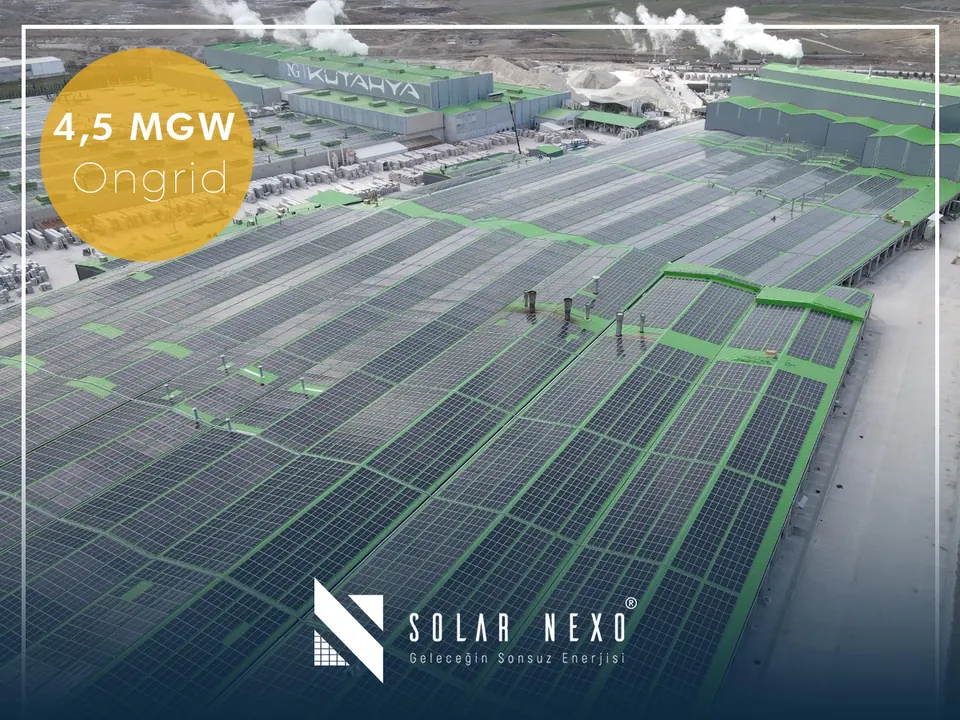
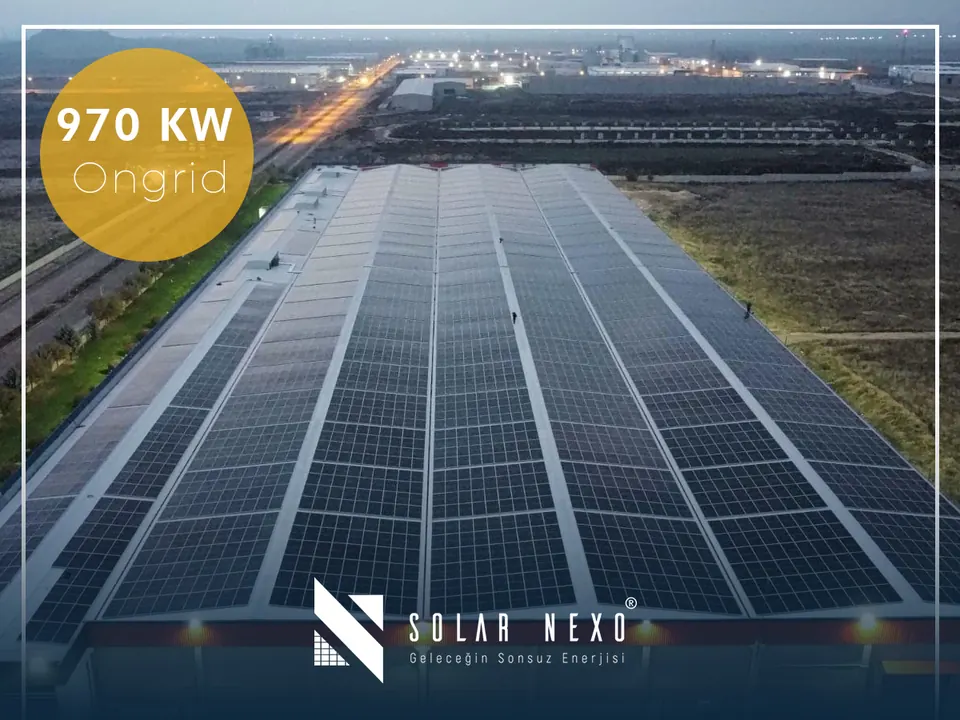
- The Solar Nexo website lists industrial roof references of 970 kW, 860 kW, 1.3 MW and 4.5 MW.
A factory solar plant is an investment aimed at first consuming the solar electricity produced on an industrial site's roof on the site's own lines. At workshops, packaging, food and logistics sites that run in the daytime in Antalya, the load curve overlaps largely with solar production, so a solar plant on the factory roof is often the most sensible first step. In this article we describe how to read the load profile, the roof and regulatory criteria and the reference scale in the field.
Why a factory solar plant: the economics of self-consumption
What determines the value of solar in industry is where the kWh you produce goes. Every kWh consumed at your site is a kWh you will not buy from the grid. Surplus fed to the grid is valued at the single-rate active energy unit price of the relevant tariff; this amount is lower than the total unit price on the bill. For this reason, the aim in a factory solar plant is to size the system as far as possible to the site's daytime consumption.
Regulation supports this approach: unlicensed generators produce for their own needs. Moreover, since 1 May 2026, for non-residential plants that received their connection approval letter (çağrı mektubu) after 12.05.2019, generation and consumption are netted separately every hour. In other words, hour-by-hour matching, not the annual total, has become what matters. You can find the details of net metering in our article on selling surplus electricity.
Load profile: how well does your factory overlap with the sun?
The first engineering step is to examine the site's hourly, or at least 15-minute, consumption data. This data, obtained from the electricity distribution company or your meter reading system, shows at which hours and in which season consumption is concentrated.
| Site type | Typical load feature | Fit with solar |
|---|---|---|
| Single-shift, daytime workshop and manufacturing | Heavy in working hours, low at night and weekends | High; weekend surplus needs a separate calculation |
| Multi-shift production | Continuous load at night too | Medium; the daytime share is decisive |
| Cooling and storage-heavy site | Compressor load all day, rising in summer | High; summer production and cooling load rise together |
| Packaging, seasonal food processing | Intensity depends on the season | The season calendar limits system size |
Low consumption on weekends and holidays is the most often overlooked point in a factory solar plant. If production cannot be consumed the same day, the excess is treated as surplus. For this reason, system size is usually set somewhere between the lowest daytime load and the average daytime load.
Roof suitability: sheet, sandwich panel and supporting structure
Industrial roofs in Antalya are mostly trapezoidal sheet, sandwich panel or reinforced-concrete terrace. Each needs a different mounting structure: on sheet roofs, seam clamps or screw fixings; on a flat terrace, a ballasted or anchored structure. The roof's load-bearing capacity must be assessed by a civil engineer; the distribution company and the municipality may ask for a structural suitability document.
The manufacturer's warning matters for fire safety: the panel must be mounted on a fire-resistant surface with enough ventilation left behind it. Panels must not be installed on fire-vulnerable roofs such as plastic or PVC without a fire-protection layer; installation contrary to the manual voids the warranty. A rough measure of panel surface: a 605 Wp panel of 2278 × 1134 mm takes up about 2.58 m²; as panel surface alone, that comes to about 4.3 m² per kWp (calculation). Mounting gaps, maintenance paths and roof projections increase this area.
Regulation: capacity and application in industry
According to Article 5/1/h of the Unlicensed Electricity Generation Regulation, industrial sites can install a plant of up to twice their contract power; other subscriber groups are limited to contract power. For plants that received their connection approval letter after 12.05.2019, production in a calendar year cannot exceed twice the annual total of the related consumption. With the 2026 amendment, a separate contract-power floor formula also applies for industry; if the condition is not met, the generation counts as a free contribution to YEKDEM (the Renewable Energy Support Mechanism). It is therefore essential to assess your contract power and consumption data together before the project.
The application is made in Antalya through AEDAŞ's (Akdeniz Elektrik Dağıtım A.Ş., the local electricity distribution company) LUS platform. According to AEDAŞ's 2026 tariff, the application fee for 250 kW to 5 MW is 7,942.8 TL including VAT; this fee may change, so verify the current one with the distribution company. The rule on equipment is also clear: panels and inverters must have been manufactured within the last five years, and operating before acceptance results in disconnection and a 3-year application ban. For the whole regulatory framework, see our article on the unlicensed generation regulation.
Solar Nexo's industrial-scale references
On its website, Solar Nexo shares the following on-grid references at industrial and commercial scale: a 1.3 MW industrial roof solar plant, a 970 kW factory roof (focused on self-consumption), an 860 kW industrial roof, a 4.5 MW large-scale industrial roof, a 450 kW commercial building roof and 2.4 MW and 680 kW ground-mounted plants. The company also states that it has 12+ MW of installed capacity and a 27-person specialist field team. All the references are on our references page.
How is production estimated for a factory solar plant?
Use PVGIS 5.3 data as a reference: with 14 percent system loss and optimum tilt facing south, the annual specific yield in central Antalya is about 1,656 kWh/kWp. For a hypothetical 500 kWp plant, this means about 828 MWh a year under optimum conditions. Industrial roofs are mostly low-tilt and an east-west layout can be used; in that case specific yield falls below the reference but the daily production curve spreads out. For a real estimate, roof dimensions, shade (chimneys, ventilation towers, neighbouring structures) and dust soiling must be taken into account.
In the summer months the average July maximum temperature is 34.2 °C; because of heat, panel power falls and the factory's cooling load rises. These two effects partly offset each other: consumption and production rise in the same season. Because dust and industrial pollution also affect the panel surface, a monitoring system and a regular cleaning plan should be part of the project.
A factory solar plant project, step by step
- Data collection: The last 12 months of bills, hourly load data, contract power, transformer information and the roof plan are obtained.
- Site survey: The roof structure, shade, cable route and inverter placement area are inspected.
- Preliminary sizing: The load curve is compared with the PVGIS-based production curve and the self-consumption rate is estimated.
- Project and application: The electrical and structural project is prepared and the application is made through LUS.
- Installation and acceptance: Installation is completed; the system is not run until acceptance is finished.
- Monitoring and maintenance: Production is monitored, and cleaning and inverter checks are planned.
This sequence is consistent with the flow Solar Nexo describes on its website: survey, project design, installation and commissioning, maintenance and technical support.
Uninterrupted production and safety
For production continuity in a factory, you need to know this: a standard on-grid system shuts down for safety when the grid is cut. A solar plant does not keep the site running during a grid outage; critical loads need a generator or a separate battery-supported solution. On the other hand, a solar plant reduces the share of energy in your production cost by lowering your energy bill. Addressing lightning, overvoltage and fire protection in the project design is especially important on industrial roofs.
The process starts with a free survey: load data, roof, contract power and transformer status are examined; then come the project, application, installation and maintenance steps. For a financial assessment at business scale, you can read our article on rooftop solar investment for businesses. Be careful when researching support such as KOSGEB (the Small and Medium Enterprises Development Organisation) for corporate investment: the Green Industry 2023-01 call is repayable, not a grant, and its application window closed in November 2024; no new call has been confirmed.
What to look at when comparing quotes?
At industrial scale, comparing quotes only by price per kWp is misleading. Compare in writing the equipment brand and model, panel and inverter warranties, the scope of the monitoring system, who is responsible for the application and acceptance procedures, and the maintenance terms. Ask about the loss rate and shade assumption on which the production estimate is based; you can use the PVGIS value above as a reference point.
Conclusion
The success of a factory solar plant depends less on the number of panels than on reading the load profile, roof structure and regulatory compliance correctly. At Antalya sites that consume heavily in the daytime, a high self-consumption rate can be kept; the system must be sized together with contract power, the hourly net metering rule and the annual production ceiling. If you want a realistic assessment for your site, you can request a free survey.
Frequently asked questions
How many kW of solar panels can be installed on a factory roof?
The limit is set by roof area, supporting structure and regulation. Industrial sites can install an unlicensed solar plant up to twice their contract power; annual production also cannot exceed twice the related consumption. As panel surface, about 4.3 m² per kWp is needed, and mounting gaps increase this. The exact value is determined at the survey and written into the project.
Can I sell surplus electricity from a factory solar plant?
Surplus is valued within the framework of regulation at the single-rate active energy unit price of the relevant tariff; this is lower than the total unit price on the bill. For non-residential plants, net metering has been hourly since 1 May 2026. So the system should be sized to the site's daytime consumption. Weekend and holiday surplus should be assessed separately and included in the payback calculation.
Does a factory solar plant keep working if the grid is cut?
A standard on-grid system shuts down for safety when the grid is cut, so it does not keep the site running. If critical loads must keep running during an outage, a generator, battery or hybrid solution must be added to the project. Which loads count as critical is determined at the survey and the cost of the extra equipment is reflected in the quote. This extra cost varies with your continuity needs and your critical load list.
Can solar panels be installed on a sandwich panel roof?
They can if the supporting structure and roof material are suitable. The roof's load-bearing capacity must be assessed by a civil engineer. According to the manufacturer's instructions, the panel must be mounted on a fire-resistant surface with ventilation left behind it; on vulnerable roofs such as plastic or PVC, installation without a fire-protection layer must not be done. Installation contrary to the manual voids the warranty; so it matters that the installation team knows the manufacturer's instructions.
Where do I apply for a factory solar plant?
The application is made to the grid operator. In Antalya the distribution company is AEDAŞ, and it has taken unlicensed generation applications through the LUS platform since 01.10.2023. The connection approval letter (çağrı mektubu), project approval, connection agreement and acceptance steps are followed in order; the system must not be run before acceptance is complete. Otherwise the connection is cut and a 3-year application ban may follow.
Is there government support or a grant for a factory solar plant?
There is no verified current rooftop solar grant. The KOSGEB Green Industry 2023-01 call was a repayable support and its application window closed in November 2024; no new call has been confirmed. Banks have their own solar loans but terms are set by project. You should confirm current support with the institutions. For agricultural businesses there is a separate interest-subsidised loan framework.
How long does a factory solar plant installation take?
There is no official figure for the total time. The regulation defines step periods such as 90 days for project approval after the connection approval letter; installation time depends on system size and roof conditions. The best method is to ask for the work programme in writing in the quote after the survey. Application and acceptance times may lengthen depending on the distribution company's workload.
Sources
- Official Gazette - Amendment to the Unlicensed Electricity Generation Regulation (02.04.2026)
- EPDK Board Decision 14531 - Net Metering Procedures and Principles (Official Gazette 05.05.2026)
- Akdeniz Elektrik Dağıtım A.Ş. - Unlicensed Generation
- European Commission JRC - PVGIS
- TommaTech TOPCon 605 W panel datasheet
Want a clear calculation for your roof?
The Solar Nexo team carries out a free site survey at your address in Antalya and designs the system that suits your roof, consumption and budget.