Short answer
Among solar energy frequently asked questions, the most important are output, cost and regulation. In central Antalya, about 1,656 kWh/kWp per year is expected with optimum installation; price varies by system type, and rooftop systems up to 25 kW apply through the simplified procedure. The 30 short answers below link to the related detailed articles.
Key takeaways
- In central Antalya, annual specific yield with optimum installation is about 1,656 kWh/kWp (PVGIS 5.3, 14 percent loss).
- Rooftop and facade systems up to 25 kW apply through the simplified procedure; the limit was raised to 25 kW on 12.03.2022.
- Main equipment must have been manufactured within the last five years (2026 regulation text).
- Solar energy systems are subject to the general VAT rate; the general rate is 20 percent, so get confirmation from a financial adviser for application.
- A grid-tied system without a battery does not work when the grid is cut; a hybrid solution is needed for backup power.
Solar energy frequently asked questions are usually gathered under the same headings: how much does it produce, how much does it cost, which permits are needed, how is maintenance done. This page gives short, verifiable answers to the 30 questions most often asked by homeowners, businesses and farm owners in Antalya. The figures are taken from PVGIS, MGM (the Turkish State Meteorological Service), EPDK (Turkey's Energy Market Regulatory Authority) and manufacturer datasheets; because regulation changes often, dates are stated separately.
Solar energy frequently asked questions: basic concepts
1. How does a solar panel generate electricity?
The photovoltaic cells inside the panel convert light into direct current. The inverter converts this current into the alternating current used in homes. Output rises with irradiance; that is why in Antalya production is highest from June to August and lowest in December and January.
2. What is the difference between on-grid, off-grid and hybrid systems?
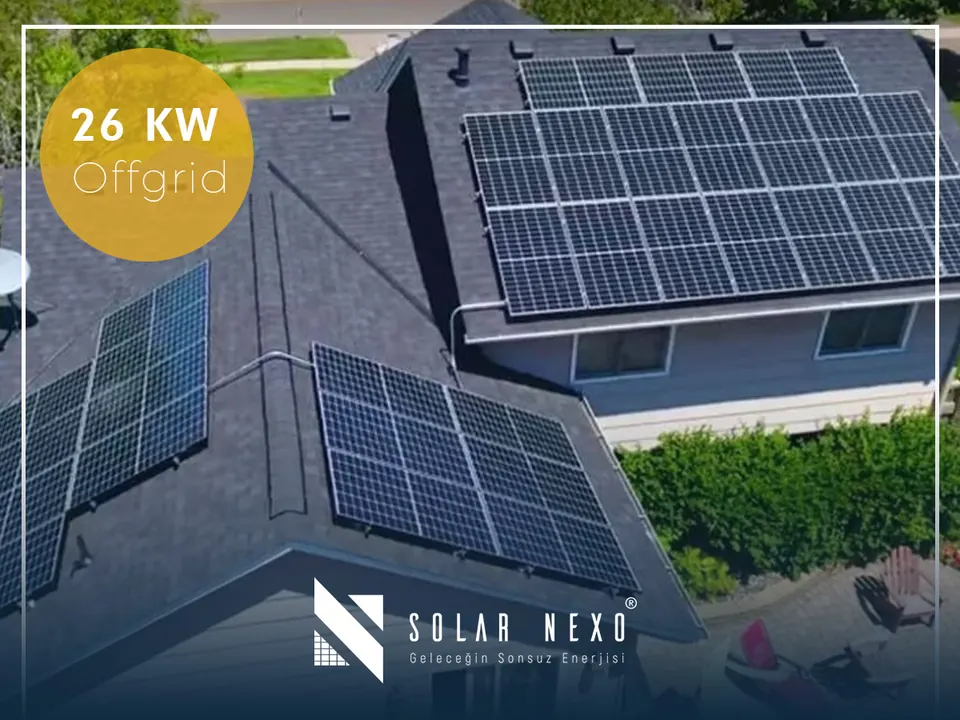
An on-grid system works connected to the grid and has no battery. An off-grid system is independent of the grid and works with a battery. A hybrid system uses the grid and the battery together; it can provide backup power during an outage. The choice depends on your consumption hours, your outage history and your access to the grid.
3. How much does a solar panel produce a year in Antalya?
According to PVGIS 5.3 data, a south-facing system at the optimum tilt (33°) in central Antalya produces about 1,656 kWh/kWp (assuming 14 percent system loss). On a real roof, tilt, orientation and shade pull this value down.
4. Do panels work in cloudy or rainy weather?
They work, but produce less; output falls with cloud density. According to MGM data, Antalya has about 73 rainy days a year and most of the rain falls between November and February, so summer production is hardly affected.
5. Do panels produce electricity at night?
No, production stops without sunlight. Night consumption is met from the grid or, if there is a battery, from stored energy. So in systems without a battery, the real gain comes from production that matches daytime consumption.
6. If the power is cut, does my on-grid system keep working?
A standard on-grid system without a battery shuts itself down for safety when the grid goes. If you want electricity during an outage, you need a battery-supported hybrid system or a solution with a backup line. We determine this choice at the survey according to your critical loads.
Solar energy frequently asked questions: cost, payback and financing
7. How many kW of solar panels does my home need?
A starting value is found by dividing annual consumption by the region's specific yield. For example, for 4,000 kWh a year, 4,000 / 1,656 ≈ 2.4 kWp. Roof area, shade and budget change the result; for details, see our article on how many kW of panels you need.
8. How much does a solar energy system cost?
It would not be right to give a fixed price; cost varies with system type, power, equipment brand, roof conditions and battery. For a realistic amount, you should get a quote after a survey that lists the items one by one.
9. What is the payback period?
There is no official fixed period. The period depends on system cost, the tariff and how much of the energy you produce you consume yourself. It shortens as self-consumption increases, because surplus is paid a lower unit price rather than the total amount on the bill.
10. Is there a loan or support for solar energy?
Banks have their own solar products, but interest and term are set by project. For agricultural businesses, the interest-subsidised loan framework under Communiqué 2024/15 is valid until 31.12.2026; confirm current terms with Ziraat Bank.
11. What is the VAT rate when buying solar panels?
According to a Revenue Administration (GİB) private ruling, solar energy systems are subject to the general VAT rate; the general rate has been 20 percent since July 2023. Be cautious about claims of a reduced rate and consult your financial adviser before the transaction. For details, see our article on VAT and tax.
12. Can I sell the electricity I generate in surplus?
Yes, surplus is assessed within the framework of regulation; however, payment is made not on the total amount on the bill but on the single-rate active energy unit price of the relevant tariff. For details, see our article on selling surplus electricity.
Frequently asked questions on technology and performance
13. What is a TOPCon panel?
TOPCon is a technology that uses a thin tunnel oxide layer in n-type silicon cells. For example, the datasheet of a 605 W TommaTech model gives an efficiency of 23.42 percent and a temperature coefficient of −0.30 %/°C. For details, see our article on TOPCon panels.
14. How many years is the panel warranty?
It varies by product. For example, the TommaTech 605 W single-glass model has a 15-year product warranty and a 30-year performance warranty; for the double-glass model the product warranty is 25 years. Ask for the warranty in writing in the quote, by brand and model.
15. How long does a solar panel last?
Manufacturers give a linear performance warranty extending to 30 years; in the example datasheet power is at 87.4 percent in year 30. In NREL's 2012 review, the median degradation for field modules was found to be about 0.5 percent per year.
16. Does Antalya's heat affect the panel?
Yes, panel power falls as temperature rises. By calculation, at 34 °C ambient and 1000 W/m² irradiance the cell reaches about 65 °C and, in a panel with a coefficient of −0.30 %/°C, the loss relative to STC is about 12 percent. Ventilated mounting helps limit this effect.
17. Why is the LiFePO4 battery preferred?
LiFePO4 (lithium iron phosphate) is common in home systems; it stands out for its cycle life and safety profile. The number of cycles and the warranty period differ from manufacturer to manufacturer; so the datasheet should be consulted by brand and model.
18. How much does partial shade affect the system?
In a series-connected string, shading of a single panel can lower the current of the whole string. Half-cell panels are more tolerant of shade thanks to their two-parallel-sub-array structure; still, correct placement and, if needed, the use of optimisers are planned at the survey.
Frequently asked questions on regulation, applications and permits
19. Where do I apply for a rooftop solar plant?
The application is made to the grid operator. In Antalya the distribution company is AEDAŞ (Akdeniz Elektrik Dağıtım A.Ş.), and it has taken unlicensed generation applications through the LUS platform since 01.10.2023. For the step-by-step process, see our article on applying for a rooftop solar plant.
20. What is the simplified procedure for systems up to 25 kW?
Roof and facade systems up to 25 kW that do not exceed the contract power of the consumption facility apply through the simplified procedure. Generation and consumption are connected at the same metering point. The limit was raised from 10 kW to 25 kW on 12.03.2022.
21. Is a building permit needed for a rooftop solar plant?
In planned areas there is a permit exemption provided that the load-bearing system is not affected and the consent of the condominium owners is obtained. Even so, an implementation project, a technical responsibility undertaking (fenni mesuliyet taahhütnamesi) and permission from the authority are needed. Confirm your situation with your municipality.
22. What is needed to install solar on an apartment building roof?
Among the application documents is a notarised copy of the "solar may be installed" decision in the resolution book. We do not give a firm ratio for the majority by which the decision must be taken; you should speak to the manager and a legal adviser about this.
23. Can I run the system before acceptance is completed?
No. A plant operated without acceptance is disconnected without notice, the equipment must be removed within 60 days and the owner cannot apply under this regulation for 3 years (Official Gazette 14.05.2024). Being patient is therefore essential.
24. Can an unlicensed application be made with second-hand panels?
No. According to the 2026 text of the regulation, main equipment such as panels, inverters and batteries must have been manufactured within the last five years. So you need to stay away from second-hand or old-stock equipment.
Antalya-specific and maintenance questions
25. How often should I clean the panels?
In Antalya, because the average number of rainy days in July and August is about 0.5, dust builds up for a long time. Cleaning frequency varies with the surroundings (dust, pollen, sea salt, agriculture); a check is recommended when a drop is seen in production monitoring.
26. Do wind, hail and snow strain the panel?
In datasheets, the typical wind resistance is 2400 Pa and the snow resistance 5400 Pa. The greatest snow depth recorded in Antalya is 5 cm. Hail and tornadoes are recorded especially in the Kumluca-Finike-Demre greenhouse region; we do not give a numerical hail risk.
27. Does salty air on the coast affect installation?
Humidity and salt from the sea can raise the risk of corrosion in metal parts and fasteners. On villa and hotel roofs on the coast, a corrosion-resistant mounting structure and regular checks are preferred.
28. Can I install solar panels if I am a tenant?
The property owner's approval and a document showing the right of use are needed for the application. For a detached building, the title deed, a lease or a right-of-use document is requested. Also plan for the possibility of moving.
29. How do I track the system after installation?
Most inverters show production through a monitoring app. Solar Nexo states that it provides maintenance and 24/7 technical support. If your production falls clearly below the expected value, have cleaning, shading and the inverter checked.
30. What services does Solar Nexo offer?
Based in Kepez, Solar Nexo offers on-grid, off-grid, hybrid and net metering systems, solar-powered agricultural irrigation and wind energy solutions. The process starts with a free survey and continues with project, installation and maintenance steps.
Conclusion
Solar energy frequently asked questions mostly get a concrete answer at the survey stage, because roof, consumption and grid conditions differ for every property. Use the answers here as a starting point, confirm current information from the relevant institutions for critical decisions (VAT, permits, apartment decisions) and compare quotes by equipment and warranty details.
Frequently asked questions
Does a solar energy system make sense for a home?
Whether it makes sense depends on your consumption, roof conditions and the tariff. High sunshine in Antalya is an advantage; systems work more efficiently in homes with high daytime consumption and a shade-free roof. For the decision, it is right to have a survey done with your last 12 months of bills and see a concrete production and cost calculation. The annual consumption on your bills is the most important data used in the survey.
Where can I have solar panels installed?
You should get a survey and a written quote from companies that carry out solar installation in Antalya. Compare the quotes by equipment brand and model, warranty, application scope and production assumption. Solar Nexo states that, based in Kepez, it offers the survey, project, application, installation and maintenance steps under one roof. You can also look at the real installations on the references page.
Do solar panels need maintenance?
Because there are no moving parts, maintenance needs are low, but not zero. The panel surface needs cleaning, connections and the mounting structure need checking and inverter status needs monitoring. Because dust builds up in Antalya's dry summer months, cleaning and a shading check should be done when a drop in output is seen. A technical check at least once a year is also useful.
Will solar energy bring my bill down to zero?
A firm promise of zero would not be right. Items such as the distribution fee, taxes and consumption in hours when you cannot produce may remain on the bill. System size, self-consumption rate and the way surplus is treated determine the result. So do not trust statements such as "your bill will be zero". After the survey, a realistic scenario can be calculated with your consumption data. This calculation should be updated as tariffs change.
Is a system with or without a battery more suitable?
In places with high daytime consumption and few outages, an on-grid system without a battery is mostly enough. If outages are frequent or you want to cover evening consumption too, a battery-supported hybrid solution is considered. Also take into account that no payment is made for energy fed from the battery to the grid. The right choice is made by drawing up a load list at the survey.
How long does the application process take?
There is no official figure for the real time from application to connection. The regulation defines separate periods for the steps: for example 90 days for project approval after the connection approval letter (çağrı mektubu) and 15 days for the connection agreement after project approval. The total time depends on the completeness of the file and grid capacity. Missing documents are among the things that lengthen the process most.
Sources
Want a clear calculation for your roof?
The Solar Nexo team carries out a free site survey at your address in Antalya and designs the system that suits your roof, consumption and budget.