Short answer
A public building solar plant uses the solar energy produced on the roof of schools, municipal service buildings and similar institutions for daytime consumption. In Antalya, the load profile of public buildings that work daytime hours overlaps the production curve; however, school consumption drops in the summer holiday. Capacity is limited by regulation according to contract power, roof structure and institution type.
Key takeaways
- In public buildings, heavy daytime consumption overlaps naturally with the solar production curve.
- The school summer holiday coincides with June-August, when about 30 percent of annual output falls according to PVGIS (calculation).
- Municipalities and their affiliates can install an unlicensed plant up to twice their contract power; for other institutions the limit is contract power (Art. 5/1/h).
- Net metering for non-residential sites has been hourly since 1 May 2026; self-consumption is therefore decisive.
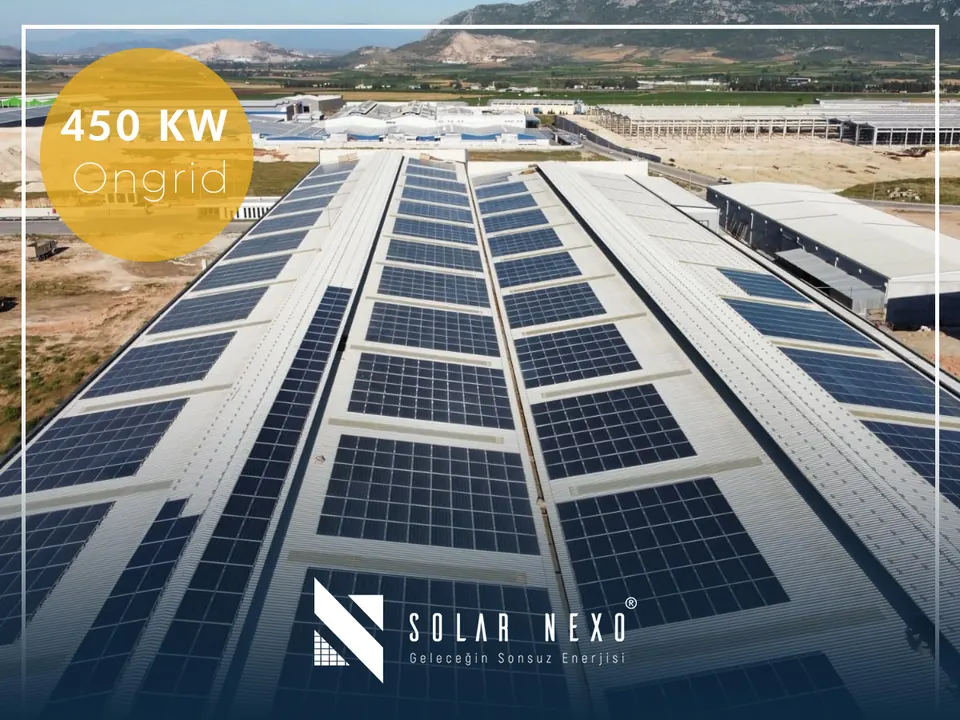
- The Solar Nexo website lists 'Public Buildings' as an application area and shares scale references such as a 450 kW commercial building roof.
A public building solar plant is a solar energy system installed on the roof of a building in public use, such as a state school, a municipal service building, a health facility or a dormitory, whose output is used primarily for the building's own consumption. In Antalya, public buildings offer a suitable profile for solar energy when daytime working hours combine with air-conditioning load and high irradiance. However, there are also issues of their own such as school holiday periods, regulation and public procurement processes. In this article we take them up step by step.
Why can a public building solar plant be a sensible investment?
The consumption of public buildings is generally concentrated in the daytime: lighting, computers and office equipment, air conditioning, ventilation and water pumps run during working hours. Solar production also peaks in the daytime; so most of the energy produced is consumed directly in the building. For non-residential sites, since 1 May 2026 generation and consumption are netted separately every hour; in other words, hourly matching has become important, and public buildings with high daytime consumption benefit from this structure.
Surplus is valued at the single-rate active energy unit price of the relevant tariff, and this amount is lower than the total unit price on the bill. So the aim is to choose a system size suited to the building's daytime consumption. For the net metering rules, you can read our article on selling surplus electricity.
Load profile: school, municipal building and health facility
| Building type | Consumption feature | Solar fit and point to watch |
|---|---|---|
| School | Heavy on weekday daytimes; low at weekends and in the summer holiday | Holiday-period production may be surplus; system size is therefore chosen moderately |
| Municipal service building | Heavy in working hours, air-conditioning load in summer | High fit; weekend surplus is taken into account |
| Health facility | Continuous load all day and partly at night | Medium-high fit; backup power for critical loads is considered separately |
| Dormitory and staff housing | Heavy in morning and evening, low in the daytime | Lower fit; a battery or a small size is considered |
| Water pumping and treatment plant | Steady, generally continuous load | The daytime share is decisive |
This table shows only general trends. The real decision is made after the building's hourly or 15-minute consumption data is examined. This data, which the institution can obtain from the distribution company or its meter reading system, is the basis of correct sizing.
School solar energy and the summer holiday: how is the calculation done?
The most asked question for schools is the summer holiday. According to PVGIS 5.3 data, per kWp in Antalya, 159 kWh is produced in June, 168 in July and 167 in August; together they come to 494 kWh. Given that annual production is 1,656 kWh/kWp, the share of the summer months is about 494 / 1,656 ≈ 30 percent (calculation). Because schools will be largely closed in this period, this part of production is not consumed within the building and is treated as surplus.
Making the system smaller is not the only answer. In some schools, consumption may continue in summer courses, administration buildings or sports halls. Some institutions may have other facilities in the same subscriber group; net metering depends on the generation and consumption facilities belonging to the same person and being in the same subscriber group. So the size of the system on the school roof is determined by assessing the holiday period and the related consumption facilities together.
Regulation: capacity and application for public institutions
According to Article 5/1/h of the Unlicensed Electricity Generation Regulation, municipalities and their affiliates can install a plant of up to twice their contract power; other persons are limited to contract power (2022 text). In 2026 a separate contract-power floor formula also applies for municipalities, and if the condition is not met, the generation counts as a free contribution to YEKDEM (the Renewable Energy Support Mechanism). For other public facilities such as schools, which clause applies may depend on the institution's status; so the distribution company should be consulted before applying.
Applications in Antalya are made through AEDAŞ's (Akdeniz Elektrik Dağıtım A.Ş., the local electricity distribution company) LUS platform. The steps in the regulation are: connection approval letter (çağrı mektubu), 90 days for project approval, the connection agreement, acceptance and the system use agreement. In addition, the main equipment (panels, inverter, battery) must have been manufactured within the last five years; the system must not be run before acceptance is complete. For the process details, you can look at our article on applying for a rooftop solar plant.
The procurement processes of public institutions (tender, direct procurement, financing model) are subject to separate legislation and fall outside the scope of this article. You need to confirm with your institution's finance unit and the relevant legislation.
Roof, structure and safety: special points on school roofs
In school and public buildings in Antalya, reinforced-concrete flat terraces or pitched tile roofs are common. On a flat terrace a ballasted or anchored structure is used, and on a pitched roof a hook and rail system. In public structures, the building registration certificate, the earthquake regulation and structural safety carry special sensitivity; the roof's load-bearing capacity must be assessed by a civil engineer. Although there is a permit exemption in planned areas, an implementation project, a technical responsibility undertaking (fenni mesuliyet taahhütnamesi) and permission from the authority are needed.
In schools, it matters to prevent children's access to the roof, to design maintenance paths safely, to protect cable routes and to ensure fire safety (the panel mounted on a fire-resistant surface with ventilation behind it). Lightning and overvoltage protection must also be included in the project. In panel selection, data such as power, temperature coefficient and warranty should be taken from the manufacturer's datasheet; for example, a 605 Wp TOPCon model has a 15-year product warranty and a 30-year performance warranty.
What does Solar Nexo offer for public buildings?
On its website, Solar Nexo lists "Public Buildings" as an application area, and the process starts with a free survey: load data, roof and electrical infrastructure are examined; then come the project design, installation and commissioning, maintenance and technical support steps. As scale examples, the company shares a 450 kW commercial building roof reference and industrial roof references ranging from 970 kW to 4.5 MW on its website; these are not presented as public projects and should be treated as indicators of scale and technical experience. For the references, see our references page.
Worked example: a 100 kWp public building system
Let us make a hypothetical calculation: suppose 100 kWp is installed on the roof of a municipal service building. With the PVGIS reference, annual production in central Antalya would be about 100 × 1,656 = 165,600 kWh (south-facing, optimum tilt, 14 percent loss). Looking at the monthly distribution, about 16,800 kWh is expected in July and about 9,900 kWh in January. If the building's annual consumption is far above this production, almost all of what is produced is consumed within it; if consumption is low, the excess is treated as surplus. On a real roof, tilt, orientation and shade pull these values down.
In addition, under the 2026 regulation, for plants that received their connection approval letter after 12.05.2019, annual production cannot exceed twice the annual total consumption of the related consumption facilities. In a public building with high consumption this limit usually does not cause a problem; however, in a structure with small consumption, the limit can be exceeded if the system is chosen too large. This is why consumption data is the first input of the project.
Tariff context
EPDK raised retail sales prices from 4 April 2026; the increase was 17.5 percent in the public and private services group. Because tariffs may change, check the current unit price from the EPDK table and your bill. Whatever the price, the value of a kWh you use in your own consumption is higher than the amount paid for surplus; this puts the self-consumption rate at the centre of the target.
Roadmap for a public building solar plant
- Data: The last 12 months of bills, the meter and hourly consumption data are collected.
- Survey: The roof, shade, electrical panel and supporting structure are inspected.
- Sizing: The load curve is compared with the production curve, taking the summer holiday and related facilities into account.
- Application: An application is made to the distribution company through LUS and the connection approval letter and project approval are awaited.
- Installation and acceptance: Installation is completed; the system is not run until acceptance is finished.
- Monitoring: Production is monitored and maintenance and cleaning are planned.
For the technical structure of on-grid systems, you can look at our on-grid systems page, and for the regulation as a whole, our article on the unlicensed generation regulation.
Educational value: turning a school solar plant into a lesson
A solar energy system on a school roof can give students a live science and energy lesson through its monitoring screen. Topics such as production graphs, seasonal change, the effect of temperature on panel power and awareness of saving energy are taught with concrete data. Although this educational value is not directly a financial item, it fits with an institution's sustainability goals.
Conclusion
A public building solar plant can be a meaningful energy solution for Antalya public buildings that consume heavily in the daytime; however, the summer holiday of schools, the institution's status, contract power and roof safety must be assessed together. The healthiest path is to set system size with consumption data and to confirm regulation and procurement processes with the relevant units. You can make a survey request for your institution.
Frequently asked questions
Can solar panels be installed on a school roof?
They can if the supporting structure is suitable and the necessary permits are obtained. The roof's load-bearing capacity must be assessed by a civil engineer, an implementation project must be prepared and permission must be obtained from the authority. For grid-connected systems an application to the distribution company is also needed. Children's access to the roof and fire safety must also be planned separately in schools. In public structures, structural safety is a particularly sensitive subject.
What is the solar capacity limit for municipal buildings?
According to Article 5/1/h of the Unlicensed Electricity Generation Regulation, municipalities and their affiliates can install a plant of up to twice their contract power (2022 text). In 2026 a separate contract-power floor formula also applies for municipalities. For current capacity, the distribution company should be consulted before applying. The clause that applies may change according to the institution's status.
What happens to the electricity a school produces during the summer holiday?
Because consumption will be low while the school is on holiday, a significant part of production is treated as surplus and calculated at the active energy unit price of the relevant tariff. According to PVGIS, June-August makes up about 30 percent of production. So system size should be chosen with the holiday period and related consumption facilities in mind. A smaller system also reduces the surplus that arises in the holiday.
How can public institutions finance a solar investment?
The financing model depends on the institution's budget and the relevant public finance legislation; we cannot give details here. For the purchasing method (tender, direct procurement and so on) and the form of payment, the institution's finance unit and the relevant legislation should be the basis. The opinion of the legal counsel also secures the process. On the technical side, an item-by-item quote should be obtained after the survey.
How many years does a public building solar plant take to pay for itself?
There is no official fixed period; it depends on system cost, the public and private services tariff and the self-consumption rate. The period shortens as self-consumption rises, because surplus is paid a lower unit price than the total on the bill. After the survey, a realistic calculation can be made with consumption data. The calculation should be updated as tariffs change.
What information is needed for a public building solar plant?
The building's last 12 months of bills and meter data, contract power, the roof plan and structural information, any other related consumption facilities and the institution's authorisation documents are needed. In a grid application, the unique code (tekil kod) and the related declarations are also requested. Missing information can be completed at the survey, but consumption data is critical for sizing. Missing documents can lengthen the application process.
Does a public building solar plant need maintenance?
Because there are no moving parts, maintenance needs are low but not zero. On school and public roofs, surface cleaning, connection and mounting structure checks and inverter monitoring are needed. Because dust builds up in Antalya's dry summer months, regular cleaning preserves production. Solar Nexo states that it provides maintenance and 24/7 technical support.
Sources
- Official Gazette - Amendment to the Unlicensed Electricity Generation Regulation (02.04.2026)
- Regulation on Unlicensed Electricity Generation in the Electricity Market (Official Gazette 11.08.2022 amendment text)
- EPDK Board Decision 14531 - Net Metering Procedures and Principles (Official Gazette 05.05.2026)
- European Commission JRC - PVGIS
Want a clear calculation for your roof?
The Solar Nexo team carries out a free site survey at your address in Antalya and designs the system that suits your roof, consumption and budget.