Short answer
To find how many kW of solar panels you need, divide your last 12 months' total electricity use (kWh) by 1,656, which per PVGIS is the annual yield of 1 kWp in central Antalya. For example, a home using 8,000 kWh a year needs about 4.8 kWp, or 8 panels of 605 Wp. Roof area, shading and contract power can limit the result.
Key takeaways
- Formula: required kWp = annual consumption (kWh) ÷ 1,656. This is PVGIS 5.3's central Antalya value, assuming optimum tilt and south orientation.
- A 605 Wp panel produces about 1,000 kWh a year in Antalya; as a rule of thumb, dividing annual consumption by 1,000 gives the panel count.
- Output varies by season: 1 kWp produces 168 kWh in July and 99 kWh in December (PVGIS). Matching annually does not mean matching monthly.
- Residential subscriptions have no generation or sales limit; system power is limited by contract power and roof area (EPDK clarification, May 2026).
- If the system is sized above consumption, surplus is valued only at the active energy unit price, which is lower than the total unit charge on the bill.
The answer to how many kW of solar panels you need comes from two numbers: your annual electricity consumption and the annual specific yield of your location. For central Antalya, PVGIS (European Commission JRC) shows that 1 kWp produces about 1,656 kWh a year, assuming optimum tilt and south orientation. So when you divide your annual consumption by 1,656, you get approximately the system power (kWp) that covers your need. In this article we show the formula with examples and explain the factors that change the result and the official limits.
How many kW of solar panels do you need? The basic formula
The calculation takes three steps:
- Find your annual consumption: Add up the kWh values on your last 12 months of bills. Do not look only at a summer or winter bill; in Antalya the seasonal difference is large because of air conditioning.
- Divide by the specific yield: Required kWp = annual consumption ÷ 1,656.
- Convert to panel count: Required kWp ÷ panel power (kW). For a 605 Wp panel, divide by 0.605 and round up.
There is also a simple rule of thumb: a 605 Wp panel produces about 0.605 x 1,656 = 1,002 kWh a year in Antalya. So dividing your annual consumption by about 1,000 gives you the panel count. This rule is only for a first estimate; it does not account for roof orientation or shading.
Worked examples by bill consumption
The table below shows the required system power starting from average monthly consumption values. Panel surface is calculated for 605 Wp panels of 2278x1134 mm; layout gaps are not included.
| Average monthly consumption | Annual consumption | Required power | Panel count (605 Wp) | Panel surface |
|---|---|---|---|---|
| 250 kWh | 3,000 kWh | 1.81 kWp | 3 panels (1.82 kWp) | about 8 m² |
| 400 kWh | 4,800 kWh | 2.90 kWp | 5 panels (3.03 kWp) | about 13 m² |
| 600 kWh | 7,200 kWh | 4.35 kWp | 8 panels (4.84 kWp) | about 21 m² |
| 1,000 kWh | 12,000 kWh | 7.25 kWp | 12 panels (7.26 kWp) | about 31 m² |
| 2,000 kWh | 24,000 kWh | 14.49 kWp | 24 panels (14.52 kWp) | about 62 m² |
For example, a detached house consuming 600 kWh a month needs 7,200 ÷ 1,656 = 4.35 kWp. Seven panels at 4.24 kWp fall slightly short of the need; 8 panels at 4.84 kWp exceed it. Which to choose depends on roof area and your goal. For a comparison of sizes at home scale, see our 3, 5 and 10 kWp comparison.
How many kW of solar panels do different home types in Antalya need?
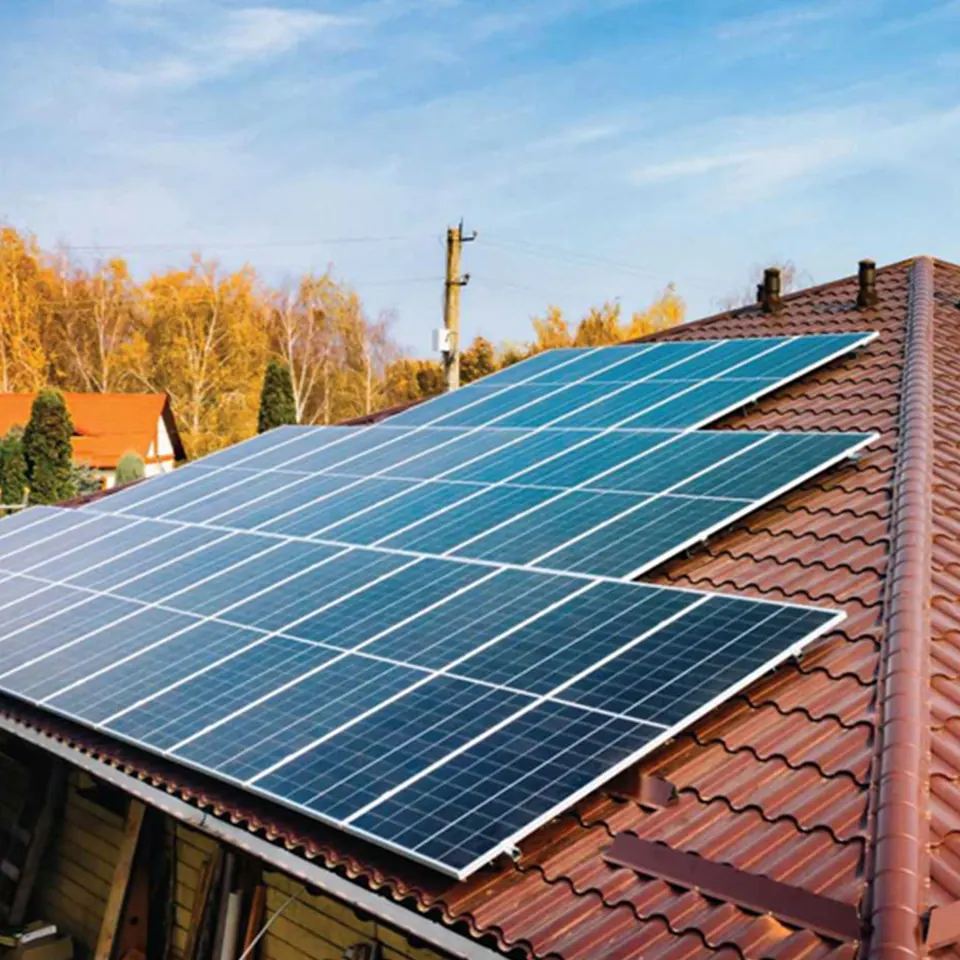
The consumption profile varies markedly by home. 2+1 or 3+1 flats in Muratpaşa and Kepez often consume in the 250-400 kWh a month band; a 2-3 kWp system is often enough for such a flat, but on an apartment roof, space and the decision of the unit owners are decisive. In detached homes in Aksu, Döşemealtı and Kepez, monthly consumption can reach 500-800 kWh and systems of 4-6 kWp come into play. In villas in Konyaaltı, Belek and Manavgat, air conditioning, a pool pump and many appliances run together, so calculations of 10 kWp and above are common. These ranges are examples; they are no substitute for your own bill data.
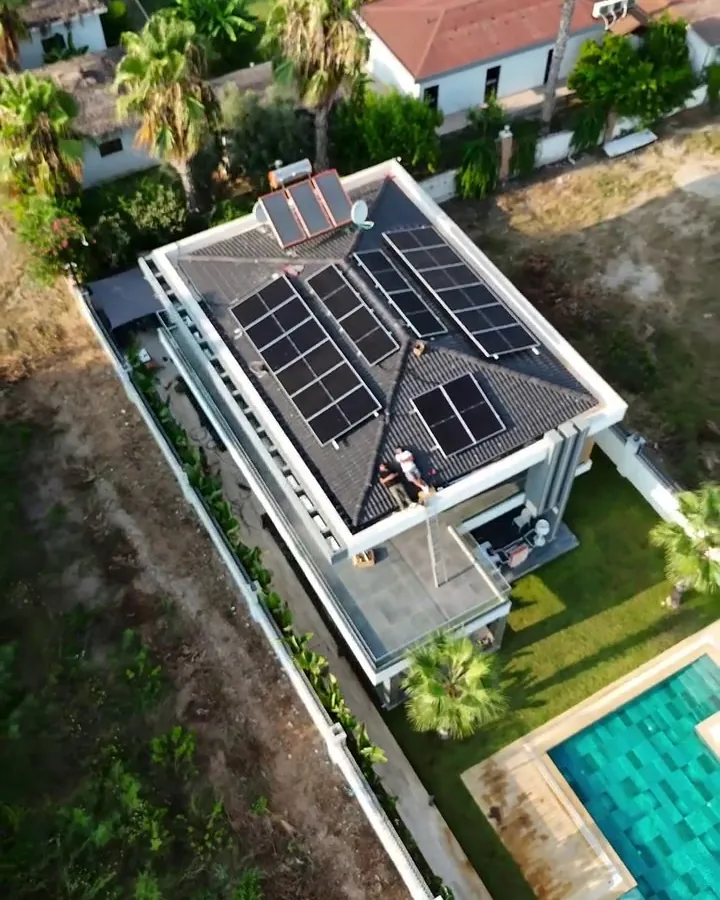
The installations that Solar Nexo shared on Instagram show this variety: in Manavgat, 20 panels of 605 W (12.1 kWp) with a 15 kW hybrid inverter; in Belek, 24 panels of 605 W (14.52 kWp) with a 20 kW hybrid inverter; and in Döşemealtı, 36 panels of 605 W (21.78 kWp) with a 20 kW hybrid inverter. Each was calculated separately for that home's roof, consumption and battery need.
Factors that change the result
Orientation, tilt and shading
The 1,656 kWh/kWp value applies to a surface that is south-facing at a 33° tilt. If your roof faces east or west or has a low pitch, production falls and more kWp is needed to cover the same consumption. Shadows from a nearby building, tree or chimney have a similar effect. For details on angle and orientation, see our article on the solar panel angle and orientation for Antalya.
Losses and real production
The PVGIS value includes 14% system loss; however, factors such as dirt, cable loss, inverter efficiency and temperature can give a different result in the real field. In Antalya, ambient temperature is high in summer; the temperature coefficient is −0.30 %/°C in TOPCon panels versus about −0.34 %/°C in PERC. Panel choice therefore also indirectly affects the required power calculation.
Seasonal distribution
A balance over the year does not mean every month is in balance. According to PVGIS, 1 kWp in Antalya produces 99 kWh in December, 99 in January, 168 in July and 167 in August. A 4.84 kWp system produces about 813 kWh in July and about 479 kWh in December. If your air-conditioning load is heavy in summer, production and consumption overlap well; if your winter consumption is high, purchases from the grid continue in those months.
How many kW of solar panels do you need: should the goal be all of your consumption?
Not necessarily. For installations connected to a residential subscription, no generation or sales limit applies and net metering is done monthly; surplus is valued at the single-rate active energy unit price of the relevant tariff. Because this price is lower than the total unit charge on the bill, sizing the system far above your consumption is economically less efficient. On the other hand, choosing too small a system is often inefficient too, because you spread the roof and infrastructure cost over fewer kWp.
The capacity ceiling is your contract power; the system power cannot exceed it. Rooftop systems up to 25 kW benefit from the simplified procedure. For non-residential installations, hourly net metering applies from 1 May 2026 and annual production cannot exceed twice the annual consumption of the associated consumption facilities. The right size for a business is therefore determined by its hourly load profile. For the business approach, see our article on rooftop solar investment. These rules are based on texts in force as of October 2026 and may change; verify the current conditions with the distribution company before applying.
How many kW will fit on the roof?
The kWp you calculate may not fit on the roof. As a rough measure, 1 kWp needs about 4.3 m² of panel surface alone; maintenance walkways, roof protrusions and shading distances mean not all of the usable area can be given to panels. On tile roofs in Antalya, the pitch allows panels to be placed directly parallel to the roof. On flat roofs, if a tilted structure is used, a shading distance is needed between rows and less kWp fits in the same area. The load-bearing capacity of the roof needs to be assessed by a civil engineer; the distribution company and the municipality may ask for a structural suitability certificate.
Sizing differs for battery and off-grid systems
In grid-connected systems, sizing from the annual total is a sufficient starting point. In off-grid or battery systems, the worst month (December or January, 99 kWh/kWp) is the basis, because if winter production does not cover consumption the system runs out of energy. Battery capacity and night-time consumption are calculated separately. We covered this in more detail in our article on solar systems with batteries.
Common mistakes in sizing
- Looking at a single month's bill: A July bill can be high because of air conditioning and an April bill low. The annual total is always more reliable.
- Forgetting losses: Calculating production with the ideal values in marketing brochures instead of 1,656 makes the system look smaller than it needs to be.
- Not checking contract power: If the calculated kWp is larger than your contract power, the application is limited by capacity.
- Not allowing for future loads: If a pool, a second air conditioner or new appliances are added later, the system will be too small.
- Focusing only on panel count: Inverter power and roof layout also determine the result.
Step-by-step preliminary calculation checklist
- Add up your last 12 months of bill consumption.
- Note any loads to be added in future (air conditioning, pool pump, electrical appliances).
- Divide the total by 1,656 and calculate the panel count.
- Check roof orientation, tilt and shading.
- Verify your contract power from your subscription document.
- Confirm the calculation with an engineer at the free survey.
For a quick preliminary calculation, you can use our solar energy calculation tool.
How many kW do you need for your bill?Use the solar calculator to see system size, number of panels and annual production straight away.Conclusion
You can answer how many kW of solar panels you need approximately by dividing your annual consumption by 1,656; however, the final decision should be made on roof area, shading, contract power and your usage habits. At the free survey, Solar Nexo measures your roof on site, examines your consumption profile and firms up the sizing with an engineering calculation.
Frequently asked questions
How much electricity does a 5 kW solar system produce in a year?
According to PVGIS, 1 kWp produces about 1,656 kWh a year in central Antalya, so 5 kWp gives about 8,280 kWh. This figure is for optimum tilt, south orientation and 14% system loss. Roof orientation, shading and soiling can reduce real output, so at the survey you should ask for a production estimate specific to your roof. For the monthly distribution, see the PVGIS chart.
How many panels does a home using 500 kWh a month need?
Annual consumption comes to 6,000 kWh. 6,000 ÷ 1,656 = about 3.62 kWp, which corresponds to 3.63 kWp with 6 panels of 605 Wp. Because of the summer-winter consumption difference and roof area, the decision is made between 6 and 7 panels. The exact number is settled at the survey, once your roof's orientation and shading have been seen.
Should I install a system large enough to cover all my consumption?
It is not mandatory. A residential subscription has no sales limit, but surplus is valued only at the active energy unit price, which is lower than the total unit charge on the bill. Keeping the system at a size matched to consumption is therefore usually a balanced choice. Do not assume summer surplus will make up for the winter shortfall. Roof area, budget and daytime consumption habits also influence the final decision.
How many kW of solar panels will fit on my roof?
For 1 kWp, panel surface alone needs about 4.3 m² (with 605 Wp panels). In reality more area is needed for maintenance walkways, protrusions and shading distances. On a tile roof the panels sit parallel to the roof; on a flat roof, a tilted structure requires gaps between rows. Exact fit is determined once the roof is measured and the panel layout drawn; roof conditions can change the result.
Does my contract power limit the system power?
Yes. For most subscribers, including residential ones, the capacity ceiling is the contract power; the system power cannot exceed it. In municipal, industrial and agricultural irrigation installations, this limit can go up to twice the contract power. Check your contract power from your subscription document or the distribution company; you also need to confirm which group your installation falls into.
If winter production is low, why do we size the system on annual consumption?
In a grid-connected system, the shortfall in winter is bought from the grid, and summer surplus is credited through net metering. The annual balance is therefore a practical yardstick. In an off-grid system there is no grid, so the lowest production of the winter months, the December or January value, forms the basis of sizing; the panel count therefore generally comes out higher.
Does the calculation tool replace a site survey?
No. The calculation tool gives a quick preliminary estimate from the consumption you enter and Antalya's general production values. Without seeing roof orientation, tilt, shading, structural condition and subscription details on site, an exact size cannot be determined; the tool does not take these into account. The healthiest route is to confirm the preliminary calculation with an engineer at the free survey; just bring your latest bills.
Sources
Want a clear calculation for your roof?
The Solar Nexo team carries out a free site survey at your address in Antalya and designs the system that suits your roof, consumption and budget.