Short answer
The solar panel angle for Antalya is about 33° for a fixed system facing south. According to PVGIS 5.3, at this tilt 1 kWp of panels in Antalya city produces about 1,656 kWh per year. For east-west layouts and flat roofs, the loss must be determined with a roof-specific simulation; on tile roofs the panels usually follow the roof pitch.
Key takeaways
- According to PVGIS 5.3 data, the optimum fixed tilt in Antalya city is 33°, facing south.
- At this angle annual specific production is about 1,656 kWh/kWp (assuming 14% system losses).
- In Antalya, about 168 kWh/kWp is expected in July and about 99 kWh/kWp in December (PVGIS).
- On a tile roof the panel tilt follows the roof pitch; on a flat roof you choose the angle with tilt-up frames.
- The district difference is small: Alanya 1,615, Elmalı 1,719 kWh/kWp (PVGIS).
The best solar panel angle for Antalya is about 33° for a fixed, south-facing system. According to PVGIS 5.3 data, at this tilt 1 kWp of panels in Antalya city produces roughly 1,656 kWh per year (assuming 14% system losses). If your roof's tilt and orientation differ from this, output drops slightly; how much it drops should be calculated with a roof-specific simulation.
Why is the solar panel angle in Antalya 33°?
PVGIS is the free calculation tool of the European Commission's Joint Research Centre (JRC). If you run it for the coordinates of Antalya city (about 36.9° north) using satellite-based irradiance data and a 14% system loss assumption, the fixed tilt that maximizes annual output comes out at 33°, with the panels facing due south (azimuth 0°).
It is no surprise that the optimum tilt is a few degrees lower than the latitude. Most of the annual energy is collected in the summer months, when the sun is high. Because the summer sun sits higher in the sky, laying the panel a little flatter increases summer production and offsets the small loss in winter output.
How do tilt and orientation affect production?
A ray that strikes the panel surface at a right angle delivers the most energy. Tilt is the angle of the panel relative to the horizontal. Orientation is the compass direction the panel faces; in Turkey the ideal direction is south. A fixed system uses a single angle all year round, so the goal is to find a small compromise that works for every season.
- Steeper tilt: captures the low winter sun better and trims summer production somewhat.
- Flatter tilt: increases summer production and weakens winter output.
- Deviation from south: enlarges the share of morning or afternoon production and usually reduces total annual output.
Production by season: winter versus summer in Antalya
The sun works all year round in Antalya, but production is not evenly distributed. According to PVGIS, 1 kWp is expected to produce about 168 kWh in July and about 99 kWh in December. The ratio between the two is roughly 1.7 (calculated from PVGIS monthly values).
According to the 1930-2025 data of the MGM (Turkish State Meteorological Service), the average daily sunshine duration is 4.8 hours in December and 11.7 hours in July. In a grid-connected system the annual total matters most, so a tilt around 33° is generally a reasonable target. In an off-grid system, however, the real challenge is charging the batteries in winter. In that case a steeper tilt that raises winter production can be considered. This is a design opinion; the exact angle is determined by simulation based on the consumption profile and battery capacity. In our off-grid systems we do this calculation together with your consumption during the site survey.
Practical tilt by roof type: tile, trapezoidal and flat roofs
Tile roof
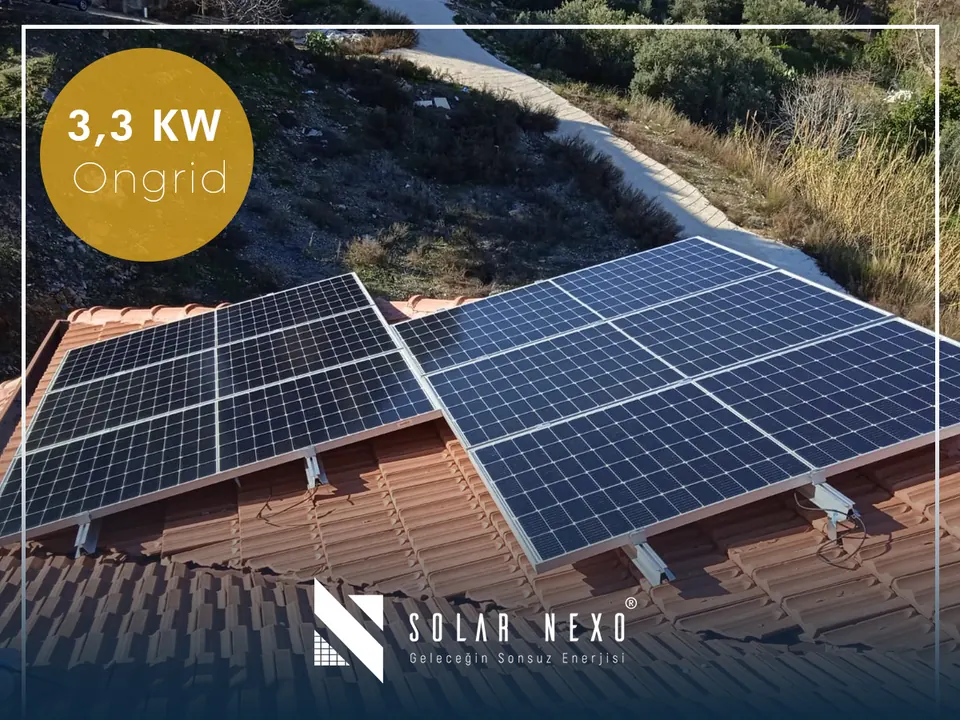
Tile roofs are very common on villas and detached houses in Antalya. The panels are fixed parallel to the roof surface with hooks, which means the roof's own pitch sets the tilt. If you have a slope facing south, southwest or southeast, placing the panels on that surface is often the most practical solution. Solar Nexo's website lists a reference project of a 3.3 kW on-grid home with a tile roof.
Trapezoidal sheet roof
Trapezoidal sheet roofs are common on industrial and agricultural buildings. The panels are mounted on a rail system at the roof's pitch. These roofs usually have a low pitch; available area and load-bearing capacity matter more than angle losses.
Flat roof
On a concrete flat roof you can choose the angle yourself; with tilt-up frames the panels can be raised to around 33°. However, as the tilt increases, the shading distance between rows grows, fewer panels fit on the same area and wind load rises. The MGM records show a maximum wind speed of 43.2 m/s in Antalya, so ballast and fixing calculations are as important as the angle. For mounting options, see our article on solar panel mounting systems.
| Roof type | What sets the tilt? | What to watch for |
|---|---|---|
| Tile | The roof's own pitch | Which slope faces south, shading |
| Trapezoidal sheet | Roof pitch (via rails) | Load-bearing capacity, area |
| Flat roof | Chosen frame height | Row shading, wind and ballast |
Panel orientation: south, southwest and east-west options
South is the PVGIS reference direction and delivers the highest annual total. A small deviation toward the southwest raises the afternoon share of production. Because air-conditioning load is high on summer afternoons in Antalya, this sometimes matches consumption. This is an interpretation; you should see the size of the loss by entering the relevant azimuth angle in PVGIS or through a project simulation.
An east-west layout arranges some of the panels to face east and some west. Total annual production falls compared with south, but the daily production curve spreads toward the morning and evening. On flat roofs the panels can be placed closer together, so area use improves. This layout can be considered for businesses that also consume outside working hours. North-facing surfaces, on the other hand, are not suitable for production in Turkey.

Solar panel angle and production differences by district
Across Antalya the optimum angle is very similar. PVGIS annual specific production values under the same conditions (optimum tilt, south, 14% losses) are as follows:
| Location | Annual specific production (kWh/kWp) |
|---|---|
| Alanya | 1,615 |
| Manavgat | 1,649 |
| Korkuteli | 1,655 |
| Antalya city | 1,656 |
| Kaş | 1,664 |
| Elmalı | 1,719 |
The difference between Elmalı and Alanya is about 6.4% (calculated from PVGIS values). In most projects the district difference is smaller than the effect of roof orientation and shading. For the effect of climate on production, see the article on Antalya's climate and panel performance.
Shade and temperature allowances in the angle decision
Angle alone does not decide the outcome. Even at the same tilt, the shadow of a chimney or a neighboring building can cause a larger annual loss than a difference in tilt. We cover shading in detail in the article on the effect of shading on solar panels.
Temperature is also an important part of the calculation and is indirectly related to the angle decision. In Antalya the average maximum temperature in July is 34.2 °C (MGM). The Pmax temperature coefficient of the TommaTech 605 W panel is -0.30 %/°C; in other words, power falls as the cells heat up. A mounting so close to the roof that it restricts ventilation, or a very flat array, can increase this loss. For this reason, leaving airflow behind the panel is a good design habit regardless of the angle.
Worked example: output of 9 panels
A 605 W TOPCon panel measures 2278 x 1134 mm (TommaTech datasheet), so it occupies about 2.58 m². If you place 9 panels on your roof, the installed capacity is 5.445 kWp and the panel area is about 23 m². Using the PVGIS value for Antalya city at the optimum angle (1,656 kWh/kWp), annual production comes to about 9,000 kWh. This is an ideal assumption: unshaded, south-facing and at the optimum tilt.
On a real roof, differences in tilt, orientation, shading, cable losses and soiling are added. You can see an estimate for your own roof with our solar energy calculator and get the exact result at the site survey.
Checklist for choosing the solar panel angle in Antalya
When deciding on angle and orientation during the survey, we answer the following questions together. You can also use them as preparation for your own roof.
- Which slope of the roof faces south, southwest or southeast?
- How far does the roof pitch deviate from around 33°?
- Do trees, buildings, chimneys or water tanks nearby cast shade?
- Is the roof's load-bearing capacity sufficient for the panels and ballast? A civil engineer should assess this.
- Does your consumption peak in the morning, at noon or in the evening?
- Is the system grid-connected or off-grid? Is winter or the whole year the priority?
Conclusion
For a fixed south-facing system in Antalya, the PVGIS optimum tilt is about 33°, and annual specific production in the city center is calculated at 1,656 kWh/kWp. If your roof is far from this value, it is healthier to measure the loss rather than force the panel angle and, if necessary, to choose orientation and layout that match your consumption. If you would like an angle and orientation analysis for your roof, you can get in touch with us.
Frequently asked questions
What tilt should solar panels be installed at in Antalya?
According to the PVGIS 5.3 calculation, the optimum tilt for a fixed south-facing system in Antalya city is about 33°. This value maximizes annual production. On a tile roof the pitch is mostly set by the roof itself. If the roof pitch differs from 33°, the loss should be measured with a simulation and the panel layout decided accordingly.
Which direction should solar panels face?
In Turkey, solar panels should face south for the highest annual production. PVGIS uses azimuth 0° as the reference. Deviations toward the southwest or southeast can reduce output but may be acceptable depending on the roof structure, since not every roof's orientation can be chosen. The loss is calculated for each roof. North-facing surfaces are generally not suitable for production in Turkey.
Can solar panels be installed on an east-west roof?
Yes, they can. In an east-west layout total annual production is lower than facing south, but production is spread across the morning and evening. This can be useful for facilities that consume throughout the day. How large the loss will be depends on the roof pitch and the region; a project simulation gives the exact value. Assuming a fixed percentage would be wrong, because the loss varies with region, tilt and shading.
How is the solar panel angle set on a flat roof?
On a flat roof, panels are raised to the desired tilt with frames. As the tilt increases, spacing is needed between rows to avoid shading, and wind load rises. For this reason, rather than automatically choosing 33° on every roof, area, ballast weight and roof load-bearing capacity are assessed together. A civil engineer should assess the roof's load-bearing capacity.
Does it make sense to choose a steeper angle for winter?
In off-grid systems winter production is critical, so a steeper tilt can be considered; in Antalya December production of about 99 kWh/kWp is well below July's about 168 kWh/kWp. In grid-connected systems the annual total carries the weight and around 33° is suitable. The decision depends on the consumption profile and battery capacity.
How many kWh does a 5 kWp system produce per year in Antalya?
Using the PVGIS value (1,656 kWh/kWp, optimum tilt, south, 14% losses), about 8,300 kWh is calculated for 5 kWp. This is an ideal assumption. Shading, roof orientation, cable losses and soiling can reduce real production. You can use our calculator for your own roof or request a free site survey.
Does the panel angle change by district?
Within Antalya the optimum angle is very similar; the difference is small. According to PVGIS, annual specific production is 1,615 kWh/kWp in Alanya, 1,649 in Manavgat, 1,656 in Antalya city, 1,664 in Kaş, 1,655 in Korkuteli and 1,719 in Elmalı. In most projects, roof orientation and shading matter more than the district difference.
Sources
Want a clear calculation for your roof?
The Solar Nexo team carries out a free site survey at your address in Antalya and designs the system that suits your roof, consumption and budget.