Short answer
A solar system with battery includes panels, a hybrid inverter and a battery. Battery capacity is found by dividing the kWh of the load to be supplied at night or during an outage by usable depth and efficiency; for example, a 10 kWh night-time load needs about 11.7 kWh nominal capacity. In Antalya, cost is driven by battery kWh, inverter power and roof conditions.
Key takeaways
- Nominal battery capacity = load to be supplied (kWh) x autonomy (days) ÷ (usable depth x efficiency). Assumptions must be updated with the manufacturer's values.
- No payment is made for energy fed from the battery to the grid; storage can be installed up to the electrical power of the generation plant (Official Gazette 2 April 2026, Additional Article 3).
- Main equipment, batteries included, must have been manufactured within the last five years (Art. 37/6).
- Winter output is low: per PVGIS, 1 kWp in Antalya produces about 3.2 kWh a day in December and about 5.4 kWh in July; extra panels for battery charging must be sized on the winter value.
- LiFePO4 cycle life and warranty periods vary by brand; read the documents model by model.
A solar system with battery stores part of the electricity the panels produce during the day in a battery so that you can use it in the evening, at night or during a grid outage. Its cost is determined less by the number of panels than by battery capacity (kWh), the power of the hybrid inverter and the installation conditions. In this article we do not quote an exact amount; instead we explain the cost items, how battery capacity is calculated and sizing examples drawn from real installations in Antalya. The aim is to keep you from buying a battery that is too small or needlessly large.
How does a solar system with battery work?
During the day the panels produce direct current; the hybrid inverter first feeds this to the home's instantaneous consumption and directs the remainder to the battery. Once the battery is full, surplus energy can go to the grid. In the evening when production falls, the home is first supplied from the battery; if the battery runs out, power is drawn from the grid. When the grid fails, the hybrid inverter switches to a backup mode that feeds critical loads from the battery. In a conventional on-grid system, by contrast, the inverter shuts down for safety when the grid fails.
For a detailed description of the system, see our article on the hybrid solar energy system, and for how it works during an outage, our article on a solar energy system that works during power cuts.
The items that determine cost
| Item | How it affects cost | What to watch |
|---|---|---|
| Battery capacity (kWh) | The most decisive item; cost rises noticeably as kWh increases | Look at usable, not nominal, capacity |
| Hybrid inverter power (kW) | Chosen according to the load running at the same time | Allow for the starting current of motor loads |
| Panel power (kWp) | Covers both the daytime load and battery charging | Size on winter production |
| Battery chemistry and brand | Cycle life and warranty conditions affect price | Read the warranty document model by model |
| Cabinet, panel board and protection | Needed for safety and backup | The critical-load board is planned separately |
| Installation and cabling | Varies with roof type and distance | A ventilated space is needed for battery placement |
For a general price guide, you can read our article on solar panel prices. Because the battery item can be enlarged or reduced independently of the other items in the system, it should appear as a separate line in the quote.
How is battery capacity (kWh) calculated?
The calculation has four steps. First, decide the load to be supplied from the battery: only at night, or critical loads during an outage? Second, find that load's daily consumption in kWh. Third, choose how many days of autonomy (running without charging) you want. Finally, calculate the nominal capacity with this formula:
Nominal capacity (kWh) = load to be supplied (kWh) x autonomy (days) ÷ (usable depth x efficiency)
The table below uses assumptions for example purposes only: usable depth 90%, combined battery and inverter efficiency 95% and autonomy of 1 day. You should replace these values with the real values from the datasheet of the brand you choose.
| Load to be supplied (kWh/day) | Calculated nominal capacity | Typical use |
|---|---|---|
| 6 | about 7.0 kWh | Small home, night-time consumption |
| 10 | about 11.7 kWh | Detached house, night and evening load |
| 20 | about 23.4 kWh | Villa with air conditioning and pool pump |
For example, a 10 kWh night-time load needs 10 ÷ (0.90 x 0.95) = 11.7 kWh nominal capacity. Because module sizes on the market are fixed, the result is rounded up to the next standard capacity. In real life the load is not the same every night; summer air-conditioning use and winter lighting use differ. A year of hourly consumption data therefore gives a far more accurate basis than an estimate.
The panel side: being able to fill the battery in winter too
Even if battery capacity is chosen correctly, the battery will not fill if the panels are insufficient. Winter production is the deciding factor here. According to PVGIS, 1 kWp in Antalya produces 99 kWh in December; that is about 3.2 kWh/kWp a day. In July it produces 168 kWh, about 5.4 kWh/kWp a day. Suppose your daytime load is 8 kWh and 10 kWh more is needed for battery charging; that is 18 kWh in total. For December you need 18 ÷ 3.2 = about 5.6 kWp, and for July 18 ÷ 5.4 = about 3.3 kWp of panels. If you size a battery system on summer, the battery will not fill in winter; if you size it on winter, there is surplus production in summer.
For this reason, in hybrid systems with an on-grid part, the energy that falls short in winter is made up from the grid; in fully off-grid systems, sizing on the winter value is essential. We covered this approach in more detail in our article on off-grid system cost for a vineyard house and mountain cabin.
LiFePO4 batteries and warranty conditions
LiFePO4 (lithium iron phosphate) chemistry is widespread in solar storage. In home LFP modules, the cycle life declared by manufacturers varies by product; for example, one dealer listing states more than 6,000 cycles at 25 °C and 90% depth of discharge for the Pylontech US5000. This is a dealer page, not a manufacturer datasheet; figures such as 8,000 or 10,000 cycles also appear in sources. Warranty periods also vary between 7 and 10 years. The quote should therefore state the battery's brand, model, cycle life and warranty document clearly.
For example, the product warranty on TommaTech LV batteries is 60 months. Warranty conditions and performance thresholds differ by brand, so do not generalise. For battery details, see our article on what a LiFePO4 battery is.
The choice of installation location also affects cost and safety. Batteries are temperature-sensitive; since ambient temperature in Antalya reaches an average maximum of 34.2 °C in July (MGM, the Turkish State Meteorological Service, 1930-2025), placing a battery in a space with direct sun and no ventilation can shorten its life. A shaded, ventilated room or cabinet is preferred. The manufacturer's installation manual is binding on this; installation contrary to the manual can void the warranty. The battery management system (BMS) protects charge and discharge limits; however, for this protection to be effective, the communication compatibility between inverter and battery must be verified at the survey and design stage.
Regulation: the battery's place in the grid and net metering
Under the regulation amendment in the Official Gazette of 2 April 2026, the owner of a licence-exempt installation can install a storage unit up to the electrical power of the generation plant. Main equipment, batteries included, must have been manufactured within the last five years. Most importantly, no payment is made for energy fed from the battery to the grid; if the quantity supplied from storage cannot be determined, no surplus payment is made at all. A 10% tolerance applies at acceptance. The battery therefore makes sense not for selling to the grid but for increasing self-consumption and providing backup power.
From 1 May 2026, net metering (mahsuplaşma) for non-residential installations is done hourly. Consuming the daytime surplus in the same installation in the evening can make economic sense in such installations; this is an interpretation, and the rules it rests on are the provisions of the regulation mentioned above. For residential subscriptions net metering is monthly. Verify the current rules with the distribution company before applying.
Real installation examples from Antalya
The installations Solar Nexo has shared on its Instagram account show that different load profiles require different battery ratios:
| Location | Panels | Inverter | Battery |
|---|---|---|---|
| Döşemealtı (hybrid) | 36 panels of 605 W (21.78 kWp) | 20 kW hybrid | 30 kWh LiFePO4 |
| Manavgat (hybrid) | 20 panels of 605 W (12.1 kWp) | 15 kW hybrid | 15 kWh LiFePO4 |
| Belek (hybrid) | 24 panels of 605 W (14.52 kWp) | 20 kW hybrid | 15 kWh LiFePO4 |
| Döşemealtı (off-grid) | 10 panels of 605 W (6.05 kWp) | 11 kW off-grid | 15 kWh LiFePO4 |
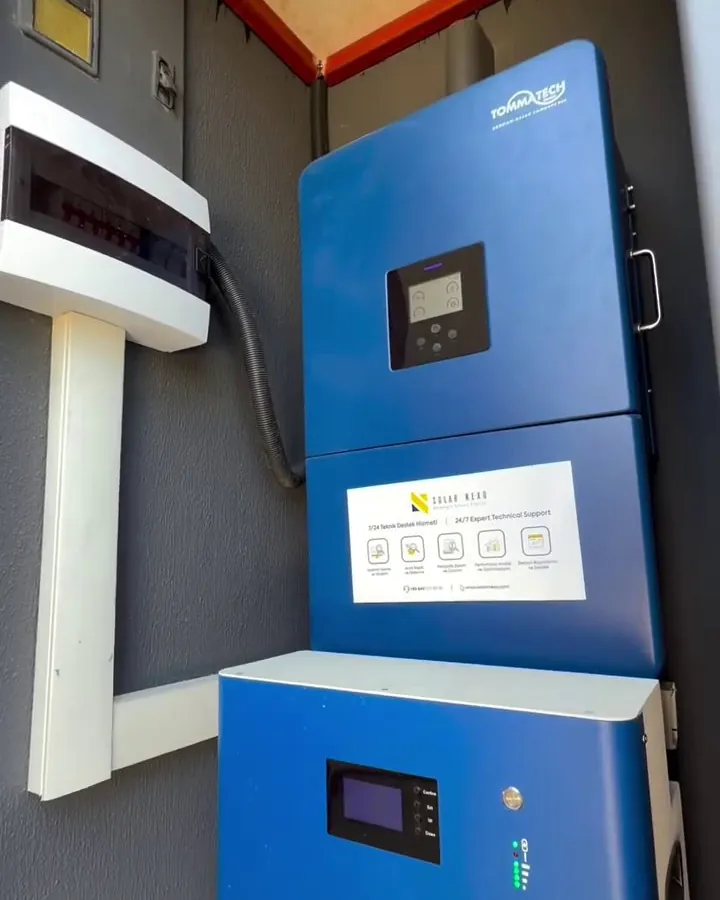
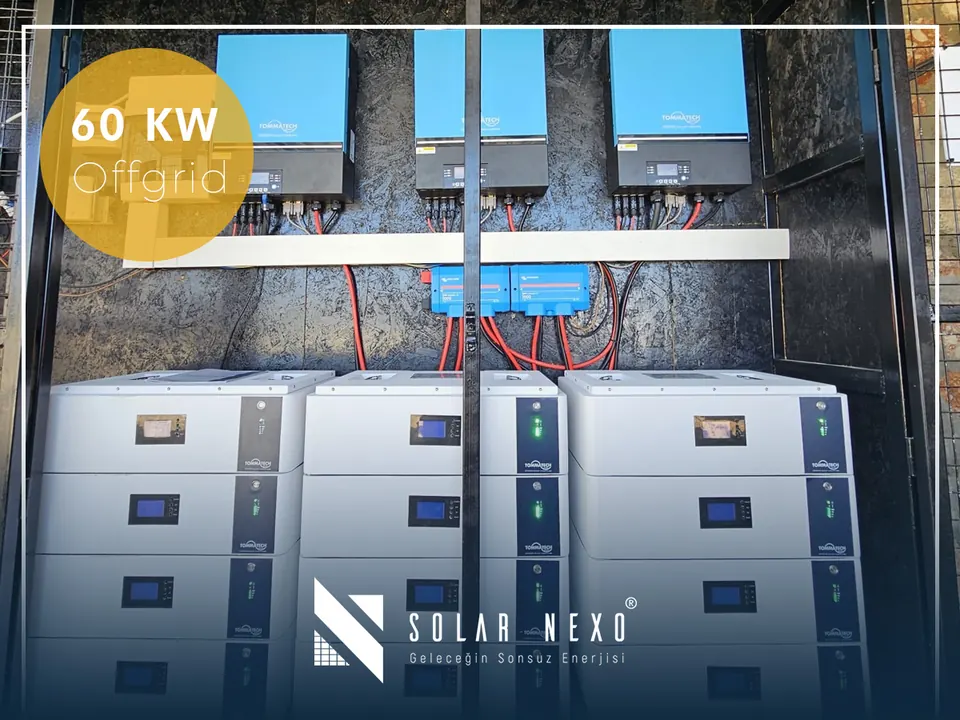
Looking at the ratios, the ratio of battery capacity to kWp varies between 1.03 and 2.48, because an off-grid system has no grid support and needs larger storage. These figures were chosen for each home's own loads and are not a rule to copy. As a large-scale battery application, you can also look at the 60 kW off-grid parallel-inverter lithium battery energy room reference on the site.
Who does a battery system make sense for?
- Those who suffer frequent power cuts: It backs up critical loads (refrigerator, lighting, pump).
- Those with high night-time consumption: It carries daytime production into the evening.
- Places with no grid: Essential in mountain cabins, vineyard houses and rural settlements.
- Critical businesses: Those with loads intolerant of interruption, such as cooling or data.
For a user with heavy daytime consumption and no outage problem, an on-grid system without a battery is often enough, with a lower investment. To decide the size by examining your consumption profile, you can get preliminary information from our calculation tool.
How many kW do you need for your bill?Use the solar calculator to see system size, number of panels and annual production straight away.Conclusion
The cost of a solar system with battery is set by battery kWh, inverter power and roof conditions; the right size is found by calculating the load to be supplied. The battery should be considered for self-consumption and backup power, not for selling to the grid. At the free survey, Solar Nexo reviews your load list and determines the panel, inverter and battery size with an engineering calculation that takes winter production into account.
Frequently asked questions
How many kWh of battery does a solar system with battery need?
It depends on the kWh of the load to be supplied at night or during an outage. Formula: load x autonomy ÷ (usable depth x efficiency). For example, a 10 kWh night-time load needs about 11.7 kWh nominal capacity at 90% depth and 95% efficiency. Real depth and efficiency values vary with the brand's datasheet, so sizing should be finalised together with the chosen product.
Can I sell the electricity in the battery to the grid?
No, no payment is made for energy fed from the battery to the grid. Under Additional Article 3/2 of the regulation, no payment is made for the part of the remaining surplus after net metering that is supplied from storage. If the quantity supplied from storage cannot be determined, no surplus payment is made at all. The battery should therefore be considered for self-consumption and backup power, not bought expecting sales income.
Does a battery system power the house during an outage?
In a system with a hybrid inverter and a backup output, yes; critical loads are fed from the battery. However, the battery's capacity and the inverter's power determine how many hours and which appliances will run. In a conventional on-grid system, for safety reasons the inverter shuts down when the grid fails and does not power the house; this feature is known as anti-islanding protection.
Will a battery system fill sufficiently in winter?
Because winter production is low, panel power must be chosen accordingly. According to PVGIS, 1 kWp in Antalya produces about 3.2 kWh a day in December and about 5.4 kWh in July. In a grid-connected hybrid system the shortfall is made up from the grid; in a system without a grid, sizing on the winter value is essential and an extra margin is left for cloudy days.
How many years does a LiFePO4 battery last?
It varies with brand, depth of use and temperature. Manufacturers declare thousands of cycles; a dealer page lists more than 6,000 cycles at 90% depth of discharge for one model, but other figures appear in sources. Warranty periods also vary by model; read the document by brand and model, and ask which temperature and depth of discharge the cycle-life claim applies to.
Can the battery be old or second-hand?
Not in a licence-exempt application. Article 37/6 of the regulation requires that, together with the panels and inverter, the batteries in the storage unit also be manufactured within the last five years. Ask in writing for the manufacturing date, brand and model of the battery in the quote. Old-stock or second-hand batteries can lead to the application being rejected.
Is a battery necessary for every home?
No. In homes with high daytime consumption and no outage problem, an on-grid system without a battery is often enough. A battery makes sense for high night-time consumption, frequent outages or places far from the grid. The decision should be assessed together at the free survey, based on your load profile, outage history and budget; you do not need to make an unnecessary battery investment.
Sources
Want a clear calculation for your roof?
The Solar Nexo team carries out a free site survey at your address in Antalya and designs the system that suits your roof, consumption and budget.