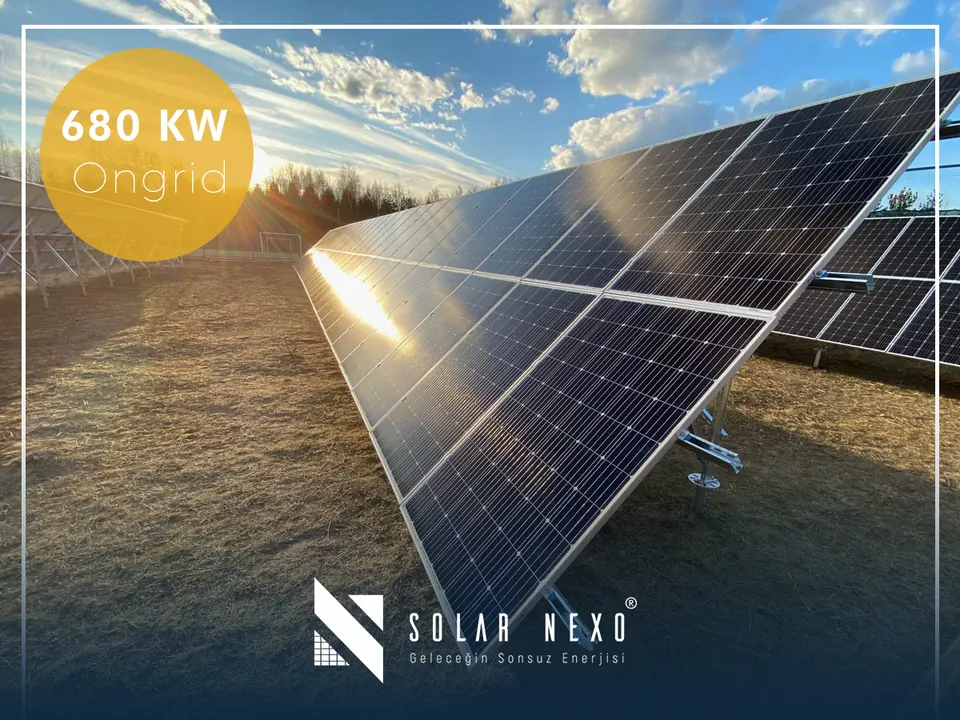
Short answer
Solar panel mounting in Antalya depends on the roof type: hooks and rails on tile roofs, profile clamps and rails on trapezoidal sheet, and ballasted or anchored tilt-up frames on flat roofs. The deciding factors are wind load, coastal corrosion and the roof's load-bearing capacity; the right system is chosen at the survey, with the roof seen on site.
Key takeaways
- On a tile roof the panel is fixed to the rafter with hooks via rails; the hook must seat on the structure, not on the tile.
- The TommaTech 605 W panel weighs 29 kg and covers 2.58 m²; the load is about 11 kg/m², so wind is the deciding factor.
- According to the datasheet the panel withstands 2400 Pa wind and 5400 Pa snow load; the greatest recorded snow depth in Antalya is 5 cm (MGM).
- On a flat roof ballast does not penetrate the roof but adds weight; anchors reduce weight but create a waterproofing risk.
- The roof's load-bearing capacity should be assessed by a civil engineer.
Solar panel mounting varies by roof type: hooks and rails on a tile roof, profile clamps and rails on a trapezoidal sheet roof, and ballasted or anchored tilt-up frames on a flat roof. The right mounting system ensures the panel withstands wind, corrosion and roof movement over its 25-30 year life. Because roof types in Antalya vary widely, the mounting decision is made at the site survey, by looking at the roof itself.
Why is solar panel mounting at least as important as the panel?
The panel is the expensive, visible part, but the structure that attaches the system to the roof (the solar mounting structure) also works alongside it for years. The TommaTech TT605-144TN10 panel measures 2278 x 1134 mm and weighs 29.0 kg; that means about 2.58 m² of area and a load of about 11 kg/m² (calculated from datasheet values). The panel itself is light. The real load comes from the wind.
The same datasheet states that the panel is tested to withstand 2400 Pa of wind load and 5400 Pa of snow load. In the MGM (Turkish State Meteorological Service) records, the fastest wind in Antalya is 43.2 m/s (22.01.1998) and the greatest snow depth is 5 cm (07.01.1993). In other words, snow load generally takes a back seat in mounting calculations in Antalya; wind uplift, and the number and location of fixing points, are what decide. No matter how sturdy the panel is, the system suffers if the structure is inadequate.
The datasheet also states clearly that installation contrary to the manufacturer's installation manual voids the warranty. For this reason, when choosing a mounting system you need to consider not only cost but also the panel manufacturer's clamping zones, clamp spacing and frame-holding requirements.
Hook and rail mounting on a tile roof
Tile roofs are very common on villas and detached houses in Antalya. On these roofs the panels do not sit directly on the tiles; roof hooks are passed beneath the tiles and screwed to the roof rafter or purlin. Aluminum rails are attached to the hooks, and the panels are fastened to these rails with clamps.
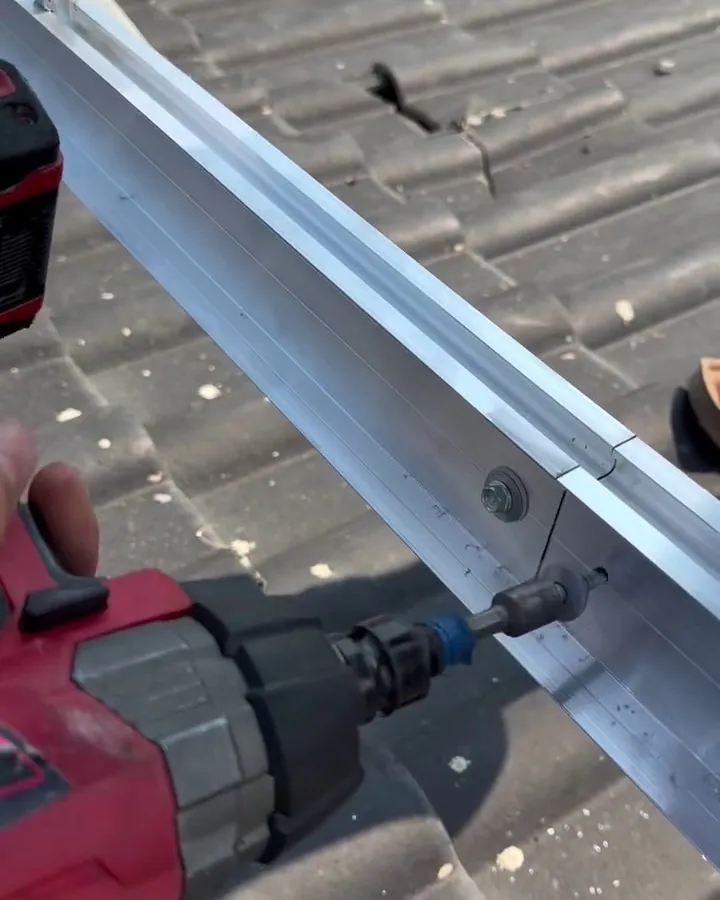
- Hook position: The hook must seat on the rafter; a hook that grips only the tile or timber sheathing cannot carry the wind load.
- Waterproofing: When the tile is lifted and put back, the watertightness must not be compromised.
- Tile damage: Walking on the roof and cutting work can produce broken tiles; the installation crew should plan for spare tiles.
- Ventilation: Leaving an air gap between the panel and the tile lowers cell temperature.
The tile type matters as well. Different hook geometries are used for Marseille-type and traditional curved (alaturka) tiles; an unsuitable hook either breaks the tile or lets water in. That is why the tile type, rafter spacing and roof age are noted at the survey. On older roofs, the insulation under the tiles and the condition of the timber are also checked.
On a tile roof, the panel tilt follows the roof pitch. If the roof has a south-facing slope, this solution is both practical and economical. We calculated the effect of the tilt and orientation decision on production in the article on the solar panel angle and direction for Antalya.
Profile clamps and rails on a trapezoidal sheet roof
On factories, warehouses, greenhouses and agricultural buildings, the roof is mostly trapezoidal sheet. There are two common methods for a panel system. The first is clamps fitted to the vertical edge of the sheet (the profile rib). The second is fixing parts that drill through the sheet and are screwed to the purlin beneath. With the clamp method the sheet is not drilled, so the risk of water leakage is lower; however, a suitable profile geometry is needed.
On trapezoidal roofs, rail spacing is calculated according to panel size. The thickness of the roof sheet, the spacing of the purlins and the age of the roof are also evaluated. Adding extra load on top of old, rusted or poorly fastened sheet would not be right. On large roof projects area is usually sufficient; what decides is load-bearing capacity.
Ballast, anchors and tilt-up frames on a flat roof
Concrete flat roofs are common on apartment and commercial buildings in Antalya. Here the structure determines the panel angle; panels can be raised to a certain tilt with tilt-up frames. The method of attaching to the roof falls into two types.
- Ballasted system: Does not penetrate the roof; it is held in place with concrete blocks or similar weights. Waterproofing is preserved, but extra weight is added to the roof.
- Anchored system: The feet are fixed to the concrete. The weight load is reduced, but the waterproofing of the drilled points must be done well.
- Hybrid system: Because wind load is high at edge and corner zones, extra fixings or extra ballast may be used.
On flat roofs, wind load is not the same everywhere. Roof edges and corners are exposed to more uplift than the central area. For this reason, using extra ballast, extra anchors or wind deflectors in these zones is a common design approach. Leaving a certain distance from the edge free is also useful for maintenance safety; roof access and fall protection should be planned for the installation crew.
As the tilt increases, the wind load and the shading distance between rows also increase. That is why the steepest tilt is not always the best solution on a flat roof. The roof's load-bearing capacity must be assessed by a civil engineer; the distribution company and the municipality may ask for a structural suitability document.
| Roof type | Mounting method | Main risk |
|---|---|---|
| Tile | Roof hook + rail | Hook not seated on the rafter, water leakage |
| Trapezoidal sheet | Profile clamp or screwed fixing + rail | Age and load-bearing capacity of the sheet |
| Flat (concrete) | Ballasted or anchored tilt-up frame | Extra weight, wind load, waterproofing |
| Ground | Frame driven into the ground or set on concrete | Soil survey, foundation |
Materials, corrosion and grounding
The structure generally uses aluminum rails and galvanized steel or stainless fasteners. In the coastal areas of Antalya, salty air can accelerate corrosion; so screw and bolt materials should be chosen with the panel's service life in mind. It should also be remembered that there is a risk of galvanic corrosion where different metals touch each other.
Cable management is also part of the structure. Cables should be gathered on the rail with UV-resistant ties and kept away from sharp edges and hot surfaces. For details, see the article on solar cables and MC4 connectors.
The structure is also a conductive body; grounding and equipotential bonding are critical for fire and life safety. We covered lightning and storm protection in the article on lightning and storm protection for solar plants.
Fire safety and ventilation
The TommaTech datasheet requires the panel to be mounted over a fire-resistant surface, leaving sufficient ventilation behind it. Installation must not be carried out on roofs of non-fire-resistant materials such as plastic or PVC without a fire protection layer. On lightweight roofing materials (for example some sandwich panel and membrane types), a suitable solution is sought together with the manufacturer. For details, see our article on fire safety for solar plants.

Installation and permit process
A rooftop solar plant goes through a process before going to the site. In planned areas, solar systems built for a building's own needs are not subject to a building permit, provided they do not affect the load-bearing system and consent is obtained under the Condominium Law (Kat Mülkiyeti Kanunu) (Planned Areas Zoning Regulation, Art. 59/2). Even so, implementation projects must be prepared and permission obtained from the authority. In other words, the mounting system is not only site work but paperwork as well.
The process stated on Solar Nexo's website starts with a free site survey and continues with project design, installation and commissioning, followed by maintenance and 24/7 technical support. At the survey the roof type, rafter layout, fixing points and shade sources are recorded. Depending on the system type, you can look at the details on our on-grid systems page.
Checklist when choosing a mounting system
- What are the roof type and age? Are the waterproofing and the load-bearing system sound?
- Are the hook or clamp points attached directly to the rafter, purlin or concrete?
- Has the wind load calculation been made for building height and the roof edge zones?
- Are the aluminum, galvanized and bolt materials used suitable for coastal air?
- Are the ventilation gap behind the panel and the fire-resistant surface requirement met?
- Is installation carried out in line with the panel manufacturer's clamping zones?
Conclusion
Solar panel mounting rests on different fixing logic on tile, trapezoidal and flat roofs, and over the panel's life it is tested by wind, corrosion and roof load. To determine the right structure for your roof, the roof needs to be seen on site. For a survey, you can get in touch with us.
Frequently asked questions
How is a solar panel mounted on a tile roof?
On a tile roof, roof hooks are passed beneath the tiles and fixed to the rafter or purlin. Aluminum rails are attached to the hooks and the panels are fastened to the rails with clamps. Keeping the waterproofing intact, seating the hook on the structure and leaving a ventilation gap behind the panel are the critical points. The panel tilt is the same as the roof pitch. A suitable hook model must be chosen for the tile type.
Can solar panels be installed on a trapezoidal sheet roof?
Yes, they can. On trapezoidal sheet, rails are fixed with profile clamps or screwed connections that drill through the sheet, and the panels are mounted on the rails. With the clamp method the sheet is not drilled, so the water leakage risk is lower, but the profile geometry must be suitable. The sheet's age, rust condition, thickness and the load-bearing capacity of the purlins must be checked before installation.
Is a ballasted or an anchored system better on a flat roof?
Both have pros and cons. A ballasted system does not drill the roof, so it preserves the waterproofing, but it adds extra weight to the roof. In an anchored system the weight is reduced, but the waterproofing of the drilled points must be done well. Hybrid solutions with extra fixings at the edge zones are often preferred too. The choice is made by engineering calculation based on the roof's load-bearing capacity, waterproofing condition and wind load.
Is a roof structural report needed for solar panel mounting?
There is no verified clear threshold for the capacity from which it is mandatory. However, the roof's load-bearing capacity must be assessed by a civil engineer. The distribution company and the municipality may ask for a structural suitability document during project approval. For this reason, consulting the relevant authority and the distribution company before applying, and having an engineer's report prepared for the roof, is the safest route.
Why is wind load important in panel mounting?
The panel's weight is low (about 29 kg for the 605 W model), but the wind applies uplift to the panel. That is why the number and position of fixing points and extra fastening in the roof edge zones matter. In the MGM records the fastest wind measured in Antalya is 43.2 m/s; the mounting calculation must take this into account. Extra fastening is considered for edge and corner zones.
Can solar panels be installed on a plastic or PVC roof?
According to the manufacturer's datasheet, panels must not be mounted on non-fire-resistant roofs such as plastic or PVC without a fire protection layer. The panel must be installed over a fire-resistant surface with sufficient ventilation behind it. Installation contrary to the installation manual voids the warranty. System safety is also affected; for this reason an engineering assessment must always be made for such roofs.
Is maintenance needed after solar panel mounting?
Yes, periodic inspection is recommended. Whether fasteners have loosened, signs of corrosion, the condition of cables and clamps, and the roof's watertightness are reviewed. Corrosion checks are even more important in coastal areas. Solar Nexo's website lists maintenance and 24/7 technical support as a step of the service process. The inspection frequency is planned according to the region's climate and the age of the system.
Sources
Want a clear calculation for your roof?
The Solar Nexo team carries out a free site survey at your address in Antalya and designs the system that suits your roof, consumption and budget.