Short answer
Farm solar energy cuts energy costs by powering daytime-heavy loads such as milk cooling tanks, irrigation pumps, lighting and ventilation with the sun. In Antalya, off-grid is chosen for farms far from the grid, hybrid where outages are frequent and on-grid where the grid is reliable. The right solution is set by the load list and a survey.
Key takeaways
- A farm has three main load groups: cooling, irrigation pumps and lighting/ventilation; system type is chosen accordingly.
- Agricultural irrigation facilities can install an unlicensed solar plant up to twice their contract power (Art. 5/1/h, 2022 text).
- Off-grid systems need no licence or distribution company application; zoning, structural and fire obligations are separate.
- The interest-subsidised loan framework under Ministry of Agriculture and Forestry Communiqué 2024/15 ends on 31.12.2026.
- PVGIS annual specific yield is 1,719 kWh/kWp in Elmalı and 1,655 kWh/kWp in Korkuteli.
Farm solar energy is an investment that powers an agricultural business's daytime machines directly from the sun and cuts the cost of grid electricity or generator fuel. In Antalya, both high irradiance and, in rural areas, the occasionally long grid lines make this solution attractive. Loads such as milk cooling tanks, irrigation pumps, poultry-house fans and lighting have different characteristics; in this article we describe which system type suits each.
Energy loads on a farm: what will you power?
The first step in sizing is to draw up the load list. In agricultural and livestock businesses, loads are generally divided into four groups:
- Cooling: Milk cooling tanks, cold rooms and stores. The compressor load lasts all day and rises in summer.
- Pumps and irrigation: Well pumps, drip irrigation and sprinkler pumps. They mostly run in the daytime.
- Ventilation and heating-cooling: Barn and poultry-house fans, misting systems.
- Lighting and auxiliary loads: Milking machine, feed mixer, water heater, office and worker housing.
For each load, the power (kW) and daily running time (hours) are listed. A hypothetical example: if you consider a 3 kW compressor running 4 hours a day, it consumes 3 × 4 = 12 kWh/day. The sum of all loads gives the system's daily energy need. Doing this calculation with real measurements prevents installing an oversized or an inadequate system.
Farm solar energy for milk cooling and livestock
In livestock, the cooling load arises from the need to bring milk to a suitable temperature after milking. This load concentrates in the morning and evening depending on milking hours; the compressor, however, may stay in circuit all day. Solar energy produced in the daytime covers the compressor load towards midday, while the grid or a battery steps in for evening and night. If your milking hours do not overlap with the production curve, a battery or a timing adjustment is considered.
In poultry houses and barns, ventilation fans run longer in hot months; this falls at the same time as the highest solar production. This overlap is the strongest side of a farm solar energy investment. On the other hand, loads regarded as critical for animal welfare (ventilation, water pump) cannot tolerate interruption; in that case backup power is added to the system design.
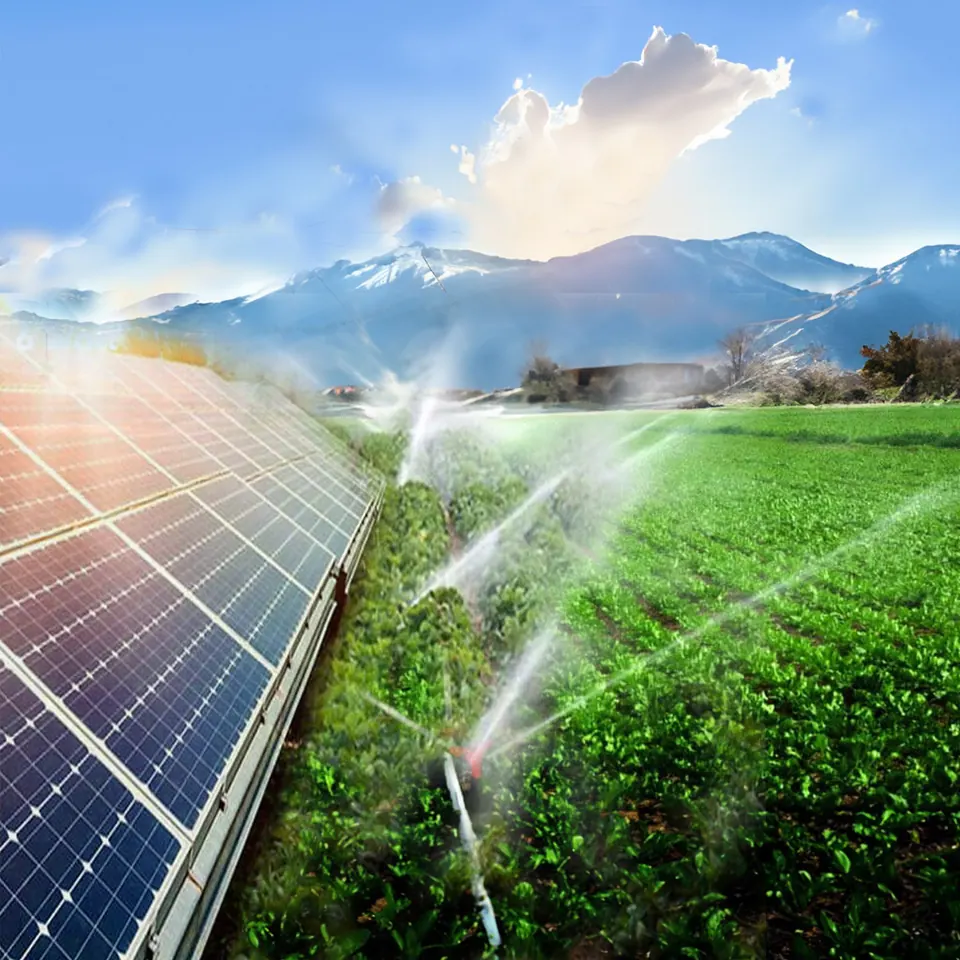
Irrigation pump and field: Korkuteli, Elmalı and beyond
Irrigation is one of the agricultural loads best suited to solar energy: as water demand rises, solar production rises too. In Antalya's inland areas, PVGIS annual specific yield is 1,719 kWh/kWp for Elmalı and 1,655 kWh/kWp for Korkuteli (optimum tilt, south, 14 percent loss). These values are at or above that of central Antalya (1,656 kWh/kWp). The irrigation pump's daily water need and the well depth determine the required pump power and therefore the panel power.
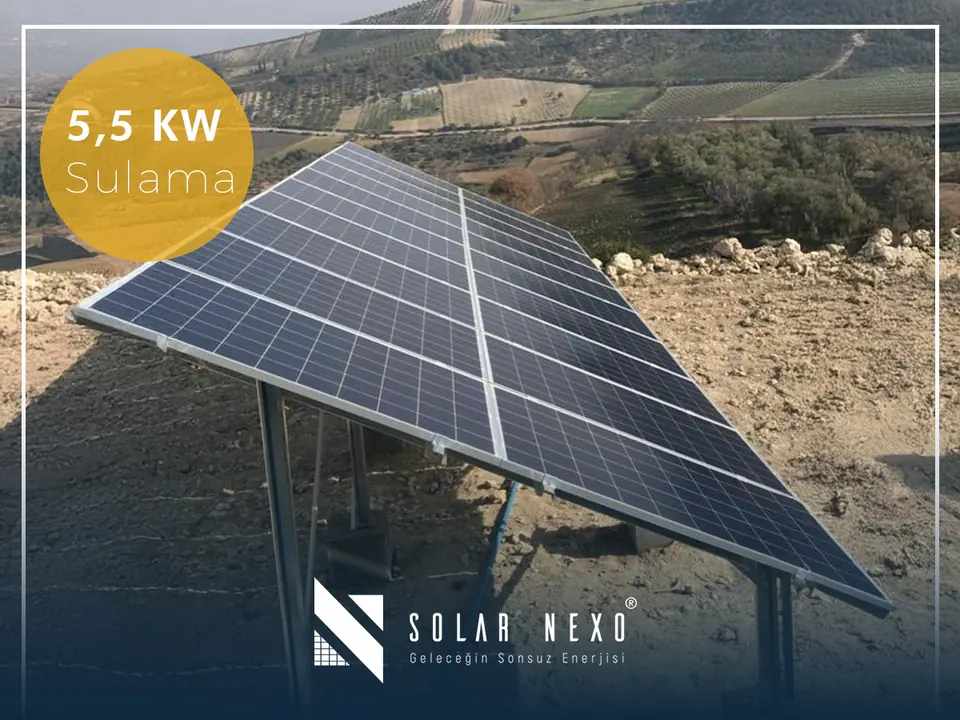
Solar Nexo shares a 5.5 kW solar-powered agricultural irrigation reference on its website. On the irrigation side, both off-grid and grid-connected solutions are possible; for details, you can read our article on solar-powered agricultural irrigation systems.
Which system type suits your farm?
| Situation | Suitable system | Why? |
|---|---|---|
| Reliable grid, high daytime consumption | On-grid | No battery, simple and economical; surplus is treated within the framework of regulation. |
| Frequent outages, critical loads (cooling, fans) | Hybrid | The battery feeds critical loads during an outage. |
| No grid or connection too far away | Off-grid | Works independently; needs a battery and, if necessary, generator support. |
| Only a pump runs in the daytime | Pump-specific system | A battery-free, direct pump-drive solution is possible. |
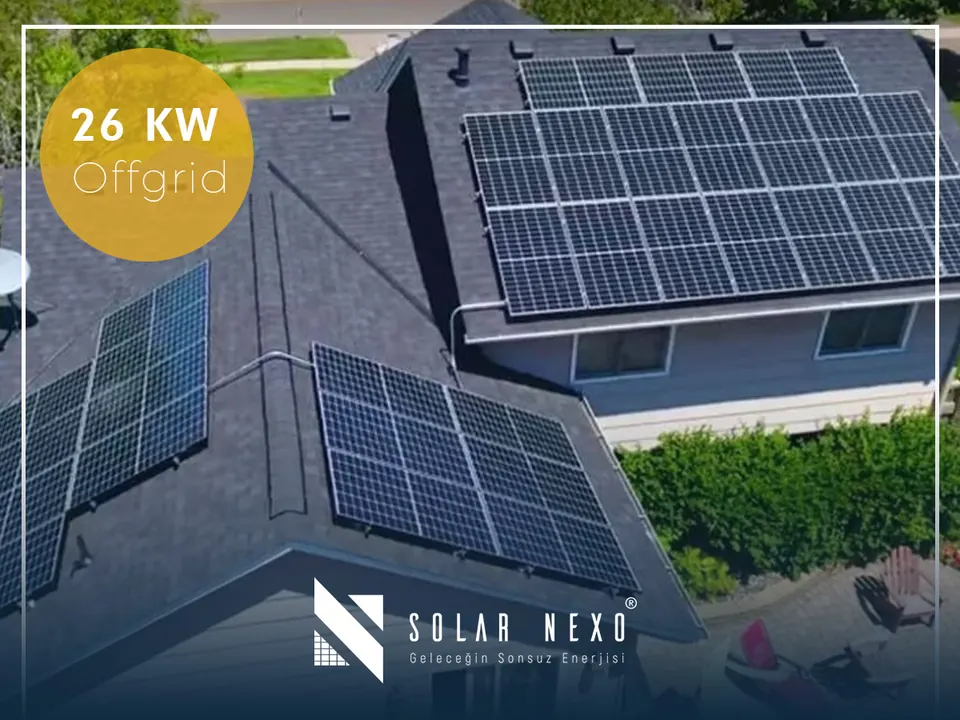
The main factors affecting the choice are load profile, grid status and budget. In off-grid systems, battery size is set by how many hours you want to run independently on overcast days; for hybrid systems you can look at our hybrid system service, and for grid-independent solutions our off-grid systems. The Solar Nexo website also includes examples such as a 2.2 kW rural compact off-grid system and a 4.4 kW off-grid home with a garden.
Sizing example: pump and battery
Let us proceed with a hypothetical example. Consider a 5 kWp system in an orchard in Elmalı. With the PVGIS reference, annual production is about 5 × 1,719 = 8,595 kWh; in the irrigation season, using central Antalya values, 5 × 159 = 795 kWh is expected for June and 5 × 168 = 840 kWh for July (on a real roof or field, tilt, orientation and shade change these values). If the pump runs only in the daytime, production is consumed directly and no battery is needed.
Suppose you have a daily load of 12 kWh for an off-grid farmhouse and cooling. If you want to run independently for one day, the usable battery capacity must be at least 12 kWh; with LiFePO4 batteries, because of depth of discharge and inverter losses, the nominal capacity is chosen above this figure. Panel power is also increased according to the recharging need on overcast days. These calculations must be firmed up with load measurement.
Regulation and permits: what should a farmer know?
According to Article 5/1/h of the Unlicensed Electricity Generation Regulation, agricultural irrigation facilities can install a plant of up to twice their contract power (2022 text); other persons are limited to contract power. With the 2026 amendment, a separate contract-power floor has also been introduced for agricultural irrigation; if the condition is not met, the generation counts as a free contribution. For grid-connected systems, the application is made in Antalya through AEDAŞ's (Akdeniz Elektrik Dağıtım A.Ş., the local electricity distribution company) LUS platform. For the application steps, see our article on applying for an agricultural irrigation solar plant.
For off-grid systems, the Regulation exempts plants with no connection to the transmission or distribution system from the licence and company formation obligation. This does not mean "subject to no permit at all"; obligations such as zoning, structural and fire are separate matters. Although a permit exemption is said to apply in unplanned areas for agricultural irrigation systems with a small panel surface and no reinforced-concrete foundation, this information comes from secondary sources; you should confirm the current position with the provincial directorate of agriculture and forestry and the municipality.
Financing and support
The Ministry of Agriculture and Forestry's Communiqué 2024/15 allows investment loans based on a test report for renewable energy systems that meet the business's energy needs for the period 01.01.2024-31.12.2026, and "use of renewable energy" counts as an additional interest-discount criterion. The programme ends on 31.12.2026 and no new decision for 2027 has been confirmed. The phrase "zero-interest solar loan from Ziraat" is installers' marketing language; the official framework is a criteria-based interest discount. For an application, learn the current terms from Ziraat Bank.
On the tariff side, EPDK raised retail prices for agricultural activities by 24.8 percent as of 4 April 2026. Although price rises increase the value of self-consumption, the payback calculation depends on system cost and your consumption; no exact period can be promised.
Practical tips for farm solar energy in Antalya
- If you mount panels on a barn or poultry-house roof, have the supporting structure checked by a civil engineer.
- Dust, straw and animal-related soiling affect the panel; make a cleaning plan.
- Hail and storm events are recorded in the Kumluca-Finike region; the mounting structure should be chosen for wind load.
- Motors such as pumps and compressors have a high starting current; inverter selection must take this into account.
- Monitor the system remotely; even when you are not at the farm you can see a drop in production.
For regional details, you can look at our article on agricultural irrigation solar in Korkuteli and Elmalı.
What information is asked of the farmer at the survey?
For a sound quote, the nameplate power of pumps and compressors, daily running hours, the current electricity bill or generator fuel consumption, land or roof dimensions and, if any, the distance to the grid pole are important. For irrigation, well depth, flow rate and irrigated area; for livestock, the daily milk quantity and milking hours are also noted. With this information the farm solar energy system is designed to the real need.
Conclusion
When done with correct load analysis, farm solar energy matches daytime-heavy loads such as cooling, irrigation and ventilation with the sun. On-grid stands out for businesses with a reliable grid, hybrid for those at risk of outages and off-grid for those far from the grid. Because regulation and loan terms can change, get confirmation from the relevant institutions; you can request a free survey for your business.
Frequently asked questions
Can a milk cooling tank run on solar energy?
Yes, once the compressor power and running time are calculated, a solar system can feed this load. If your milking hours do not overlap with the production curve, a battery or grid support is needed. Tank power and daily milk quantity determine system size; so we recommend load measurement on site. Measurement prevents both oversizing and undersizing.
Should livestock farms choose on-grid or off-grid?
In a business with a reliable grid, an on-grid system is generally the most economical solution. If outages are frequent and there are critical loads such as cooling or ventilation, a battery-supported hybrid solution is safer. If there is no grid connection or it is too expensive, an off-grid system is considered; the decision is made with the load list and a survey. Budget also affects the choice because the battery is a major cost item.
What is the unlicensed solar capacity limit for agricultural irrigation?
According to Article 5/1/h of the Unlicensed Electricity Generation Regulation, agricultural irrigation facilities can install a plant of up to twice their contract power (2022 text). In 2026 a separate contract-power floor also applies for agricultural irrigation. You need to confirm the current limit with the distribution company before applying. You should also prepare the documents for the application file completely.
Is there a solar loan or interest support for farms?
Ministry of Agriculture and Forestry Communiqué 2024/15 allows interest-subsidised investment loans for renewable energy systems for the period 01.01.2024-31.12.2026. The programme ends at the end of the year and no new decision for 2027 has been confirmed. Be cautious of zero-interest claims and confirm the terms with Ziraat Bank.
Is a permit needed to install an off-grid system?
Off-grid systems need no licence or distribution company application; however, this does not mean no permit is needed at all. Zoning, structural and fire obligations are assessed separately. If it will be installed on a roof, it is right to check the supporting structure and get current information from the municipality and the provincial agriculture directorate. In other words, being off-grid does not mean you are entirely independent of regulation.
Is it safe to install panels on a barn roof?
It is safe if the supporting structure is suitable and installation follows the manufacturer's instructions. The roof's load-bearing capacity must be assessed by a civil engineer. The panel must be mounted on a fire-resistant surface with ventilation left behind it; regular cleaning should also be planned for straw and dust build-up. On barn roofs, ammonia and humidity must also be considered when choosing the mounting structure.
Does a farm solar energy system need maintenance?
Because there are no moving parts, maintenance needs are low but not zero. In a farm environment, dust, straw and bird droppings can soil the panel surface; cleaning and connection checks are needed. The monitoring system shows a production drop early; Solar Nexo states that it provides maintenance and 24/7 technical support. Tracking production from the monitoring app is the most practical check.
Sources
Want a clear calculation for your roof?
The Solar Nexo team carries out a free site survey at your address in Antalya and designs the system that suits your roof, consumption and budget.