Short answer
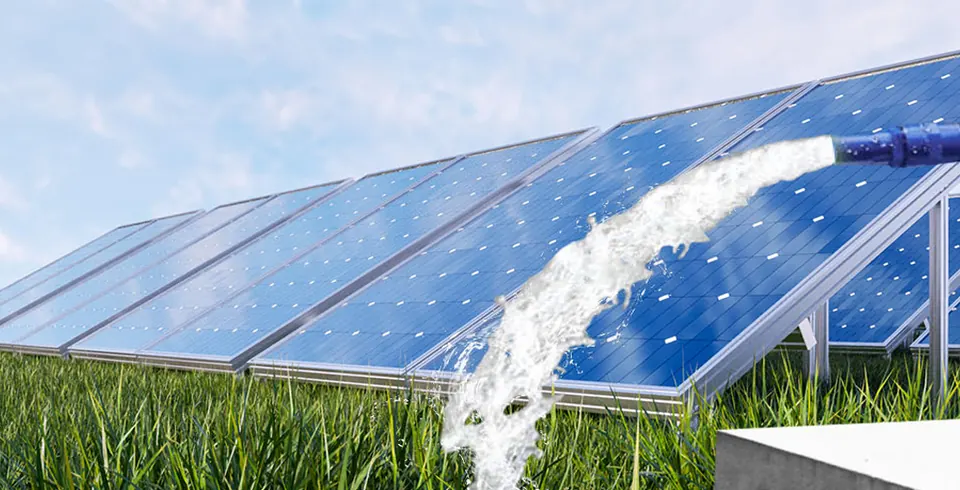
Solar-powered irrigation sends the electricity from solar panels directly to a water pump and often runs without batteries. In Antalya, summer irrigation demand and solar output fall in the same period. The design rests on four inputs: flow rate, total dynamic head, panel capacity of roughly 1.2-1.5 times the motor power, and a tank that stores the water. Exact sizes come from an on-site survey.
Key takeaways
- Hydraulic power in kW is roughly flow rate (m³/hour) × head (m) ÷ 367.
- Panel capacity is usually chosen at 1.2-1.5 times motor power; a water tank is used instead of batteries.
- According to PVGIS, 1 kWp of panels in Antalya produces 168 kWh in July and 99 kWh in December.
- Under the 11.08.2022 text, agricultural irrigation facilities may install unlicensed generation up to twice their contracted capacity; the current status should be confirmed.
- The interest-subsidised agricultural loan framework (Communiqué 2024/15) ends on 31.12.2026.
Solar-powered irrigation is a system in which the electricity from solar panels runs a water pump directly, and it is often installed without batteries. In Antalya, both irrigation demand and solar output peak through the summer, so the two curves overlap naturally. In this article we walk through the four core design decisions for solar-powered irrigation, from pump flow rate and panel capacity to the irrigation inverter and the water tank, with worked examples.
How does a solar-powered irrigation system work?
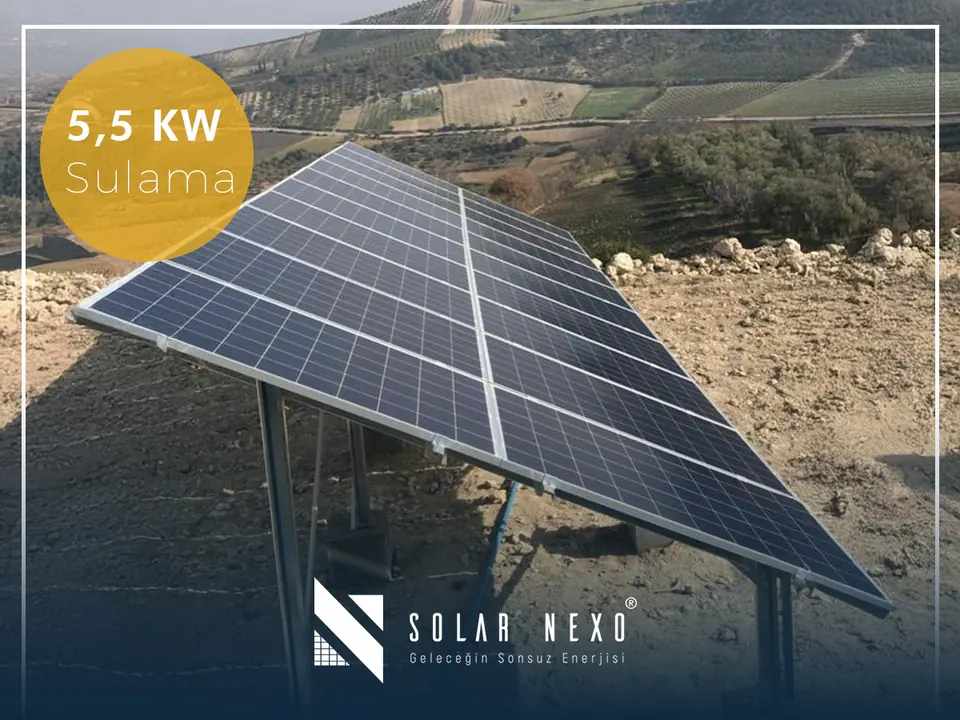
The system has three main parts: solar panels, an irrigation inverter (a solar pump drive) and the pump. The panels produce direct current; the irrigation inverter converts it into the alternating current the motor needs and adjusts motor speed to the instantaneous irradiance. As irradiance rises in the morning the pump gradually starts, reaches its highest flow around midday, then slows and stops towards evening.
The key difference here is that you store the energy as water instead of in a battery. The water pumped during the day collects in a tank or pond, and irrigation is then done by gravity or with a separate booster pump whenever you need it. Using a tank instead of a battery reduces both the initial investment and the maintenance burden.
How do you calculate pump flow rate and total dynamic head?
Designing solar-powered irrigation starts with deciding how many metres up, and how fast, you need to push the water. Two figures are required: the daily flow rate you need (m³/hour) and the total dynamic head. Total head includes the dynamic water level in the well, the lift to the tank or irrigation line, pipe friction losses and the operating pressure of the drip line.
Hydraulic power in kW is roughly flow rate (m³/hour) × head (m) ÷ 367. If we take combined pump and motor efficiency as about 55%, the following examples result (hypothetical values; they vary with well data):
| Flow rate | Total head | Hydraulic power | Required shaft power (55% efficiency) |
|---|---|---|---|
| 10 m³/hour | 40 m | 1.09 kW | about 2.0 kW |
| 20 m³/hour | 60 m | 3.27 kW | about 5.9 kW |
| 30 m³/hour | 80 m | 6.54 kW | about 11.9 kW |
| 50 m³/hour | 30 m | 4.09 kW | about 7.4 kW |
In a real project, the pump curve, the well's sustainable yield and the motor series are evaluated together. Choosing a pump that exceeds the flow the well can supply continuously means dry running and pump damage.
Panel capacity and the irrigation inverter
In solar pump systems, panel capacity is usually chosen at 1.2 to 1.5 times the motor power, because panels operate below their rated output for most hours and you want the pump to run longer in the morning and evening. If a 7.5 kW motor is chosen for the 5.9 kW shaft power above, roughly 9 to 11 kWp of panels would be considered. The exact value is set at the design stage according to the flow target and shading.
An irrigation inverter (VFD) differs from an ordinary frequency converter in that it carries an MPPT algorithm. It keeps the panel voltage continuously at its most efficient point, provides soft starting and includes the following protections:
- Dry-run protection: Stops the pump when the well level drops.
- Tank-full input: Stops the pump automatically with a float or level sensor.
- Overcurrent and overvoltage protection: Protects the motor during cloud cover and sudden irradiance changes.
- Minimum frequency limit: Cuts out when the pump slows to the point where it no longer delivers flow.
According to the pump affinity laws, flow is proportional to speed, while power is proportional to roughly the cube of speed. When speed halves, flow halves and power drops, in theory, to one eighth. However, when static head is high, below a certain speed the pump cannot lift any water at all; that is why the minimum frequency setting must be made correctly.
Tank, drip line and grid options
Size the tank for the amount of water needed on a day with insufficient sun. If your daily water requirement is 120 m³ and the system delivers half of it on a cloudy day, a tank holding at least a day and a half of water will give you peace of mind. If you plan night irrigation, tank volume matters even more. Placing the tank at the high point of the land reduces the need for a separate booster pump for the drip line.
For land with a grid connection there is a second route: install the system on-grid and feed the pump from both the grid and the panels. The regulation supports this route too; under the 11.08.2022 amendment to the Unlicensed Electricity Generation Regulation, agricultural irrigation facilities may install unlicensed generation plants up to twice their contracted capacity. Because the limits change often, the current version should be confirmed with the distribution company before you apply. For grid-connected irrigation systems you can look at our net metering system service.
Summer irrigation and production match in Antalya
According to PVGIS data, monthly production of 1 kWp of panels in Antalya is 159 kWh in June, 168 kWh in July and 167 kWh in August; in December it falls to 99 kWh. In other words, the period of heaviest irrigation is also the period when the panels produce the most. In Korkuteli and Elmalı, where highland farming is practised, annual specific yield reaches 1,655 and 1,719 kWh/kWp; these values are at the same level as, or higher than, the Antalya city centre figure of 1,656 kWh/kWp.
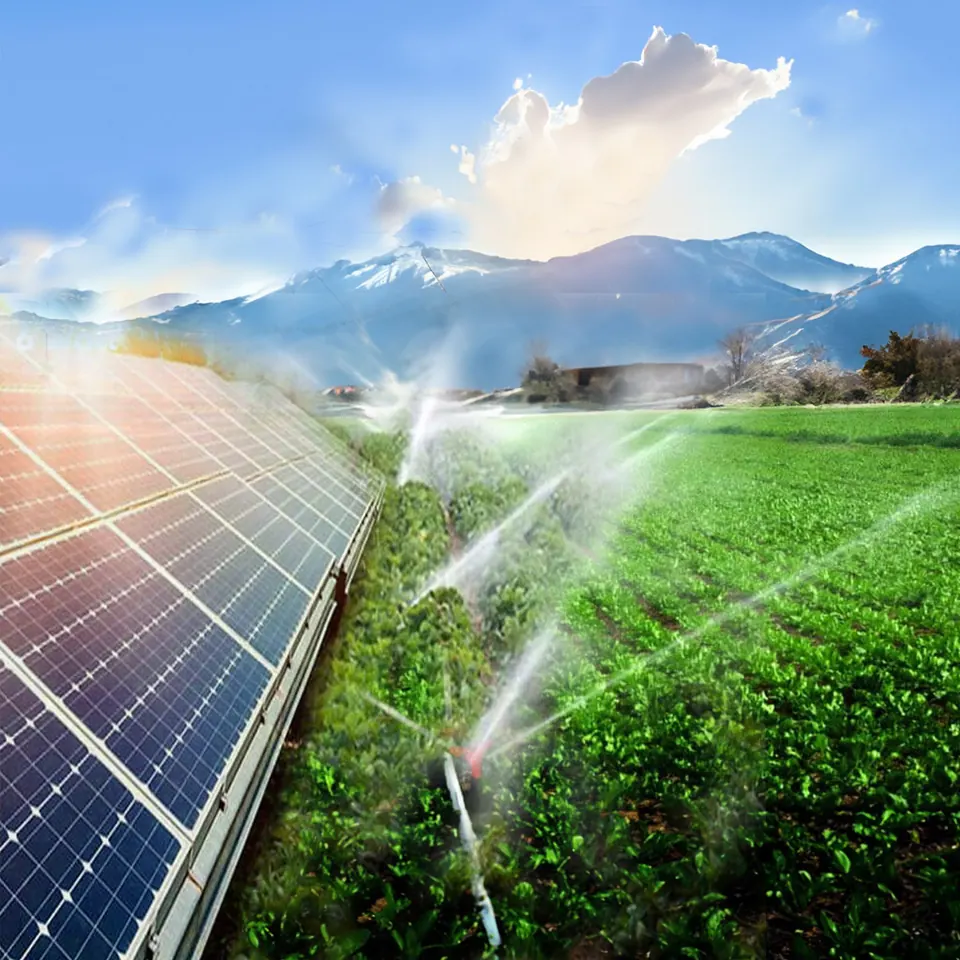
In summer, the hours when the pump runs at full power coincide with the hours when the panels peak. In winter, irradiance drops and the pump runs less, but irrigation demand usually falls in this period as well. If greenhouse climate-control loads are also involved, the design should consider the greenhouse's whole load profile; for that, see our greenhouse solar energy article.
Panel layout and points to watch during installation
In the field, the panel array is mostly installed on the ground on a steel structure. A south-facing array tilted at about 33 degrees for Antalya is close to the PVGIS optimum; if irrigation is used only in summer, a lower tilt may be preferred. For tilt and orientation, see our panel tilt and orientation guide.
- Shading: Shadows from trees, greenhouses, tanks or water towers must not fall on the array; the array should be laid out with open row spacing.
- Wind load: In open land, ground connections and foundation footings are calculated for wind load. In MGM (Turkish State Meteorological Service) records, the fastest wind measured in Antalya is 43.2 m/s; typical wind resistance in panel datasheets is given as 2400 Pa.
- Cable distance: The longer the DC cable run between the array and the pump, the greater the voltage drop; the cable cross-section must be chosen accordingly.
- Security: In open land, fencing, anchoring and panel-locking solutions against theft should be considered.
Common mistakes
The most common mistake in the field is choosing a pump without measuring the well's sustainable yield. When the pump tries to draw more water than the well can give, the level drops and the dry-run alarm keeps tripping. The second mistake is calculating total head only as the vertical elevation difference; pipe friction and drip-line pressure add significantly to the total head.
The third mistake is keeping the tank volume too small; on a cloudy day the irrigation schedule falters. The fourth is building the system with a cheap, unprotected converter, which leads to early failure of the pump and motor. Finally, not cleaning the panel surfaces during Antalya's dusty summer months reduces production; regular cleaning and a monitoring system catch the problem early.
Support schemes and the application framework
The Ministry of Agriculture and Forestry's Communiqué No. 2024/15 provides an interest-subsidised loan framework for renewable energy investments that meet a farm's energy needs in the period 01.01.2024-31.12.2026; the interest reduction depends on criteria, and the programme ends on 31.12.2026. Because no new decision for 2027 has yet been confirmed, farmers planning to benefit from the support need to discuss current terms with Ziraat Bank or Tarım Kredi. For the application steps you can read our agricultural irrigation solar plant (GES) application article.
For region-specific examples you can look at our Korkuteli and Elmalı irrigation guide, and you can use our calculation tool to estimate the size of your system.
Conclusion
Success in solar-powered irrigation projects rests on three keys: correctly calculated flow and head, an irrigation inverter with MPPT, and a water tank sized sensibly in place of batteries. Antalya's high irradiance and summer irrigation demand make this system attractive. Once your well data, land slope and planting plan are clear, Solar Nexo can size the pump-panel-inverter combination specifically for you through a free site survey.
Frequently asked questions
Does a solar-powered irrigation system need batteries?
Generally no. A solar pump runs on panel energy throughout the day, and the water is stored in a tank or pond. A water tank does the job of a battery more cheaply and with less maintenance. If you plan night irrigation, simply enlarge the tank accordingly or run hybrid with a grid connection. Batteries only make sense if you have a night-time load other than the pump.
How many kW of panels does a solar irrigation pump need?
Panel capacity is usually chosen at 1.2 to 1.5 times the motor power. For example, a flow of 20 m³/hour at 60 m total head gives a shaft power of about 5.9 kW; for a 7.5 kW motor, roughly 9 to 11 kWp of panels would be considered. The exact value is set at an on-site survey according to the pump curve, well yield and shading; the figures are only an example.
What is the difference between an irrigation inverter and an ordinary frequency converter?
An irrigation inverter carries an MPPT algorithm that keeps the panel voltage continuously at its most efficient point. It also has irrigation-specific protections such as dry-run, tank-full and a low-irradiance frequency limit. An ordinary converter is designed for a stable grid supply; it behaves unstably when panel voltage fluctuates and cannot protect the pump. That is why a dedicated MPPT drive is preferred for irrigation.
Does a solar irrigation pump work in cloudy weather?
It does, but at a lower flow. The irrigation inverter reduces pump speed according to irradiance; if irradiance falls too low to reach the pump's minimum speed, the pump stops. For this reason the tank volume is chosen to cover cloudy days. Because rainfall in Antalya falls mainly between November and February, this issue stays limited during the summer irrigation season.
Is a permit required for a solar irrigation system in Antalya?
For grid-connected systems, an unlicensed generation application is made to the distribution company (AEDAŞ). For off-grid systems no licence or distribution company application is needed, but obligations such as zoning and the opinion of the provincial directorate of agriculture and forestry are assessed separately. The safest route is to confirm the requirements specific to your case in writing with your municipality, the provincial directorate of agriculture and forestry and the distribution company before applying.
Is there government support for solar-powered irrigation?
The Ministry of Agriculture and Forestry's Communiqué No. 2024/15 provides an interest-subsidised loan framework for renewable energy investments in the period 01.01.2024-31.12.2026. The interest reduction depends on criteria, and the programme ends on 31.12.2026. No new decision has been confirmed for 2027. For current terms you should speak to your Ziraat Bank or Tarım Kredi branch.
How does a solar pump compare with a grid pump on cost?
A solar pump has a higher initial investment, but running costs and the electricity bill item largely disappear. For a grid pump, the electricity bill and grid access are an ongoing cost. The comparison should be made on pump running hours, the current tariff and the distance to the grid line. Because amounts vary by project, no figure can be given without a current quotation.
Sources
Want a clear calculation for your roof?
The Solar Nexo team carries out a free site survey at your address in Antalya and designs the system that suits your roof, consumption and budget.