Short answer
In solar-powered irrigation systems in Korkuteli, annual specific production according to PVGIS 5.3 is 1,655 kWh/kWp, and in Elmalı 1,719; Elmalı is the highest of the six locations examined. Pump power is calculated from flow, head and efficiency; panel power is chosen at about 1.2 times that. Because water demand and solar production rise together in summer, the system is a good fit.
Key takeaways
- According to PVGIS 5.3, Korkuteli is 1,655 and Elmalı 1,719 kWh/kWp; Elmalı is about 3.8% higher than central Antalya.
- Pump power: flow (m³/h) × head (m) / (367 × efficiency); with 20 m³/h, 60 m and 55% efficiency it comes to about 5.9 kW (example).
- Panel power is taken at about 1.2 times pump power; about 7.1 kWp in the example.
- Using a water tank is often simpler and more economical than a battery.
- The period of Communiqué 2024/15 ends on 31 December 2026; on 4 April 2026 EPDK raised the agricultural tariff by 24.8%.
Solar-powered irrigation in Korkuteli is a way for orchard and field owners in Antalya's interior to draw water without an electricity or diesel bill. According to PVGIS 5.3 data, annual specific production in Korkuteli is 1,655 kWh/kWp and in Elmalı 1,719 kWh/kWp. Elmalı is the highest value among the six locations we examined; it is about 3.8% more than central Antalya (1,656). In other words, in these districts where highland farming is practised, the sun offers a strong source for irrigation.
This article explains panel power, pump selection and the regulatory side for running a pump that lifts water from a well or tank on solar power. The calculations are examples; exact values cannot be given without site measurements.
Solar potential in Elmalı and Korkuteli
In the interior, high altitude keeps the air cooler. Cool air lowers panel cell temperature, which reduces the temperature loss of the panels. This may be one of the reasons for the high PVGIS value in Elmalı. The chart below compares the six locations.
| Location | Annual specific production (kWh/kWp) | Difference from central Antalya |
|---|---|---|
| Elmalı | 1,719 | about +3.8% |
| Kaş | 1,664 | about +0.5% |
| Antalya centre | 1,656 | reference |
| Korkuteli | 1,655 | about -0.1% |
| Manavgat | 1,649 | about -0.4% |
| Alanya | 1,615 | about -2.5% |
The monthly curve, for its part, should be compared with the irrigation season. For central Antalya, PVGIS monthly values are April 150, May 157, June 159, July 168, August 167 and September 155 kWh/kWp. In other words, production is also highest in the summer months when irrigation is heaviest. This match is the basic advantage of solar-powered irrigation.
We do not give a separate monthly series for Elmalı and Korkuteli; the central Antalya curve can be taken as a reference in shape. At high altitude the risk of snow and frost in winter may be greater than in the centre; MGM's (the Turkish State Meteorological Service) recorded maximum snow depth for central Antalya is 5 cm, and we could not verify separate data for the highlands. For this reason it is recommended that the mounting structure be chosen for snow load.
Pump selection: flow, head and power
In solar-powered irrigation, the first step is to determine the pump requirement. Two values are taken as the basis: flow (how many cubic metres of water per hour) and total head (including well depth, tank height and pipe losses, in metres). Approximate electrical power is calculated with this formula:
- Power (kW) ≈ flow (m³/h) × head (m) / (367 × overall efficiency)
Example: assume 20 m³ of water per hour, 60 m of total head and 55% overall efficiency (pump and motor together). Calculation: 20 × 60 / (367 × 0.55) = 1,200 / 201.9 ≈ 5.9 kW. To run this pump from panels, somewhat more peak panel power is installed; because of cloud cover and temperature losses, panel power is chosen at about 1.2 times pump power: 5.9 × 1.2 ≈ 7.1 kWp. With 605 W panels this is 12 panels (7.26 kWp).
In this example the daily volume of water, with the pump running 8 hours, is 160 m³ (20 × 8). In the summer months, panel output is high at midday; the pump runs at full flow at those hours and at low flow in the morning and evening. This behaviour should be planned according to the crop's water need and the irrigation schedule.
Frequency drive and tank use
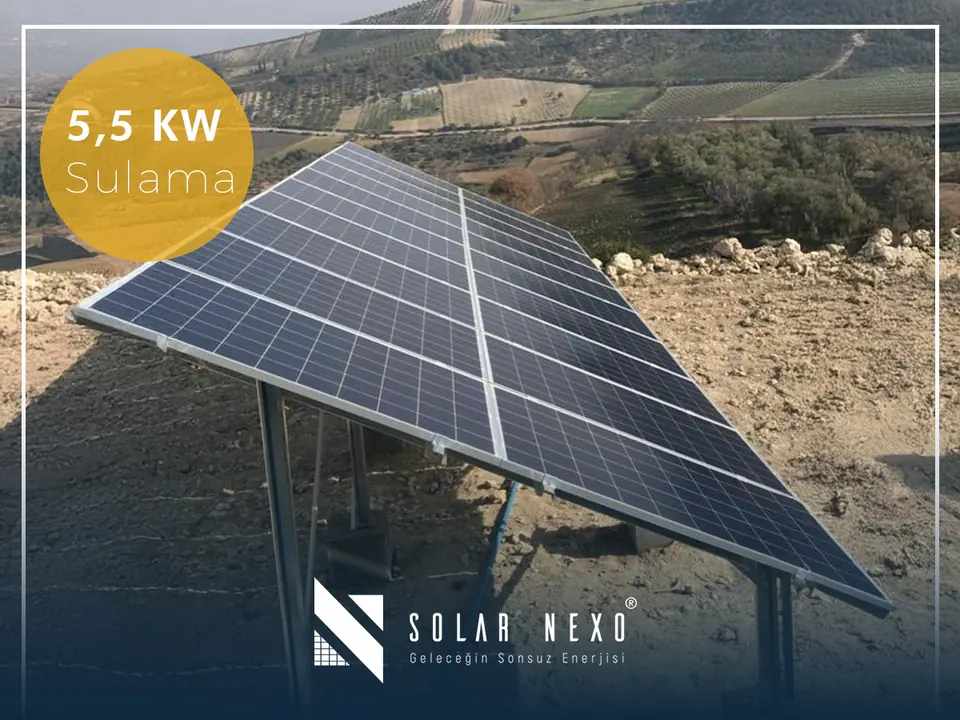
To run a pump directly from panels, a solar pump drive (irrigation inverter, VFD) is generally used. This device adjusts the pump speed according to solar irradiation: speed drops when irradiation falls and rises at noon. In this way the pump has a soft start, starting current is limited and panel power is used efficiently. The level switch and protection settings that prevent the pump from running dry are also connected to the drive.
Using a water tank instead of a battery is often more economical. During the day water is pumped into the tank, and irrigation is done at night too, by gravity from the tank or with a second booster pump. Storing water is generally simpler than storing energy. A more detailed explanation of the pump and panel calculation is in our article on solar-powered agricultural irrigation systems.
Example: annual irrigation energy and panel production
Let us suppose a grower runs the pump for a total of 90 days in the season, an average of 6 hours a day. For the 5.9 kW pump in the previous example, seasonal energy need comes to about 5.9 × 6 × 90 = 3,186 kWh. A 7.26 kWp panel group produces about 12,000 kWh a year with the Korkuteli value (1,655 kWh/kWp) (7.26 × 1,655 ≈ 12,015). That is, the energy need of the irrigation season is about a quarter of annual production.
This comparison has two meanings. First, if a direct pump system will run only in season, production may go unused for the rest of the year. Second, in a grid-connected, net-metered system this surplus production can be balanced against other consumption (house, storage, cooling). Which path to choose depends on your subscription and your consumption other than irrigation. For net metering rules and surplus, you can look at our article on net-metered systems.
Mounting notes for highland farming
In ground systems in high-altitude areas like Elmalı and Korkuteli, the following points matter:
- Wind load: Wind exposure is high on open land; the datasheet resistance of a 605 W TOPCon panel is 2400 Pa for wind, and the mounting structure should be chosen accordingly.
- Snow load: The panel's datasheet snow resistance is 5400 Pa; tilt and lower-edge height are planned to reduce snow accumulation.
- Ground and foundation: A piled or concrete foundation is chosen according to soil structure; on agricultural land, the foundation type can affect permit status.
- Theft and animal damage: Choice of fence, cable protection and cable route reduces the risk from rodents and theft.
- Frost and bifacial panels: Reflection (albedo) from the farm ground may give some extra production in bifacial panels; however, we cannot guarantee this gain, and it should be measured on site.
Solar Nexo's irrigation reference
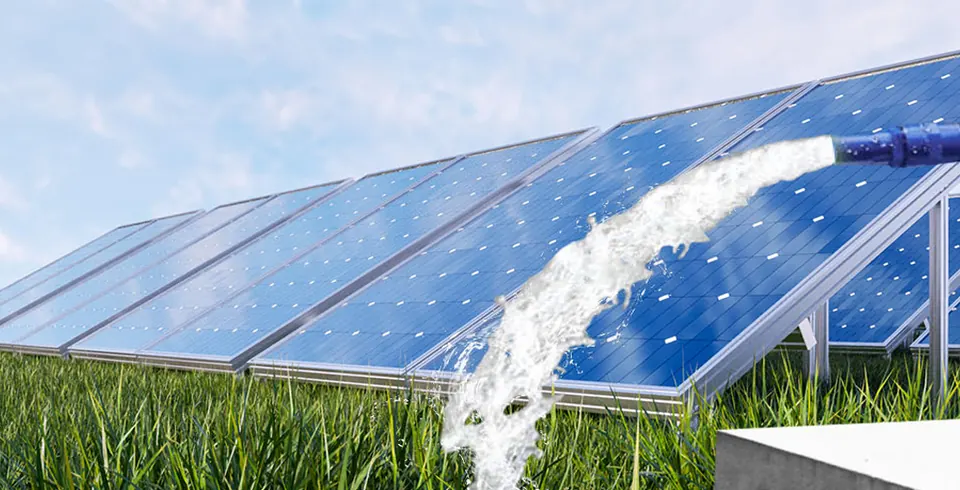
Among the references on Solar Nexo's website is a 5.5 kW solar-powered agricultural irrigation project. This project is cited only to the extent of the information on the site; because details such as well depth, pump flow or production data were not shared, we do not produce figures in this article. Our irrigation service covers survey, project, installation and commissioning; you can find the details on our irrigation systems page.
Regulation and support
If you have an agricultural irrigation subscription connected to the electricity grid, under the regulation agricultural irrigation facilities can install an unlicensed solar plant up to twice their contracted power (2022 text, Art. 5/1/h). For direct pump systems independent of the grid, no distribution company application is needed; but in that case too, zoning and permit matters are assessed separately. Although some permit exemptions are mentioned for agricultural irrigation systems in unplanned areas, we could not verify this information from the official text; you need to consult the provincial directorate of agriculture and forestry and the municipality.
On the financing side, the Ministry of Agriculture and Forestry's Communiqué No 2024/15 allows interest-supported loans for renewable energy systems that meet the enterprise's energy needs for the period 1 January 2024 - 31 December 2026. Because the interest-discount rate and limit could not be verified, we give no figures; the programme ends on 31 December 2026 and a new decision for 2027 has not been verified. In EPDK's (Turkey's Energy Market Regulatory Authority) 4 April 2026 tariff, the increase for agricultural activities is 24.8%; this raises the importance of energy cost for owners of electrically driven pumps. For the whole of the application steps, see our article on the agricultural irrigation solar application and support.
What is looked at during the survey?
At the on-site survey, the well or water source, existing pump and motor information, pipe diameter and length, tank location, shade and orientation of the area where the panels will be installed, which months of the year irrigation is done and the crop type are examined. In high-altitude places like Elmalı, wind and snow load, and in Korkuteli, wind exposure on wide open land, enter the structural calculation. You can use our contact page to request a free site survey.
Conclusion
In Korkuteli and Elmalı, solar-powered irrigation is a strong option thanks to the high PVGIS values (1,655 and 1,719 kWh/kWp) and the coincidence of summer water need and production. Choose the pump on flow and head, take panel power at about 1.2 times pump power, and plan the drive and tank use. Verify the regulation and support conditions before investing.
Frequently asked questions
How much do solar panels produce per year in Elmalı?
According to PVGIS 5.3, a south-facing system at optimal tilt in Elmalı produces about 1,719 kWh per kWp per year. This is the highest value among the six locations we examined. Actual production varies with shading, tilt and system losses and is calculated at the survey. The cool air of high altitude may be contributing to this value by reducing panel temperature loss.
How many kW should a solar irrigation pump be?
Power depends on flow and total head. Approximate formula: flow (m³/h) × head (m) / (367 × overall efficiency). For example, with 20 m³/h, 60 m and 55% efficiency it comes to about 5.9 kW. Panel power is chosen at about 1.2 times that. The exact value is determined by site measurement. As well as the pump's installed power, total head and pipe losses also determine the result.
Is a battery needed for an irrigation system?
In most cases it is not. During the day the pump runs directly from the panels and surplus water is pumped into the tank. Storing water is generally simpler and more economical than storing energy. If night irrigation is needed, pressure can be provided from the tank by gravity or with a small pump; the decision is made according to need. Even so, if night irrigation or grid outage matters, a hybrid solution is assessed separately.
Does a solar pump work in cloudy weather?
When irradiation falls, the drive reduces pump speed and flow drops; if irradiation is very low, the pump may stop. For this reason, tank use and the irrigation schedule are planned to allow for this variability. Cloudy days increase especially in the November-February period; production is high in the summer irrigation season. Tank volume and irrigation hours should therefore be planned according to irradiation variability.
Is there a solar loan for agricultural irrigation?
Ministry of Agriculture and Forestry Communiqué 2024/15 allows interest-supported investment loans for renewable energy systems that meet the enterprise's energy needs for the period 1 January 2024 - 31 December 2026. We give no figures because we could not verify the discount rate and limit; applications are made through Ziraat Bank and the programme ends on 31 December 2026. Learn the current conditions and documents in writing from the bank branch before applying.
Is an application to the distribution company needed for a solar pump on a well with no grid?
Generation facilities with no connection to the grid are exempt from licence and company-formation obligations; no connection approval letter (çağrı mektubu) application is made. However, this does not mean no permit is needed; zoning, permit and structural matters are assessed separately. On agricultural land, consulting the provincial agriculture directorate about panel surface and foundation type is recommended. Also, for installations on agricultural land, the panel surface and foundation type can affect permit status.
Does Solar Nexo install irrigation systems?
Yes. Solar Nexo lists solar-powered agricultural irrigation among its services on its website, and its references include a 5.5 kW agricultural irrigation project. The service covers survey, project design, installation and commissioning. You can request a free site survey to have your own land measured. In the quote, ask for the pump, drive, panels, mounting structure and labour items to be shown separately.
Sources
Want a clear calculation for your roof?
The Solar Nexo team carries out a free site survey at your address in Antalya and designs the system that suits your roof, consumption and budget.