Short answer
Greenhouse solar energy in Kumluca suits matching daytime irrigation pump, ventilation fan and packing loads with solar production. Panels are installed not on the greenhouse cover but on a storage-building roof, pump house or open land. Because of hail and storm risk in Kumluca and Finike, the mounting structure, insurance and subscription capacity limit should be checked before investing.
Key takeaways
- According to PVGIS 5.3, central Antalya is 1,656 and Kaş 1,664 kWh/kWp; this range is taken as a reference for Kumluca and Finike.
- Panels are installed on a storage-building roof, around the pump house or on open land so as not to shade the crop.
- In January 2019 about 1,000 decares of greenhouses were damaged; hail and storm risk should be factored into design.
- On 4 April 2026, EPDK raised the retail tariff for agricultural activities by 24.8%.
- The period of Ministry of Agriculture Communiqué 2024/15 ends on 31 December 2026; interest-discount rates should be confirmed from the official source.
Greenhouse solar energy in Kumluca is one of the concrete ways for protected-cultivation growers on Antalya's western coast to keep their electricity bill under control. Irrigation pumps, ventilation fans, circulation motors and packing-and-cooling units run heavily during daytime hours, which matches solar production well. In greenhouse farming, however, the risks are different too: hail, tornadoes and storms also affect the roofs of buildings around the greenhouse and the use of land.
In this article we explain, for greenhouses in Kumluca and Finike, where to install a solar system, which loads to calculate and what to watch for on the regulatory side.
Solar panels for a greenhouse: where are they installed?
Putting panels on the greenhouse's own cover is generally not preferred, because it would cut the light the crop needs. Instead, the following areas are considered:
- Roofs of storage, packing and office buildings: Flat or gently sloping surfaces of known structural capacity.
- Pump house and the area around the well: A small ground-mounted system placed right next to the irrigation load.
- Open land outside the greenhouse: With ground mounting, calculated for wind and hail load.
- Side strips that cast no shade: In the gaps between greenhouses, with a shading calculation.
These choices require assessing the risk of shading the greenhouse and the roof's structure together. You can find a broader design approach for greenhouse farming in our article on solar energy systems in greenhouses.
A greenhouse grower's electrical load: irrigation, fans and cooling
Every greenhouse has a different load profile, but typical items are: irrigation and fertigation pumps, a deep-well submersible pump, ventilation and circulation fans, lighting, the packing line and produce cold rooms. To get the load right, you need a year of bill data and an appliance list.
The first rule of design is to match daytime loads with solar production. For example, if you can shift irrigation to midday hours, the pump uses the energy produced directly; no battery is needed. For pump selection and flow calculation, you can look at our article on solar-powered agricultural irrigation systems.
| Load | Running time | Overlap with solar |
|---|---|---|
| Irrigation pump | Adjustable | High (can be shifted to daytime) |
| Ventilation fans | Mostly daytime | High |
| Packing line | Daytime shift | High |
| Produce cold room | Continuous | Partial (night from the grid) |
| Lighting, night work | Night | Low (does not coincide without a battery) |
Solar energy potential in Kumluca
According to PVGIS 5.3 data, annual specific production is 1,656 kWh/kWp for central Antalya and 1,664 kWh/kWp for neighbouring Kaş. We do not give a separate PVGIS value for Kumluca and Finike; a production between these two values is a reasonable reference. However, shade, topography and weather conditions around coastal greenhouses are site-specific and are assessed at the survey.
The monthly series also shows the critical periods for greenhouse farming: from November to February production falls to the 99-114 kWh/kWp range, and from June to August it rises to 159-168 kWh/kWp. Comparing the load that changes through the greenhouse season with this curve helps in choosing the system size correctly.
Example calculation: panel power for the daytime load
Let us think through a hypothetical example. Suppose a grower runs the following loads in daytime hours: a 7.5 kW deep-well pump for 4 hours a day, ventilation and circulation motors totalling 3 kW for 8 hours a day, and a 2 kW packing line for 6 hours a day. Daily daytime consumption comes out as follows:
- Pump: 7.5 kW × 4 hours = 30 kWh
- Fans and motors: 3 kW × 8 hours = 24 kWh
- Packing: 2 kW × 6 hours = 12 kWh
- Total: about 66 kWh/day
With the summer PVGIS value (July 168 kWh/kWp, that is, about 5.4 kWh/kWp per day), covering this load takes about 12 kWp of panels (66 / 5.4 ≈ 12.2). This figure assumes that system losses are already included in PVGIS's 14% assumption. With 605 W panels this is 20 panels (12.1 kWp). However, this is a calculation example: real loads should be derived by measuring the motors' load factor and running hours.
The same system produces, in the November-February period, for example in January, about 3.2 kWh/kWp per day. In greenhouse farming the ventilation load generally falls in winter, but heating, lighting and irrigation may vary. For this reason the system must be sized not for a single season but for the annual load curve.
Planning around the greenhouse season
When production and load do not rise in the same seasons, the self-consumption rate can fall. Two separate strategies are applied:
- Seasonal production, annual calculation: If there is high load in the summer season and low load in the winter season, choosing panel power on annual consumption rather than summer load reduces surplus.
- Shifting load to the sun: Moving irrigation and fertigation times to midday ensures pump power comes directly from the panel. Using a variable-frequency drive (VFD) makes this transition easier.
In pump and drive selection the motor's starting current is critical; details are in the irrigation article we linked above. Cloudy days increase in the November-February period; according to PVGIS, in central Antalya it is 114 kWh/kWp in November and 99 in December. It is necessary to include in planning that production falls to roughly half the summer value in these months.
What to have ready for the survey
Preparing the following information before the survey speeds up the process: your last 12 months of electricity bills, subscription type and contracted power, pump and motor nameplate information, transformer information if any, a sketch of the area to be used and the roof material. At the survey, the Solar Nexo team examines matters such as shade, orientation, structure and cable route on site. After that the project design, application, installation and commissioning steps follow.
Hail, tornado and storm risk
Hail, storm and tornado events are recorded in Kumluca, Finike and Demre. In January 2019 about 1,000 decares of greenhouses were damaged, and in October 2020 Kumluca experienced hail and a storm. Because we could not find a reliable province-level statistic for hail frequency at MGM (the Turkish State Meteorological Service), we do not give a numerical hail risk; however, this risk must be factored into the investment decision.
Measures that can be taken:
- Look at the mechanical load values in the panel datasheet (for the 605 W TOPCon model, wind 2400 Pa, snow 5400 Pa).
- Have the mounting structure calculated for wind load; storm turbulence can occur around greenhouses.
- Protect the system with suitable insurance; scope and exclusions should be read clearly in the policy.
- If possible, install panels close to the greenhouse cover but away from areas where flying parts could fall.
Regulation: subscription type sets the capacity
In unlicensed generation, the capacity limit varies by subscription type. According to the text of the 2022 regulation, agricultural irrigation facilities can install an unlicensed solar plant up to twice their contracted power. In greenhouse farming, however, subscription records may differ (irrigation, agricultural activity, business premises); you need to ask the distribution company which group your subscription falls into and what limit applies. The regulation changed three times in 2026; the current rules as of October 2026 are rechecked at the survey.
On the electricity price side, EPDK (Turkey's Energy Market Regulatory Authority) raised retail sales prices from 4 April 2026; the increase for agricultural activities is 24.8%. This rate raises the importance of energy cost for agricultural subscribers. The treatment of surplus electricity depends on separate rules; for details, see our article on selling surplus electricity.
Financing and support
The Ministry of Agriculture and Forestry's Communiqué No 2024/15 covers the period 1 January 2024 - 31 December 2026. The communiqué states that an investment loan based on a test report can be given for renewable energy systems that meet the enterprise's energy needs. Because we could not confirm the interest-discount rates and limits from the official source, we give no figures here. The programme ends on 31 December 2026; a new decision for 2027 has not been verified. For applications, consult Ziraat Bank or Tarım Kredi.
An example approach with Solar Nexo
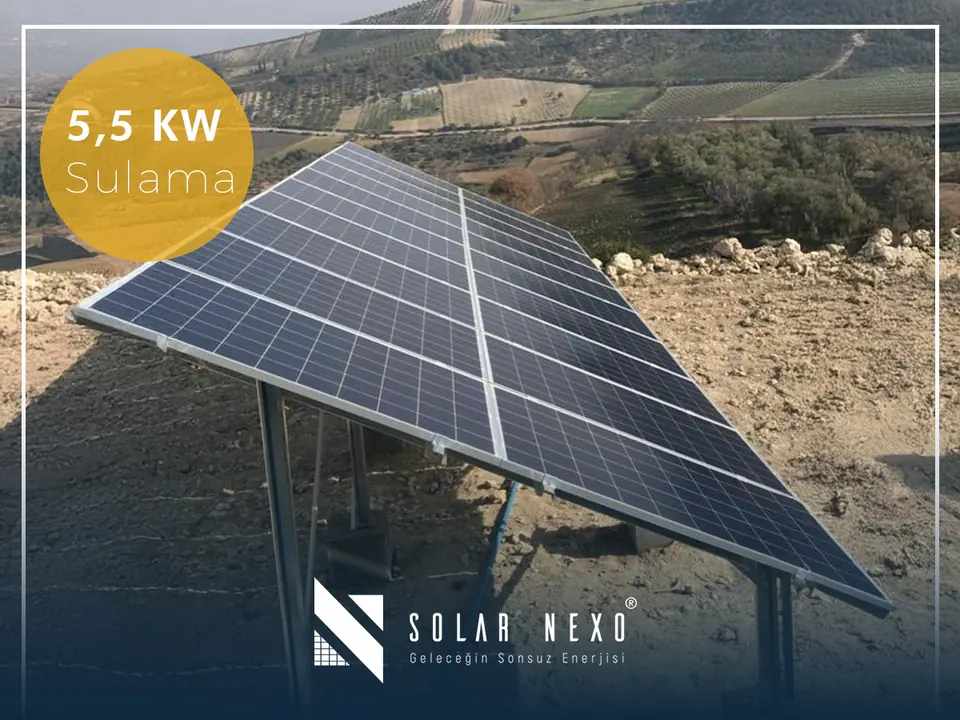
Solar Nexo's website lists a 5.5 kW solar-powered agricultural irrigation reference. A similar approach is followed in greenhouse farming: first load and bill analysis, then shading and mounting structure calculation, then the project and application steps. You can use our contact page for a free site survey, and you can find our irrigation system services on our irrigation systems page.
Conclusion
For greenhouse growers in Kumluca and Finike, solar energy makes sense for daytime irrigation, ventilation and packing loads. Installing the panels not on the greenhouse but on a storage-building roof, around the pump house or on open land does not shade the crop. Manage hail and storm risk with the mounting structure and insurance, ask the distribution company about the capacity limit for your subscription type, and confirm the support terms before investing. You can use our calculator to estimate size.
Frequently asked questions
Can solar panels be installed on a greenhouse roof?
Generally not, because panels shade the greenhouse and reduce the light the crop receives. Instead, the roofs of storage, packing and office buildings, the area around the pump house or open land outside the greenhouse are preferred. Because the shading and structural situation of each site is different, the decision is made at the survey. In practice, storage and packing roofs are used most.
How much do solar panels produce per year in Kumluca?
We do not give a separate PVGIS value for Kumluca. According to PVGIS 5.3, central Antalya produces 1,656 and Kaş 1,664 kWh/kWp per year; Kumluca is expected to be close to these two values. Actual production varies with site-specific factors such as shading, tilt and orientation, and is calculated at the survey. An exact production estimate needs a site-specific shading and tilt analysis.
Which loads do greenhouse growers benefit from with solar energy?
The highest benefit comes with daytime loads: irrigation pumps, ventilation fans, the packing line and circulation motors. The night portion of continuously running cold rooms is met from the grid. Adding a battery is possible but raises the investment; the priority is matching daytime loads with the sun. The hours at which a load runs directly determine the self-consumption rate. Whether a battery is needed for continuous loads is assessed separately in terms of cost.
Do hail and storms damage solar panels?
Hail can damage the panel surface; resistance values are given in the panel datasheet (for the 605 W TOPCon model, wind 2400 Pa, snow 5400 Pa). Because hail and storm events are recorded in and around Kumluca, a robust mounting structure and suitable insurance are recommended. We could not find reliable province-level data to give a numerical hail risk. Be sure to check whether the insurance policy includes hail and storm cover.
Is there a solar energy loan for greenhouse growers?
Ministry of Agriculture and Forestry Communiqué 2024/15 allows interest-supported investment loans for renewable energy systems that meet the enterprise's energy needs for the period 1 January 2024 - 31 December 2026. We give no figures because we could not verify the discount rate; applications are made through Ziraat Bank or Tarım Kredi, and the programme ends on 31 December 2026. Confirm the current terms in writing with the bank before applying.
What is the installed power limit for a greenhouse subscription?
The limit depends on the subscription type. According to the text of the 2022 regulation, agricultural irrigation facilities can install an unlicensed solar plant up to twice their contracted power. However, whichever subscription group your greenhouse falls into, that rule applies. You should find out the current limit from the distribution company AEDAŞ before applying. Contracted power and subscription group can be checked from the bill and contract before applying.
Does solar energy bring a greenhouse's electricity bill to zero?
No, we cannot promise that. Daytime loads can be met with solar, but night consumption and fixed charges continue. The reduction in the bill depends on system size, load profile and self-consumption rate. For a realistic expectation, a calculation needs to be made at the survey with a year of bill data. We therefore recommend assessing your bill with a realistic expectation.
Sources
Want a clear calculation for your roof?
The Solar Nexo team carries out a free site survey at your address in Antalya and designs the system that suits your roof, consumption and budget.