Short answer
Greenhouse solar energy means covering a greenhouse's irrigation, ventilation, lighting and packing loads with solar panels. In Antalya, because of shading, panels are usually installed not on the greenhouse roof but on a shed roof or on land beside the greenhouse. Daytime loads overlap with solar production, while winter output is lower than summer, so the load profile and the seasonal gap must be planned together.
Key takeaways
- If panels are placed on the greenhouse roof, the light reaching the crop is reduced; a shed roof or a ground system is usually more suitable.
- Irrigation pumps, roof vent motors and ventilation fans run in the daytime, so they overlap with solar production.
- According to PVGIS, 1 kWp of panels in Antalya produces 168 kWh in July and 99 kWh in December.
- In January 2019 about 1,000 decares of greenhouses were damaged by hail and a tornado; the structure must be designed for wind load.
- EPDK raised prices in the agricultural activity subscriber group by about 24.8% from 4 April 2026.
Greenhouse solar energy means meeting a greenhouse's electrical loads, such as irrigation, ventilation, lighting and packing, with solar panels. Because protected cultivation is so widespread in Antalya, the right question is not "can panels be installed?" but "where can panels go to produce the most without harming the crop?" The answer is usually not the greenhouse roof, but the buildings and open land next to the greenhouse. In this article we cover the load profile, shading design and Antalya-specific risks.
What are the electrical loads in a greenhouse?
Before connecting a greenhouse to solar energy, you need to know which device runs when. Electricity consumption varies widely with greenhouse type, crop and season; the table below shows the nature of the loads and their overlap with solar production in general terms.
| Load | Typical operating time | Overlap with solar production |
|---|---|---|
| Irrigation and fertigation pump | Daytime, scheduled | High |
| Roof vent motors and ventilation fans | Daytime, temperature-dependent | High |
| Fogging and humidification systems | Midday hours | High |
| Circulation fans | Day and night | Medium |
| Supplementary lighting | Night and early morning | Low |
| Packing shed and cold room | Heavy by day, cold room continuous | Medium-high |
Because irrigation pump and ventilation loads run during the day, they overlap naturally with solar production. Loads that run at night are either met from the grid or supported by a battery; a battery investment only makes sense if the night load is large.
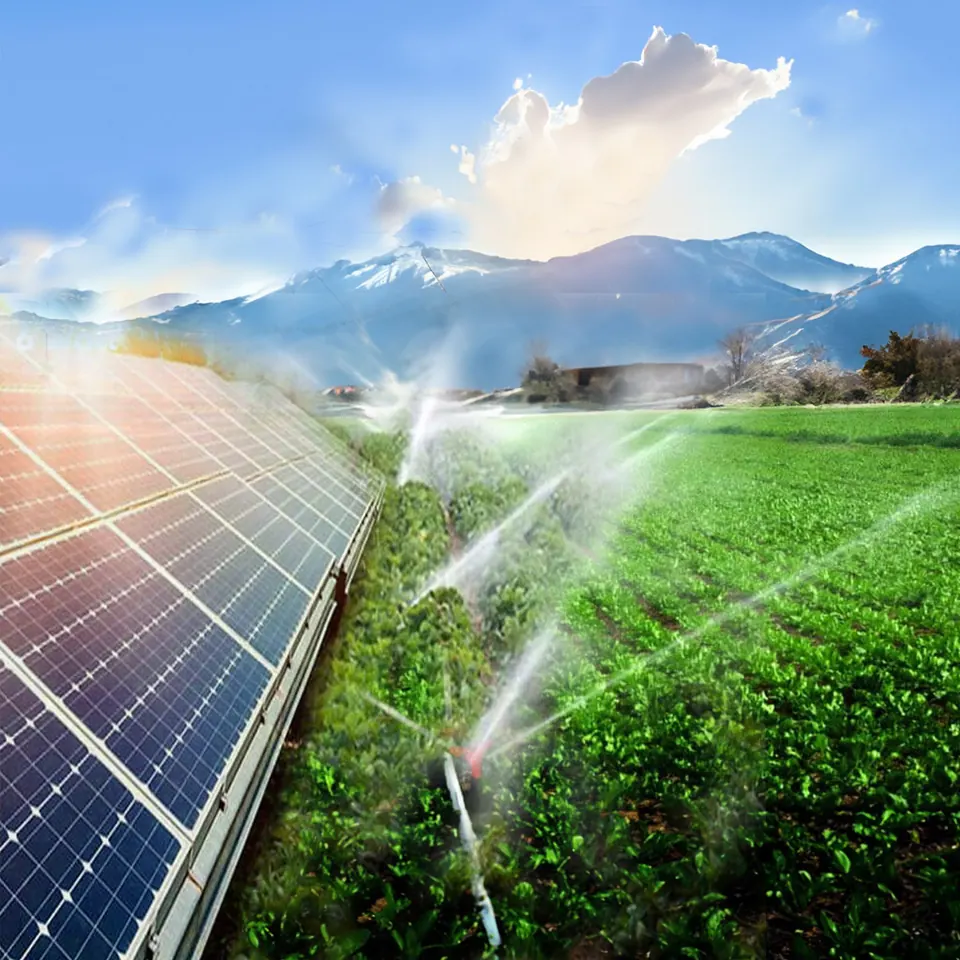
Shading design in greenhouse solar energy
Covering the greenhouse roof with panels cuts the light passing through that surface to the plants. For high-light crops such as tomatoes, peppers and cucumbers, this means a direct yield loss. For that reason, the first rule in greenhouse solar energy projects is that the panel must not take the crop's light.
The locations preferred in practice are as follows:
- Packing shed and storage roofs: The roof of a fixed structure beside the greenhouse creates no shading problem and is more suitable structurally.
- Vacant land beside the greenhouse: A south-facing tilted array on the ground gives optimum production and is easy to maintain.
- Around the water tank and pond: A system built at the same point as the pump shortens the cable run.
- The north face and side walls of the greenhouse: Considered only at points that do not affect the crop's light, and with an agronomist's approval.
For operations that want to place panels partly on the greenhouse roof, sparse-layout or semi-transparent solutions exist; however, these must be verified agronomically together with the crop's light requirement. Row spacing is also always calculated in the design so that the arrays do not shade each other or the greenhouse itself. For a ground system beside a multi-span greenhouse block, the distance between rows must be set according to the low angle of the winter sun.
Hail, storm and wind risk in Antalya
On Antalya's western coast, especially around Kumluca, Finike and Demre, hail, storm and tornado events have damaged greenhouses. In January 2019 about 1,000 decares of greenhouses were damaged, and in October 2020 hail and a storm hit Kumluca. The fastest wind in MGM (Turkish State Meteorological Service) records is 43.2 m/s. A numerical hail risk cannot be given for the region; however, these events show that the panel structure must be designed for wind load.
In typical panel datasheets, wind load is stated as 2400 Pa and snow load as 5400 Pa. For ground systems, in addition to these values, the steel structure, foundation footings and fasteners must be calculated for the site wind load. If installation is not carried out in line with the manufacturer's installation manual, the warranty may also end. Insurance coverage should be assessed separately too; for details see our solar plant insurance article.
Seasonal gap: crops in winter, production in summer
In Antalya the greenhouse season runs mainly in the cooler months, whereas solar production peaks in summer. According to PVGIS data, 1 kWp of panels in Antalya produces 168 kWh in July and 99 kWh in December; that is, December production is about 41% lower than July (calculation). This should be watched closely in systems sized on an annual net metering logic.
There are two routes in design: size the system for the winter months when consumption is heavy and feed the summer surplus to the grid, or size it for annual consumption. Which one suits depends on the subscription type, the contracted capacity and the capacity limits defined in the regulation. For agricultural irrigation subscriptions, capacity of up to twice the contracted capacity is foreseen; however, you need to confirm with the distribution company which subscription group your greenhouse electricity falls under.
Example sizing calculation
Let us proceed with a hypothetical example. Suppose the irrigation pump is 5.5 kW and runs an average of 6 hours a day: 33 kWh. Suppose the total power of the ventilation and circulation fans is 4 kW and they run about 5 hours a day: 20 kWh. Total daily consumption comes to about 53 kWh. If we assume the system runs at this load for about 180 days a year, annual consumption is 9,540 kWh.
Dividing this consumption by the 1,656 kWh/kWp that PVGIS gives for Antalya city centre yields about 5.8 kWp. With 605 W panels, this corresponds to 10 panels (6.05 kWp). In a real project, this value is corrected for shading, tilt, cable losses and the timing of the load. The figures are only to show the calculation method; they vary with the actual greenhouse load.
System selection and tariff context
For loads concentrated in the daytime, a grid-connected (on-grid) system is the simplest solution; for details you can look at our on-grid systems page. For remote greenhouses with weak grid access, a hybrid or off-grid solution comes into play. When deciding which system suits, always work out the total power and simultaneity of loads such as the irrigation pump, ventilation and cold room; high starting currents also influence the inverter and contracted capacity decision.
For a grid-connected greenhouse system, the application in Antalya is made through AEDAŞ's (the regional electricity distribution company) LUS platform; since 01.10.2023 AEDAŞ accepts unlicensed generation applications only through this portal. If the system is under 25 kW, the simplified procedure applies and the system cannot exceed the subscriber's contracted capacity. For larger greenhouse operations, a contracted capacity increase and transformer capacity are also assessed separately. Process steps such as the connection approval letter (çağrı mektubu), project approval and commissioning acceptance work the same way for these facilities; a plant operated without acceptance can be disconnected, so the system must not be energised before acceptance.
On the tariff side, with effect from 4 April 2026, EPDK (Turkey's Energy Market Regulatory Authority) raised retail sales prices in the agricultural activity subscriber group by about 24.8%. Because tariff items can change over time, always run the payback calculation with the current tariff table. You can read our solar-powered agricultural irrigation article, where we cover pump and panel selection for solar-powered irrigation in detail.
Region-specific notes: Kumluca, Finike, Demre
In greenhouse operations in western Antalya, field and greenhouse are mostly intermingled; shed, packing and storage roofs are plentiful, while vacant land is limited. In this case the most practical solution is to use the roofs of existing buildings; on trapezoidal sheet roofs, clamp fixing allows quick installation without drilling the roof. The roof's load-bearing capacity must be assessed by a civil engineer; the distribution company and the municipality may also ask for a structural suitability certificate. For regional details you can look at our Kumluca and Finike greenhouse article and our Demre greenhouse solar panel article, which focuses on tomato greenhouses.
Maintenance and monitoring in a greenhouse environment
In greenhouses, residues from spraying and irrigation can build up a layer of dirt on the panel surface. Humidity and condensation raise the risk of corrosion at cable connection points. For this reason equipment with a suitable IP protection class should be chosen, and connectors and panel entries should be checked at least once a year. For surface cleaning, chemical-free methods recommended by the panel manufacturer should be used; for details you can look at our solar panel cleaning guide. A mobile monitoring system helps catch sudden drops in production early.
Conclusion
Success in greenhouse solar energy projects depends on placing the panel where it will not cut the crop's light, working out the load profile correctly and reflecting Antalya's hail and wind risks in the structural design. While daytime loads such as irrigation and ventilation overlap with solar production, night loads need a separate strategy. You can request a free site survey from Solar Nexo with your greenhouse's load list and land plan.
Frequently asked questions
Can solar panels be installed on a greenhouse roof?
Technically yes, but the panel cuts the light passing through that surface to the crop. For high-light crops this means yield loss. For this reason most operations install the panels on a shed or storage roof beside the greenhouse, or on the ground. If roof placement is being considered, sparse layouts or semi-transparent solutions must be verified agronomically.
Which loads can a solar energy system cover for greenhouses?
It can cover electrical loads such as the irrigation and fertigation pump, roof vent motors, ventilation and circulation fans, the fogging system, lighting, the packing shed and the cold room. Loads that run in the daytime overlap naturally with solar. Loads that run at night, such as lighting, need grid or battery support. If the greenhouse has electric heating, its consumption should be measured separately.
Which areas of Antalya are suitable for greenhouse solar energy?
In terms of annual specific yield, Antalya as a whole is highly productive; according to PVGIS it is 1,656 kWh/kWp in Antalya city centre, 1,649 in Manavgat, 1,664 in Kaş and 1,719 in Elmalı. Solar irradiation is also high around the greenhouse-dense Kumluca, Finike and Demre areas. The real difference comes from local shading, roof structure and grid connection; these are assessed together at the survey.
Do hail and storms damage solar panels?
Panel datasheets state wind and snow load resistance (for example 2400 Pa and 5400 Pa), but no guarantee can be given for every storm event. Hail and tornadoes are recorded events on Antalya's western coast. For this reason the structure should be designed for wind load, and the insurance coverage should be checked in the policy for hail, storm and theft.
Which system type should be chosen for greenhouse solar energy?
If the loads run mainly in the daytime, a grid-connected (on-grid) system is the simplest and most economical solution. If the grid connection is weak or absent, a hybrid or off-grid system is considered. The decision is made on load profile, contracted capacity, distance to the grid and night consumption; for this reason an on-site survey and load analysis must be carried out.
Can solar panels meet a greenhouse's needs in winter?
It may be hard to meet them. According to PVGIS, 1 kWp of panels in Antalya produces 99 kWh in December and 99 kWh in January, against 168 kWh in July. So winter production is about 59% of summer production. If greenhouse consumption is high in winter, the system must be sized accordingly or operated together with the grid.
Is there agricultural support or credit for greenhouses?
The Ministry of Agriculture and Forestry's Communiqué No. 2024/15 provides an interest-subsidised loan framework for renewable energy investments that meet a farm's energy needs in the period 01.01.2024-31.12.2026. The programme ends on 31.12.2026 and no new decision has been confirmed for 2027. You should find out the current terms from Ziraat Bank or Tarım Kredi.
Sources
Want a clear calculation for your roof?
The Solar Nexo team carries out a free site survey at your address in Antalya and designs the system that suits your roof, consumption and budget.