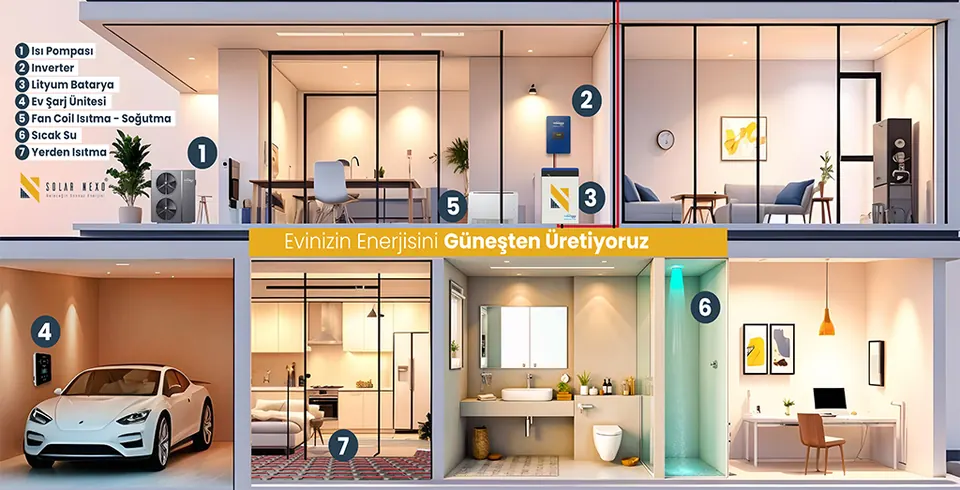
Short answer
Net metering (mahsuplaşma) is the mutual calculation of the energy your solar system feeds to the grid against the energy you draw from it. As of October 2026 it is monthly for residential subscriptions and, from 1 May 2026, hourly for non-residential installations. Surplus is valued at the tariff's single-rate active energy unit price. Rules may change; in Antalya applications go through AEDAŞ.
Key takeaways
- From 1 May 2026, net metering is hourly for non-residential licence-exempt installations and monthly for residences (Official Gazette 2 April 2026; EPDK Decision 14531).
- Surplus is valued at the single-rate active energy unit price of the relevant tariff; this is lower than the total unit charge on the bill.
- For installations that received a connection approval letter after 12 May 2019, annual production cannot exceed twice the associated consumption; no limit applies to residential subscriptions.
- No payment is made for energy fed from the battery to the grid.
- The surplus of eligible renewable installations is purchased under YEKDEM for 10 years.
The short answer to what net metering is: it is the mutual calculation of the energy your solar energy system produces and feeds to the grid against the energy you draw from the grid. That is, the surplus energy you produce is matched against the energy you draw when you need it. The rules changed significantly in 2026. As of October 2026, net metering (mahsuplaşma) is monthly for residential subscriptions and hourly for non-residential installations. In this article we explain the current rules, the payment logic and the effects in Antalya with dated sources.
What is net metering and why is it needed?
The rooftop system produces most at midday. But the consumption of a home or business does not always fall in the same hour. Energy not consumed in the daytime is fed to the grid and drawn from the grid in the evening or at night when it is needed. Net metering is the calculation of these two flows against each other. In this way the energy you feed in is assessed to cover the energy you draw, and you pay or receive only the difference.
This rule rests on the basic logic of licence-exempt generation. Licence-exempt producers generate to meet their own needs. They cannot sell surplus under bilateral agreements or in the organised wholesale market. Net metering is therefore an important tool.
A net-metered solar energy system: two different procedures
Since 1 May 2026, net metering has run in two different forms depending on the type of subscription. The basic difference is this:
| Topic | Residential subscription | Non-residential (commercial, industrial, etc.) |
|---|---|---|
| Net metering interval | Monthly | Hourly (renewable installations that received a connection approval letter after 12 May 2019) |
| Implementing body | Market operator (EPİAŞ, the Energy Exchange Istanbul) | EPİAŞ, through the Licence-Exempt Generation Module (LÜM) |
| Paid-generation limit | Not applied | Applied |
| Annual production cap | No limit independent of installed power | Twice the associated consumption |
The basis is the regulation amendment published in the Official Gazette of 2 April 2026 and EPDK's (Turkey's Energy Market Regulatory Authority) procedures and principles decision no. 14531 of 5 May 2026. Previous net metering procedures have been repealed. The regulation has changed several times in the past year; we recommend checking whether there is a new rule before publication.
Monthly net metering: what does it mean for homes?
For a residential subscription, the surplus energy you produce in the daytime is netted against the energy you draw from the grid within the same month. This allows families who are not at home during the day to balance their production with evening consumption. The example below is simplified and hypothetical:
| Scenario | Fed to grid | Drawn from grid | Netted | Result |
|---|---|---|---|---|
| A (low production) | 400 kWh | 900 kWh | 400 kWh | Normal bill for 500 kWh |
| B (high production) | 600 kWh | 450 kWh | 450 kWh | 150 kWh surplus is valued |
In scenario A, all the energy fed in is netted and a bill comes for the rest of the energy drawn. In scenario B, the energy drawn is fully covered and the remaining 150 kWh is counted as surplus. In the real calculation, tariff components and distribution charges come into play. This table only shows the logic.
Hourly net metering: what changed for businesses?
In non-residential installations, production and consumption are netted separately for every hour. That is, energy you overproduce at midday does not cover energy you draw in the evening. Each hour has its own balance. Self-consumption is therefore valuable in a business that works in the daytime; in a business with high night-time consumption, production turns into surplus because it does not coincide with consumption hour by hour.
This rule affects how an installation is sized. Sizing the system to daytime consumption is often sounder than sizing it to sell surplus production. This is an interpretation, and the rule it rests on is that only a low unit price is paid for surplus. For non-residential installations we cover the topic comprehensively in our article on selling surplus electricity.
How is the value of surplus determined?
Surplus energy is valued at the single-rate active electrical energy unit price of the relevant tariff in the activity-based tariff table approved by the EPDK Board. If there are several tariffs in the group, the lowest is used. That is, the payment is lower than the total unit charge on the bill. This is because the bill amount also includes the distribution charge and taxes. The cost avoided through self-consumption is therefore higher than the value of surplus.
The surplus is paid for by the responsible incumbent supply company (görevli tedarik şirketi). The surplus of eligible renewable installations is purchased under YEKDEM (the Renewable Energy Support Mechanism) for 10 years. By what route and on what day the money is reflected in your account, whether as bill offset or cash payment, could not be clearly drawn from the official text. We recommend confirming this in writing with your supplier.
The paid-generation limit and the annual cap
The production of installations that received a connection approval letter (çağrı mektubu) after 12 May 2019 in a calendar year cannot exceed twice the annual consumption of the associated consumption facilities. The paid-generation limit derived from this rule is the maximum production quantity that can be subject to net metering and sale. The grid operator registers it per consumption facility in the LÜM. After the limit is exceeded, net metering continues, but the surplus is set aside as a quantity payable subject to a system usage charge.
For installations connected to a residential subscription, this limit does not apply, whatever the installed power. This exception was also confirmed by EPDK's Clarification No. 1 of 13 May 2026. The capacity ceiling is the contract power.
Cases treated as free of charge
In some cases, production is counted as a free contribution to YEKDEM and no payment is made for it. These are:
- Detection of a violation of the regulation
- Failure to meet the contract power condition
- No consumption after acceptance
- Unauthorised use. In this case the month of detection and the following 6 billing periods are covered.
It is therefore important to size the system appropriately to the consumption facility and to complete acceptance procedures in full. Running the system before acceptance, meanwhile, leads to disconnection and a three-year application ban. In short, the question of what net metering is covers the discipline of acceptance and sizing as much as the rules.
How does a battery affect net metering?
The owner of a licence-exempt installation can install a storage unit up to the electrical power of the generation plant. No payment at all is made for energy fed from the battery to the grid. If the quantity supplied from storage cannot be determined, no surplus payment is made at all. The benefit of a system with a battery is therefore not to sell surplus but to consume the daytime surplus in your own installation in the evening. Batteries too must have been manufactured within the last five years. For the hybrid structure, see our net-metered systems service page.
Implementation in Antalya: from application to acceptance
In Antalya the distribution company is AEDAŞ, and licence-exempt generation applications have been taken through the LUS platform since 1 October 2023. The process consists of the connection approval letter, project approval, connection agreement and acceptance steps. After acceptance, the system usage agreement is signed within 3 days following the application, and the valuation of surplus starts from that date. For the meaning of the connection approval letter, see our article on what a connection approval letter (çağrı mektubu) is, and for the steps, our article on the rooftop solar application.
In the process Solar Nexo describes on its website, net-metered systems include the Connection Approval Letter Application and the Project Approval and Installation steps. It is important to plan these steps in advance for grid-side procedures.
Typical usage scenarios in Antalya
- A villa in Konyaaltı or Belek: The pool pump and air conditioner run in the daytime. With monthly net metering for a residential subscription, the daytime surplus is balanced against evening consumption.
- A workshop in Kepez: In a business working in the daytime, the self-consumption ratio is high under hourly net metering.
- A greenhouse or agricultural irrigation in Kumluca: If pump and greenhouse loads are heavy in the daytime, separate capacity rules apply to agricultural irrigation facilities.
- A hotel in Alanya: Summer load and production overlap, but night load does not convert into surplus under hourly net metering.

Common misconceptions to watch out for
It is useful to correct a few common mistakes. Net metering is not monthly for everyone; non-residential installations are hourly. Surplus energy is not paid at PTF (the market clearing price); the single-rate active energy unit price of the relevant tariff is used. Energy fed from the battery to the grid is not paid for. Unlimited sale of surplus production is not possible either. For non-residential installations annual production cannot exceed twice consumption. You can find the regulation's details on these topics in our article on the licence-exempt electricity generation regulation.
Questions to ask before getting a quote
After answering what net metering is, clarify the following for your own situation:
- Is your subscription residential or non-residential? This determines the monthly versus hourly distinction.
- What is your contract power and does the planned system suit it?
- How much of your consumption falls in the daytime hours?
- Is your connection approval letter date before or after 12 May 2019? The rules differ accordingly.
- Have you learned in writing from your supplier by what route surplus payment will reach you?
The answers to these questions determine the system size and the realistic expectation of the investment.
Conclusion
The answer to what net metering is directly affects your solar investment. Monthly net metering for residences and hourly for non-residential installations shape sizing and self-consumption strategy. Because surplus is valued at a low unit price, it is sound to build the system to match consumption. Remember that the rules are valid as of October 2026 and may change. To make the calculation that suits your own subscription, you can request a free survey.
Frequently asked questions
What is net metering?
Net metering is the mutual calculation of the energy a solar energy system feeds to the grid against the energy drawn from the grid. The energy fed in is assessed to cover the energy drawn. As of October 2026 it is monthly for residential subscriptions and hourly for non-residential licence-exempt installations. The remaining surplus is valued separately. The rules are dated and may change. Details may differ depending on your subscription.
Is net metering monthly or hourly?
It depends on the type of subscription. For installations connected to a residential subscription, net metering is monthly. For non-residential renewable installations that received a connection approval letter after 12 May 2019, production and consumption are netted separately for every hour from 1 May 2026. This information is valid as of October 2026 and the regulation may change. Get confirmation from the distribution company for your own subscription.
How much is paid for surplus electricity?
It would not be right to give a fixed amount, because the price depends on the current tariff. Surplus is valued at the single-rate active electrical energy unit price of the relevant tariff. If there are several tariffs in the group, the lowest is used. The payment is therefore lower than the unit charge on the bill, which includes the distribution charge and taxes. You can learn the current tariff from the EPDK table or your supplier.
What is the paid-generation limit in net metering?
It is the maximum production quantity that can be subject to net metering and sale. It is derived from the rule that annual production cannot exceed twice the associated consumption for installations that received a connection approval letter after 12 May 2019. If the limit is exceeded, net metering continues but the surplus is set aside as a quantity payable subject to a system usage charge. The limit does not apply to residential subscriptions. The installation-specific value is registered by the grid operator in the LÜM.
Can I sell the energy in the battery to the grid?
No. No payment at all is made for the part of the remaining surplus after net metering that is supplied from storage. If the quantity supplied from storage cannot be determined, no surplus payment is made at all. The battery is for consuming energy in your own installation in the evening. Batteries must also have been manufactured within the last five years. The battery should therefore be thought of as a self-consumption tool, not for sale.
What application is made for net metering and who runs it in Antalya?
The licence-exempt generation application is made to the grid operator. In Antalya this is AEDAŞ, and applications have been taken through the LUS platform since 1 October 2023. The connection approval letter, project approval, connection agreement and acceptance steps follow. Net metering itself is run by the market operator EPİAŞ. Confirm the current document list with AEDAŞ. At the free survey we can plan the application steps with you.
Is surplus production treated as free of charge in net metering?
In some cases, yes. In the case of a violation of the regulation, failure to meet the contract power condition, no consumption after acceptance or unauthorised use, production is counted as a free contribution to YEKDEM and no payment is made. In unauthorised use this covers the month of detection and the following 6 billing periods. The installation's acceptance documents and consumption conditions should therefore be monitored regularly.
Sources
- Amendments to the Regulation on Unlicensed Electricity Generation in the Electricity Market (Official Gazette, 2 April 2026)
- EPDK Board Decision 14531 - Net Metering Procedures and Principles (Official Gazette, 5 May 2026)
- EPDK Clarification No. 1 on Unlicensed Electricity Generation (news, 13 May 2026)
- AEDAŞ - Licence-Exempt Generation Applications
Want a clear calculation for your roof?
The Solar Nexo team carries out a free site survey at your address in Antalya and designs the system that suits your roof, consumption and budget.