Short answer
An off-grid solar system is an independent installation that runs on panels and a battery without connecting to the electricity grid. Energy produced in the day is stored in the battery and used from it at night. In Antalya it is chosen for vineyard houses, plateau houses and rural facilities. Sizing uses the lowest-output month; per PVGIS, December is 99 kWh/kWp.
Key takeaways
- An off-grid system consists of panels, charge control, a battery and an inverter, and is not connected to the grid.
- Sizing is based on the critical month; in Antalya, per PVGIS, December is 99 and July 168 kWh/kWp.
- For an example load of 7.8 kWh/day, about 2.8 kWp, that is 5 panels of 605 W, are needed (hypothetical calculation).
- Off-grid installations are exempt from licence and company-formation obligations; zoning, structural and fire obligations are separate.
- In the Döşemealtı example Solar Nexo shared on Instagram, 10 panels of 605 W, an 11 kW off-grid inverter and 15 kWh LiFePO4 were used.
The short answer to what off-grid solar is: an independent energy system that runs on solar panels and a battery without ever connecting to the electricity grid. Energy produced in the day is both consumed and stored in the battery, and at night and in cloudy weather it is used from the battery. In Antalya it is chosen where the grid does not reach or reaching it is expensive, such as vineyard houses, plateau houses, rural homes and fields. In this article we explain how the system works, who it suits and how it is sized.
What is off-grid solar and how does it work?
A grid-independent solar energy system consists of four main parts: panels, a charge controller (MPPT), a battery and an inverter. The panels produce direct current. This energy is written into the battery through the charge controller. The inverter converts the energy in the battery into the alternating current used in the home. In practice, many modern devices are sold as off-grid inverters that combine the MPPT and inverter in one housing.
Because there is no grid connection, the system must meet all consumption on its own. The sizing of each component is therefore more critical than in connected systems. If you are curious about the grid-connected structure, see our article on the difference between on-grid, off-grid and hybrid.
Who is it suitable for in Antalya?
An off-grid system makes sense where there is no grid or the grid is unreliable. Typical uses in Antalya are:
- Vineyard houses and garden houses: Pulling a grid line can be difficult around Korkuteli, Elmalı or Döşemealtı.
- Plateau and mountain houses: Suitable for plateau settlements in Kemer and the Taurus Mountains. We covered this topic separately in our article on off-grid solar energy in Kemer.
- Rural irrigation and farms: Daytime pumps, lighting and small coolers.
- Boats and caravans: 12 or 24 V systems.
- Buildings needing critical independence: Independent backup where outages are frequent.
In a town house that can reach the grid, an off-grid system is often an unnecessary cost. There, a hybrid system with a battery or a simple on-grid system makes more sense.
Regulation: what is needed and what is not?
Under the Regulation on Unlicensed Electricity Generation, generation facilities with no connection to the transmission or distribution system are exempt from licence and company-formation obligations. That is, for an off-grid system you do not need to apply to the distribution company for a connection approval letter (çağrı mektubu). However, this does not mean it is "subject to no permit". Obligations such as zoning, structural and fire safety are separate matters. This is the information valid as of October 2026; regulations may change.
Also remember that the panel must be mounted on a fire-resistant surface with a ventilation gap left behind it, and that the load-bearing capacity of the roof must be assessed by a civil engineer.
How is an off-grid system sized?
Sizing starts with a load list. The daily kWh consumption of each appliance is added up. The list below is a hypothetical vineyard house example:
| Appliance | Daily consumption (assumption) |
|---|---|
| Refrigerator | 1.2 kWh |
| Lighting | 0.6 kWh |
| TV and internet | 0.5 kWh |
| Washing machine | 0.5 kWh |
| Water pump | 1.0 kWh |
| Air conditioner (0.8 kW x 5 hours) | 4.0 kWh |
| Total | 7.8 kWh/day |
After this total, these steps follow:
- Choosing the critical month: In an off-grid system the worst month is decisive. In Antalya, according to PVGIS, December is 99 kWh/kWp; that is about 3.2 kWh/kWp a day (99 ÷ 31, calculation).
- Panel power: The daily need is increased by about 15% for battery losses (7.8 × 1.15 ≈ 9.0 kWh). This value is divided by 3.2: about 2.8 kWp. With 605 W panels, 5 are needed (3.03 kWp).
- Battery: The daily consumption is multiplied by the number of days of autonomy wanted. For one day, 7.8 kWh of usable energy is needed. The battery's nominal capacity is chosen higher than this.
- Inverter power: Chosen according to the total of loads that can run at the same time and the starting current. The starting current of the pump and air-conditioner compressor is high.
This is an example calculation. For a real system, a load measurement should be made at the free survey. For a quick estimate you can also use the calculation tool on our site.
The battery: the most critical part of the system
In off-grid systems the battery is both the most expensive and the most critical part. Today LiFePO4 (lithium iron phosphate) batteries are widespread in home systems. They have advantages over lead-acid batteries in cycle life, deep-discharge tolerance and safety. Cycle counts vary by manufacturer; values such as more than 6,000 cycles are seen on dealer pages, but these are not manufacturer datasheets. Ask in writing for the battery model's datasheet and warranty period in the quote. For example, in one manufacturer's low-voltage battery series the product warranty is 60 months. For technical details, see our article on LiFePO4 batteries.
The licence-exempt generation regulation has a condition that main equipment such as panels, inverters and batteries must have been manufactured within the last five years. You need to confirm how this condition is applied to off-grid installations; in any case it is sound to prefer newly manufactured equipment.
A real installation example: Döşemealtı
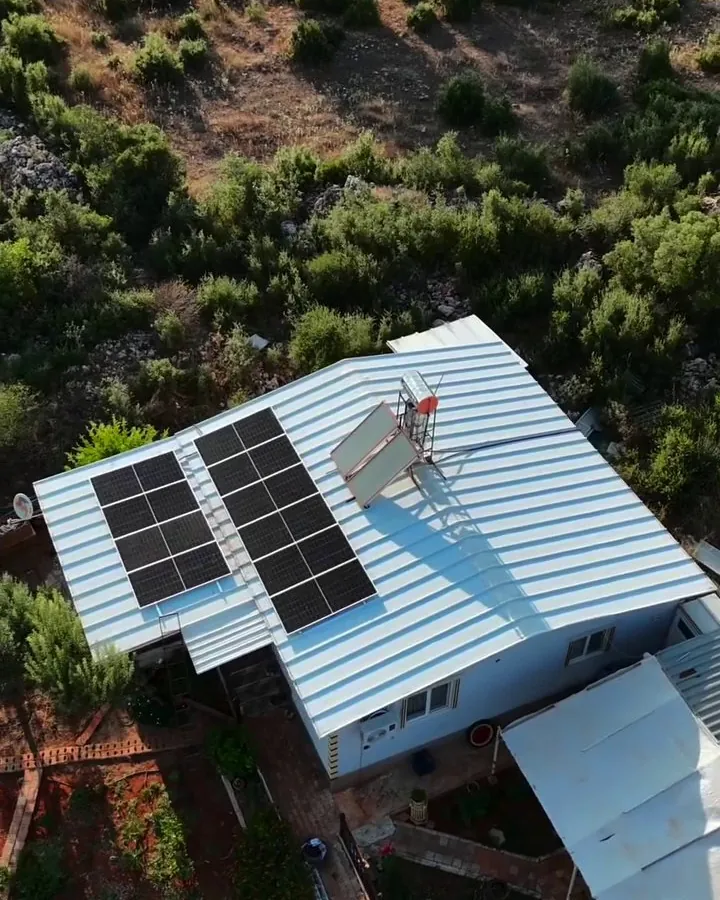
In an off-grid installation shared on Solar Nexo's Instagram account, 10 TommaTech panels of 605 W, an 11 kW off-grid inverter and a 15 kWh LiFePO4 battery were used in Döşemealtı. The panel power comes to 6.05 kWp (10 × 605 W). With PVGIS values, the theoretical daily production is about 19 kWh in December and about 33 kWh in July (6.05 × 3.2 and 6.05 × 5.4, calculation). These are ideal-condition estimates.
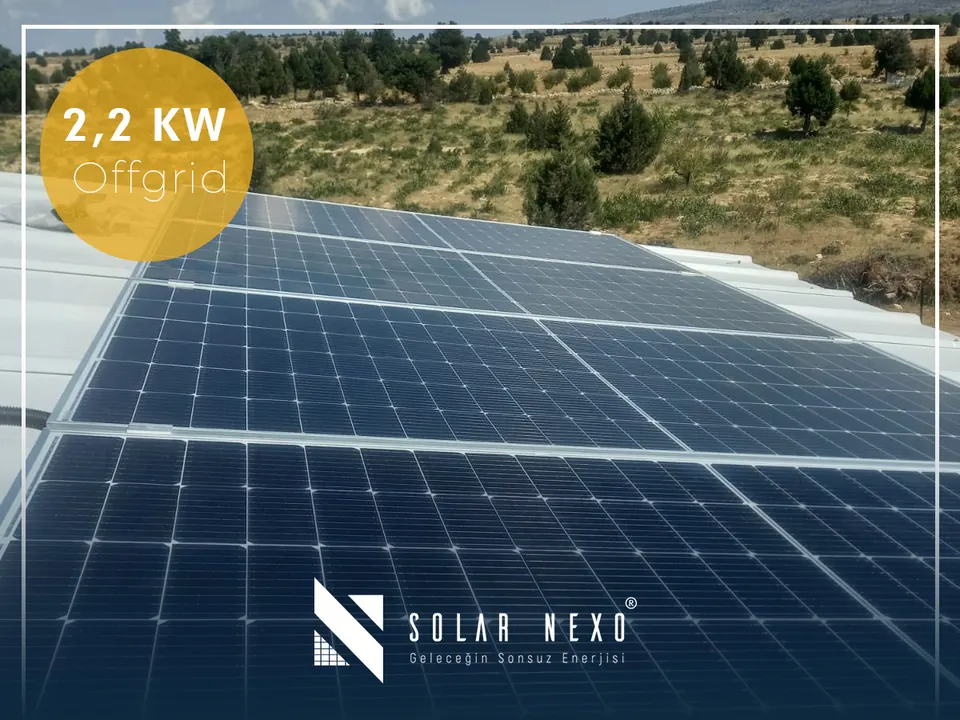
Among the references on the site are also a 2.2 kW compact rural system, a 4.4 kW garden house, a 7.7 kW sea-view residence, 26 kW villas and a 60 kW parallel-inverter lithium battery energy room. The difference in scale between them shows that an off-grid solution can be adapted from a small hut to a large facility.
You can review the options on our off-grid systems page.
The items that determine cost
We give no prices in this article, because cost differs greatly by project. The main items that affect it are:
- Daily energy need and the autonomy period wanted
- Battery capacity and brand
- Inverter power and phase
- Panel count, mounting structure and roof or ground conditions
- Cabling distance, protection elements and earthing
- Additional equipment such as monitoring and a backup generator
For the cost logic with vineyard house and mountain cabin examples, see our article on off-grid system cost.
Off-grid or hybrid?
If the grid is reachable and you experience outages, a hybrid system should be considered instead of off-grid. A hybrid system uses the battery and the grid together; when the battery runs out, the grid steps in. You then do not have to oversize battery and panel capacity for the worst case. An off-grid system is the only option where there is no grid at all or connection is not possible. We compared the two approaches in our article on the hybrid solar energy system.
Operation: monitoring and habits
The operating-side answer to what off-grid solar is, is that the user adapts to the system. User behaviour directly affects the system's life. Running loads such as the washing machine and pump in sunny hours protects the battery. On cloudy, short days consumption must be reduced. A monitoring screen showing the battery's state of charge tells you when to save. Mobile monitoring is especially useful in remote vineyard houses, because production and battery status can be seen remotely.
Regular maintenance is also important. Cleaning panels of dust and pollen, checking connection points and monitoring battery temperature are parts of the annual checklist. Keeping batteries out of extremely hot or cold environments extends their life. In Antalya, technical-room temperature in summer months is important for this reason.
Common mistakes
- Sizing on summer production and falling short in winter
- Not allowing for the starting current of compressors and pumps
- Running the battery in a way that over-discharges it
- Running the air conditioner, washing machine and heater at the same time
- Not installing a monitoring system and noticing a problem late
Most of these mistakes are avoided with correct load analysis and user-habit training. A backup source such as a generator can be added if needed.
Conclusion
To sum up what off-grid solar is: an independent system that meets energy needs with panels and a battery, without the grid. Because solar irradiation is high in Antalya, it is a strong solution in rural and remote places. The key to success is doing the load analysis correctly by choosing the critical month and sizing the battery and inverter appropriately. You can request a free survey for your own location.
Frequently asked questions
What is off-grid solar?
Off-grid is a solar energy system that is not connected to the electricity grid and runs entirely on its own production and battery. The panels produce in the day, the energy is stored in the battery and the inverter converts it into the alternating current used in the home. It is the solution chosen for vineyard houses, plateau houses and rural facilities that the grid does not reach. At the free survey, grid distance and load analysis can be done together for your location.
Do I need to apply to the distribution company for an off-grid system?
Under the Regulation on Unlicensed Electricity Generation, installations with no connection to the transmission or distribution system are exempt from licence and company-formation obligations; a connection approval letter application is therefore not needed. Still, obligations such as zoning, structural and fire matters are separate. We recommend confirming the current position before applying. The regulation is as described as of October 2026 and may change, so the current text should be confirmed.
How many panels does an off-grid system have?
The panel count depends on the daily energy need and the month with the lowest production. For example, for a daily consumption of 7.8 kWh, about 9 kWh of production is needed including battery losses. Since Antalya produces about 3.2 kWh/kWp a day in December, about 2.8 kWp is calculated, that is 5 panels of 605 W. For a real system a load measurement should be made and the result verified at the survey.
How many days does the battery last in an off-grid system?
This depends on battery capacity and consumption. The design sets the autonomy period wanted; for example, for one day, usable energy equal to the daily consumption is needed. The battery's nominal capacity is chosen higher than this. A backup source such as a generator can also be added against the risk of cloudy days coming one after another. Design and operating habits should therefore be planned together.
Can an air conditioner be run on an off-grid system?
Yes, but the sizing must be done accordingly. The air-conditioner compressor's starting current is high and inverter power must be chosen to suit it. In addition, the air conditioner's energy consumption raises the battery and panel count markedly. An efficient inverter air conditioner and a habit of running it in the daytime are therefore recommended. Separate protection and soft-start solutions may be needed for such loads.
How long does an off-grid system's battery last?
Life depends on the battery type, depth of use and temperature. For LiFePO4 batteries, manufacturers declare thousands of cycles, but the figures vary by brand. Warranty periods also differ; for example, in one low-voltage battery series the product warranty is 60 months. Ask for the datasheet and warranty document in writing in the quote. This information is general, and for every system product-specific data should be the basis.
Does an off-grid system produce enough in winter in Antalya?
It does if the system is sized for the winter months. According to PVGIS, production in central Antalya is 99 kWh/kWp in December and January and 108 in February; that is about 60% of the 168 kWh/kWp in July. In off-grid design the month with the lowest production, not summer, is therefore the basis. The gap shows that in winter the system has to be enlarged or consumption reduced.
Sources
- PVGIS - Photovoltaic Geographical Information System (European Commission JRC)
- Regulation on Unlicensed Electricity Generation in the Electricity Market (Official Gazette, 12 May 2019 - original text)
- TommaTech LV Battery Warranty Document
- Amendments to the Regulation on Unlicensed Electricity Generation in the Electricity Market (Official Gazette, 2 April 2026)
Want a clear calculation for your roof?
The Solar Nexo team carries out a free site survey at your address in Antalya and designs the system that suits your roof, consumption and budget.