Short answer
In Kemer, solar panels for mountain houses and highland buildings far from the grid can be installed as an off-grid system. For a mountain house with a daily load of 6 kWh, assuming 2 days of autonomy and a LiFePO4 battery, about 15 kWh of battery and 2-3 kWp of winter-sized panels are needed. The exact size is set by a survey and load measurement.
Key takeaways
- In an off-grid system, what decides is the daily kWh need, not the number of panels.
- According to PVGIS 5.3, production in central Antalya is 99 kWh/kWp in December and 168 kWh/kWp in July.
- A load of 6 kWh/day with 2 days of autonomy means about 15 kWh of LiFePO4 battery (example calculation).
- Off-grid facilities are exempt from licensing and the distribution company application, but zoning and structural matters are assessed separately.
- At high altitude, the choice of mounting structure matters for snow and wind loads.
For solar panels in Kemer, the first decision is whether you will connect to the grid. For highland houses, mountain houses and orchard houses far from the grid, running a pole line is often not sensible. In such places, a battery-backed off-grid system can run the lighting, the refrigerator and the water pump. For villas close to town, a grid-connected or hybrid solution is generally more suitable.
In this article we explain step by step the logic of off-grid design, battery calculation and the points to watch for mountain houses and villas in and around Kemer. The figures are example calculations; real sizing requires an on-site survey and load measurement.
Solar energy in Kemer: when is off-grid the right choice?
Although Kemer's coastal strip is heavily built up, there are buildings far from the grid on the highlands stretching towards the Beydağları mountains and on mountain slopes. For these buildings, a solar energy solution in Kemer follows one of two paths: investing in a transformer and line for a grid connection, or putting that budget into panels, an inverter and a battery.
An off-grid system stands out in the following cases:
- If the grid line is hundreds of metres from the building.
- If the building is used only in certain seasons (highland house, orchard house).
- If there is a small unit for which a power outage is unacceptable (pump, refrigerator, communications equipment).
To see how the system works, you can look at the diagram below.
The basic parts of the system are: solar panels, an inverter that handles charge control, a LiFePO4 battery and a protected distribution panel. For a detailed explanation, take a look at our article on what an off-grid solar energy system is.
The load list: everything starts here
In off-grid design, you start not with the number of panels but by calculating your daily energy need. Multiply each appliance's power (W) by its daily running hours and add them up. Appliances with a high starting and surge current, namely the refrigerator, water hydrophore and deep freezer, determine the inverter power.
An example daily list for a mountain house might look like this:
| Appliance | Power | Daily duration | Daily energy |
|---|---|---|---|
| A+++ refrigerator (average) | 60 W | 24 hours (cycling) | about 0.8 kWh |
| LED lighting | 100 W | 5 hours | 0.5 kWh |
| Water hydrophore | 750 W | 1 hour | 0.75 kWh |
| Television and internet | 150 W | 5 hours | 0.75 kWh |
| Washing machine, iron, small household appliances | various | - | about 3 kWh |
| Total | about 6 kWh/day |
When electric heating, air conditioning or a pool pump is added, this total grows quickly. Using wood, pellets or another fuel instead of electricity for heating shrinks the size of an off-grid system considerably.
Battery sizing: autonomy and depth of discharge
The battery bridges the hours without sun and cloudy days. Two concepts apply in the calculation: days of autonomy (how many days the system will last without sun) and usable depth of discharge. For LiFePO4 batteries, manufacturers declare a high depth of discharge, but the value varies by product; the datasheet should be checked.
For the 6 kWh/day load above, assume 2 days of autonomy and about 90% usable capacity:
- 6 kWh × 2 days = 12 kWh of usable energy
- 12 / 0.9 = about 13.3 kWh of nominal capacity
- Adding about 8-10% for inverter and cable losses, the target is 14.5-15 kWh
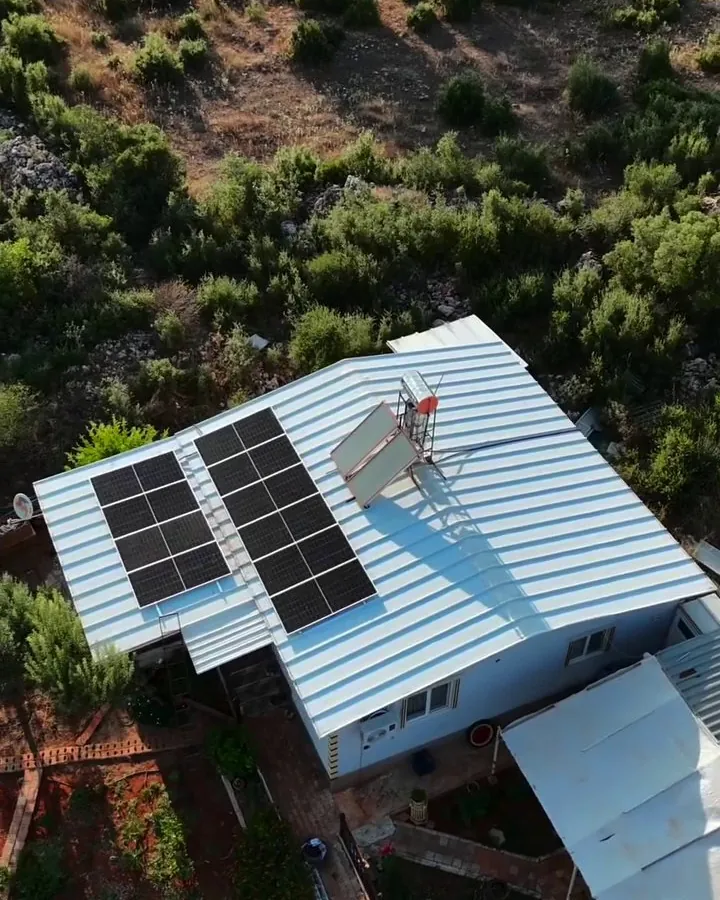
This approach is of a similar scale to the Döşemealtı off-grid installation Solar Nexo shared on Instagram: 10 TommaTech 605 W panels, an 11 kW off-grid inverter and a 15 kWh LiFePO4 battery. For a broader cost framework, you can look at our article on off-grid system cost.
Panel power and winter production
An off-grid system is sized for its weakest month, because even if the battery overflows in summer, the system is useless if it falls short in winter. According to PVGIS 5.3 data, production in central Antalya in December is 99 kWh/kWp, that is, about 3.2 kWh/kWp per day. In July this value is 168 kWh/kWp (about 5.4 kWh/kWp per day). We do not give a separate PVGIS value for Kemer; the central Antalya value is a reasonable reference for areas near the coast. On highlands and mountain slopes, shade, cloud and altitude effects can change this value.
For a winter day, with a 6 kWh load and about 90% battery round-trip efficiency, the calculation is:
- 6 / 0.9 = 6.7 kWh of production needed
- 6.7 / 3.2 = about 2.1 kWp
With 605 W panels, this is 4 panels (2.42 kWp). In reality, 5-6 panels are preferred to leave a safety margin; this makes it easier for the battery to fill during cloudy winter weeks. Every project is different: shading, orientation and tilt calculations are made at the survey.
Inverter, cable and mounting
The inverter must be able to handle both the total load and the starting current of motor loads. Motor appliances such as the hydrophore and refrigerator can momentarily draw several times their nominal power. For this reason, inverter power is chosen higher than the sum of appliance power.
The main points to watch in mounting:
- Ventilation: Air circulation must be left behind the panel; the TommaTech datasheet requires the panel to be mounted on a fire-resistant surface with adequate ventilation.
- Wind and snow load: The datasheet resistance of a 605 W TOPCon panel is 2400 Pa for wind and 5400 Pa for snow. At high altitude the snow load may be greater than in central Antalya, and the mounting structure should be chosen accordingly.
- Battery location: The battery should be kept in a ventilated area without extreme heat or freezing risk.
- Cable cross-section: As the distance between panels and inverter grows, voltage drop increases; the cross-section is calculated accordingly.
Regulation and permits: what else should you ask about?
The regulation exempts generation facilities that have no connection to the transmission or distribution system from the obligation to obtain a licence and set up a company. That is, for an off-grid system you do not need to make a connection approval letter (çağrı mektubu) application to the distribution company. However, this does not mean "not subject to any permit": matters such as zoning, structure and fire safety are assessed separately. You need to find out in advance your building's land type, permit status and the requirements of the municipality or the relevant authority.
Storage and equipment rules are also separate for grid-connected systems. Before deciding on off-grid, also compare the cost of connecting your building to the grid and the hybrid option; the process and application areas are summarised on our off-grid systems service page.
Common mistakes in off-grid installations
In systems without a grid, most problems come not from equipment but from design assumptions. The most common mistakes are:
- Sizing for summer: Seeing 168 kWh/kWp production in July and choosing the number of panels accordingly leaves the battery empty in December.
- Forgetting the starting current: If the inverter goes into protection while the hydrophore or deep freezer is running, the system shuts down.
- Discharging the battery completely: Regular very deep discharge shortens battery life; set the BMS (battery management system) according to the manufacturer's recommendation.
- Underestimating shade: Slope or tree shade has a much longer effect when the winter sun is low.
- Not planning a backup source: Planning a backup such as a generator for long cloudy periods can be more economical than oversizing the battery unnecessarily.
All of these mistakes are prevented when the load and usage calendar are drawn up correctly at the survey. Calculating the winter scenario and the cloudy-week scenario separately at the design stage shows in advance whether the system will meet your expectations through the year.
What is measured at the survey?
At a survey for a mountain house, the following data are collected: roof or land orientation, tilt, shade sources (trees, slope, neighbouring structures), cable distance, the existing appliance list and the usage calendar through the year. The system design for a highland house used only in summer and for a house lived in year-round are very different. You can request our free site survey process and next steps through our contact page.
Conclusion
For buildings far from the grid in Kemer, off-grid solar energy is a reliable solution when correctly sized. Draw up the load list, choose the days of autonomy, set the panel power for winter and choose the inverter for the motor loads. Do not guess the figures; settle them with an on-site survey and an engineering calculation. You can also use our solar energy calculator page as a calculation tool.
Frequently asked questions
Can solar panels be installed on a mountain house without grid power in Kemer?
Yes, they can. A system with panels, an off-grid inverter and a LiFePO4 battery feeds loads such as lighting, the refrigerator and the pump without needing the grid. What matters for uninterrupted operation is calculating your daily energy need correctly and sizing the system for the production of the winter month. An on-site survey settles matters such as shade, orientation and cable distance; then the panels, inverter and battery are chosen together.
Is an application to the distribution company needed for an off-grid system?
Generation facilities with no connection to the grid are exempt in the regulation from the obligation to obtain a licence and set up a company; no connection approval letter (çağrı mektubu) application is made to the distribution company, so there is no application wait. However, this does not mean no permit is needed. For matters such as zoning, structure and fire safety, you need to consult the municipality or the relevant authority.
How many kWh of battery does a mountain house need?
Battery capacity depends on daily consumption and the number of days of autonomy you want. For example, for 6 kWh/day of consumption and 2 days of autonomy, 12 kWh of usable energy is needed. With about 90% usable capacity and system losses, this corresponds to 14.5-15 kWh of nominal capacity. The real value varies with the product datasheet and battery brand; be sure to read the warranty terms too.
Does an off-grid solar system produce enough energy in winter?
Production falls in winter, but the system is designed with this in mind. According to PVGIS 5.3, production in central Antalya in December is 99 kWh/kWp, that is, about 3.2 kWh/kWp per day. Panel power is chosen on this value and a safety margin is added. The effects of high altitude, cloud and shade should be assessed separately at the survey.
Can electric heating be run on an off-grid system?
Technically it is possible, but the energy need grows very large. When an electric heater runs for hours, the daily load rises several times over, which sharply raises panel and battery cost; and because production is also low on winter days, the system is strained. In most mountain houses, meeting heating with another source such as wood or pellets gives a more sensible design.
Should I choose off-grid or hybrid?
If the grid is a reasonable distance from the building and you experience outages, a hybrid system can be a good choice; it uses a battery together with the grid. If the grid is very far or absent, off-grid is more suitable. The decision is assessed together at the survey according to connection cost, frequency of use and load profile. The investment items for the two options should be shown separately in the written quote.
Does Solar Nexo do surveys in Kemer?
Solar Nexo is an Antalya-based company and offers a free site survey. At the survey, the roof or land, shade, cable distance and appliance list are examined. You can send your survey request for Kemer and the surrounding area by telephone, e-mail or the contact page; the visit plan is settled according to your request. Preparing your appliance list and the building's location before the survey speeds up the process.
Sources
Want a clear calculation for your roof?
The Solar Nexo team carries out a free site survey at your address in Antalya and designs the system that suits your roof, consumption and budget.