Short answer
Off-grid solar system cost cannot be given as one figure; it is set by your daily energy use (load list), the days of autonomy you want, battery capacity, inverter power and site conditions. For a vineyard house or mountain cabin in Antalya, the right order is load list, panel power sized on winter output, then battery sizing; an exact amount comes only from an on-site survey.
Key takeaways
- The main driver of off-grid cost is daily energy consumption (kWh) and the days of autonomy; the battery is usually the largest item.
- Panel power is calculated on the winter value: per PVGIS, 1 kWp in Antalya produces about 3.2 kWh a day in December and about 5.4 kWh in July.
- For an example vineyard house (3.35 kWh/day, 2 days of autonomy), about 1.8 kWp of panels and an 8 kWh-class battery can be considered (hypothetical calculation).
- Off-grid installations are exempt from licence and company-formation obligations; zoning, structural and fire obligations are separate. It is not correct to say that 'no permit is needed'.
- Solar Nexo's website lists off-grid references from a 2.2 kW compact rural system to a 26 kW villa with batteries.
The honest answer on off-grid solar system cost is this: there is no single figure, because the cost of a system independent of the grid is set by your daily energy consumption, how many days you want it to run without charging and the conditions of the site. For a vineyard house or mountain cabin, the right approach is first to calculate consumption and then to size the panels and battery to that consumption. In this article we work through an example calculation step by step with Antalya data and explain the cost items. The appliance values in the example are assumptions; you should replace them with the label values of your own appliances.
What does off-grid solar system cost depend on?
In a grid-connected system there is no battery, so cost mostly consists of panels and inverter. In an off-grid system, because there is no grid support, the battery and a higher-capacity inverter come to the fore. The table below summarises the items and their effect on cost; we give no amounts.
| Item | Effect on cost | Decision variable |
|---|---|---|
| Battery (LiFePO4) | Usually the highest-weight item | Daily consumption x days of autonomy |
| Off-grid inverter | According to simultaneous load and motor starting current | Loads such as pump, refrigerator, air conditioner |
| Panels | Determined by winter production | Daily production in the winter month |
| Mounting structure and cable | Depends on roof or ground mounting | Site, wind and snow conditions |
| Protection and panel board | Needed for safety | Earthing, fuses, surge protection |
| Installation and access | Varies with road and terrain difficulty | How equipment is transported to the site |
| Backup source (optional) | Extra cost for long cloudy periods | Days of autonomy and critical loads |
Having items written separately in an off-grid solar system cost quote lets you see how much each component adds. We explained how to read general price items in our article on solar panel prices. For the basic logic of an off-grid system, see our article on what an off-grid solar energy system is.
Step 1: Draw up a load list
Sizing starts with the question "how much energy do I use?" The list below is an entirely hypothetical example for a small vineyard house; read appliance power from their labels.
| Appliance | Power / use | Daily energy |
|---|---|---|
| LED lighting | 10 x 8 W x 5 hours | 0.40 kWh |
| Refrigerator | per energy label (example assumption) | 1.00 kWh |
| Television | 100 W x 4 hours | 0.40 kWh |
| Water pump (booster) | 750 W x 1 hour | 0.75 kWh |
| Washing machine | daily average | 0.50 kWh |
| Phone, computer charging | daily average | 0.30 kWh |
| Total | 3.35 kWh/day |
Also note the loads that can run at the same time. Motor-driven appliances (pump, refrigerator compressor) can draw several times their nominal power at start-up; the inverter must withstand this starting current. Inverter power is therefore not chosen only from the total wattage of the appliances.
Step 2: Calculate panel power on the winter value
Because an off-grid system runs without grid support, panel power is set by the month with the lowest production. According to PVGIS, 1 kWp in central Antalya produces 99 kWh in December; that is about 99 ÷ 31 = 3.19 kWh/kWp a day. In July it produces 168 kWh, about 5.42 kWh/kWp a day. Hypothetically, let us take the total efficiency of the path from panel to battery and load as 85% (this value is an additional-loss assumption representing storage losses on top of PVGIS's 14% system loss; the real value varies with equipment).
Required power = 3.35 ÷ (3.19 x 0.85) = about 1.24 kWp. With 605 Wp panels the options are as follows:
| Panel count | Power | December daily energy | July daily energy | Winter margin for 3.35 kWh |
|---|---|---|---|---|
| 2 panels | 1.21 kWp | about 3.3 kWh | about 5.6 kWh | borderline, insufficient on a cloudy day |
| 3 panels | 1.82 kWp | about 4.9 kWh | about 8.4 kWh | adequate margin |
| 4 panels | 2.42 kWp | about 6.6 kWh | about 11.2 kWh | ample margin, surplus production in summer |
In this example, 3 panels leave a reasonable margin for cloudy days in winter. In Antalya the number of rainy days a year is about 73 and most of the rain falls between November and February (MGM, the Turkish State Meteorological Service); that is, the panel margin is needed precisely for these months. You can see the monthly production distribution in the PVGIS chart.
Step 3: Battery and autonomy
Autonomy is how many days the system can run without sun. Nominal battery capacity is found with the formula daily consumption x autonomy ÷ (usable depth x efficiency). Example assumptions: depth 90%, battery and inverter efficiency 95%. Update these values with the datasheet of the brand you choose.
| Autonomy | Usable energy | Nominal capacity |
|---|---|---|
| 1 day | 3.35 kWh | about 3.9 kWh |
| 2 days | 6.70 kWh | about 7.8 kWh |
| 3 days | 10.05 kWh | about 11.8 kWh |
For two days of autonomy, an 8 kWh-class battery can be considered; because each extra day of autonomy enlarges the battery item, this is the decision that affects cost the most. For battery details and warranty conditions, see our article on solar systems with batteries. For very long cloudy periods, a small backup source (for example a generator) can sometimes be more economical than enlarging the battery.
Special points for vineyard houses and mountain cabins in Antalya
In vineyard and mountain houses around the Kemer plateaus, Elmalı, Korkuteli and Döşemealtı, there is either no grid connection or it is very expensive. In such places, off-grid must be compared with the cost of a grid pole and line: the distance to the nearest transformer and pole, excavation and permit processes affect the total cost. When making the comparison, also account for the system's twenty-five-year life and the battery's replacement need.
On plateaus, roof and structure loads should be assessed separately. In MGM's Antalya data, the highest snow depth is recorded as 5 cm and the fastest wind as 43.2 m/s; however, plateau and high-altitude conditions can differ from the provincial centre and a local load calculation is needed. The panel datasheet states a wind load of 2400 Pa and a snow load of 5400 Pa. The panel must be mounted on a fire-resistant surface with sufficient ventilation left behind it. The battery location is also important: spaces that are very hot or very cold, or poorly ventilated, can harm battery life and performance; check the manufacturer's operating temperature range. For Kemer and its surroundings, see our article on off-grid solar energy in Kemer.
Solar Nexo's off-grid references
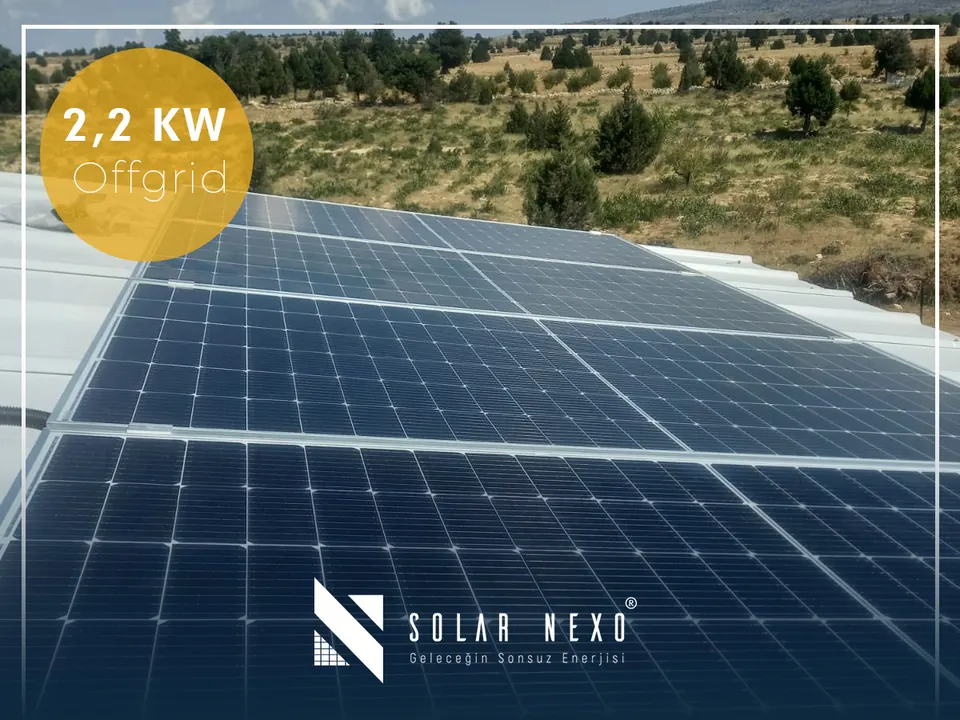
The off-grid references on Solar Nexo's website range from small scale to villa scale: a 2.2 kW off-grid compact rural system, a 4.4 kW off-grid garden house, a 7.7 kW off-grid sea-view residence, a 26 kW off-grid villa with batteries and a 60 kW off-grid parallel-inverter lithium battery energy room. In the Döşemealtı installation shared on Instagram, 10 TommaTech panels of 605 W (6.05 kWp), an 11 kW off-grid inverter and a 15 kWh LiFePO4 battery were used. These examples are not copies of one another; each was designed to its owner's load list. For details, see our off-grid systems service page. For a hybrid alternative, our article on hybrid solar energy in Döşemealtı will be useful.
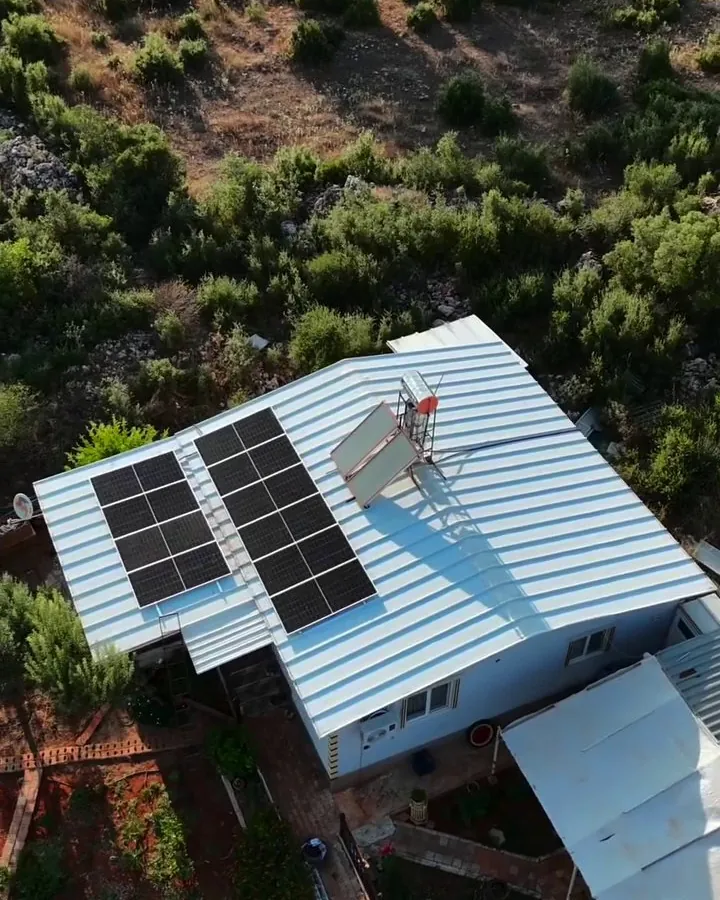
Consider an example scenario too: in a vineyard house used at weekends, weekday consumption is very low, the time the battery sits empty lengthens and surplus energy is wasted once the panels have filled the battery. A smaller system may be enough for such use; conversely, in a home lived in all year round, consumption is continuous, so sizing on the winter value is essential. Stating your frequency of use clearly at the survey keeps you from paying for unnecessary capacity. Treating seasonal loads such as an irrigation pump as a separate calculation also keeps you from choosing the main system larger than needed.
Regulation: what obligations apply to an off-grid system?
Article 5/1/b of the Regulation on Unlicensed Electricity Generation exempts generation facilities with no connection to the transmission or distribution system from licence and company-formation obligations. This means that the application to the distribution company and the connection approval letter (çağrı mektubu) process are not required; however, it has not been verified that the installation is "subject to no permit whatsoever". Obligations such as zoning, structural and fire matters are separate issues. You therefore need to get information from the local authority on the building, land type and the requirements of the municipality or relevant institution. Because regulations change often, verify the current conditions before applying.
Conclusion
What sets off-grid solar system cost is less a single per-kW figure than your daily energy consumption and your autonomy expectation. If you follow the order of load list first, then panel power on winter production, then battery and inverter selection, you avoid unnecessary investment. Our example calculation only shows the method; for your own system, at Solar Nexo's free survey we can assess your load list and your land together.
Frequently asked questions
How much does an off-grid system for a vineyard house cost?
It is not possible to give a single figure; cost is set by your daily energy consumption, days of autonomy, battery capacity, inverter power and site conditions. The right approach is to draw up a load list and then size the panels, battery and inverter to that list. An exact amount is set by a written quote based on an on-site survey; do not rely on figures given over the phone.
What is the most expensive item in an off-grid system?
It is usually the battery, because with no grid support its capacity grows with daily consumption and days of autonomy. The inverter and panels are also significant items; however, a small change in battery capacity affects the total more. Because each extra day of autonomy raises battery capacity, the decision that most affects cost is the autonomy period; choose the number of days you need realistically.
How many panels and how many kWh of battery does a mountain cabin need?
It depends on daily consumption. With the example assumption, for a home consuming 3.35 kWh/day, about 1.2-1.8 kWp of panels on the winter value and an 8 kWh-class battery for two days of autonomy can be considered. The real need should be calculated from your own load list and the datasheet values of the chosen equipment; large loads such as a washing machine or pump change the result markedly.
Does an off-grid system produce enough energy in winter?
It does, but less than in summer. According to PVGIS, 1 kWp in Antalya produces about 3.2 kWh a day in December and about 5.4 kWh in July. Panel power in an off-grid system is therefore chosen on the winter value, leaving a margin for cloudy days. A backup source can also be considered for long cloudy periods; however, this brings extra cost and maintenance.
Is a permit or application needed for an off-grid system?
Off-grid installations are exempt from licence and company-formation obligations and no distribution company application is needed; however, 'no permit is needed' is not a correct statement. Obligations such as zoning, structural and fire matters are separate. Depending on the condition of your land and building, you need to get current information from the local authority and the municipality; learning this before getting a quote saves time.
Is off-grid or a grid connection more economical?
If a grid pole and line are close, a grid-connected system usually requires a lower investment. In places far from the grid, line, excavation and permit costs must be compared with off-grid. The decision should be made on distance, consumption and the system's lifetime cost; at the survey the two alternatives can be calculated together and compared in writing.
Can a generator be added to an off-grid system?
Yes, it can. For long cloudy periods a small generator can sometimes be more economical than greatly enlarging the battery. This also brings fuel cost, maintenance needs and issues such as noise; the generator should therefore be planned as a backup source, not the main solution. Your backup requirement should be firmed up with an engineering calculation based on your days of autonomy and critical loads.
Sources
Want a clear calculation for your roof?
The Solar Nexo team carries out a free site survey at your address in Antalya and designs the system that suits your roof, consumption and budget.