Short answer
A TOPCon panel is an n-type solar panel technology whose cell contact is passivated with a tunnel oxide and doped polysilicon. In datasheet examples, it shows a lower temperature coefficient than PERC (−0.30 and −0.340 %/°C) and slower degradation. In Antalya's hot summers, this difference reduces the midday production loss by about 1.6 points.
Key takeaways
- TOPCon uses n-type silicon and a tunnel oxide contact; PERC is mostly p-type silicon.
- In the datasheet examples reviewed, the Pmax temperature coefficient is −0.30 %/°C for TOPCon and −0.340 %/°C for PERC.
- At a cell temperature of 65 °C, the power loss is about 12% (TOPCon) and 13.6% (PERC) (calculation).
- For the TommaTech TT605-144TN10, the manufacturer states a 15-year product and a 30-year performance warranty.
- In an unlicensed application, the panel must have been manufactured within the last five years (April 2026 amendment).
A TOPCon panel is a solar panel technology based on n-type silicon whose rear-side cell contact is passivated with a thin tunnel oxide and a doped polysilicon layer. In other words, a TOPCon panel is the lower-loss successor to the older-generation PERC panel. In a province like Antalya, where summers reach an average maximum of 34 °C, its main advantages are a low temperature coefficient and slower annual power loss.
What is a TOPCon panel and what changes inside the cell?
TOPCon is short for "Tunnel Oxide Passivated Contact". On the rear face of the cell there is a silicon oxide layer a few nanometres thick, and on top of it doped polysilicon. This structure lets electrons pass while reducing the loss of charge carriers at the metal contact. Because loss is reduced, the cell produces a higher voltage in the same light.
Another difference is the type of silicon. Most PERC cells use p-type (boron-doped) silicon. TOPCon, on the other hand, works with n-type (phosphorus-doped) silicon. In n-type material, light-induced degradation (LID) in the first hours stays lower; for this reason the guaranteed first-year power value written in manufacturers' datasheets is higher.
To picture this distinction, you can look at the panel's layered structure in the diagram below.
TOPCon vs PERC: what do the datasheets say?
When comparing technologies, you need to look at product catalogues published by manufacturers rather than marketing claims. The table below puts the datasheet values of one large manufacturer's TOPCon bifacial model side by side with another manufacturer's PERC bifacial model. This is a comparison of only two models; do not generalise to all TOPCon and PERC products.
| Feature | TOPCon example | PERC example |
|---|---|---|
| Pmax temperature coefficient | −0.30 %/°C | −0.340 %/°C |
| Bifaciality (rear-side ratio) | 80% ± 5 | 70% ± 5 |
| First-year degradation | 1% (year 1: 99%) | less than 2% |
| Annual degradation (years 2-30) | 0.40% | 0.45% |
| Guaranteed power in year 30 | 87.4% | 84.95% |
| Highest module efficiency | 21.68-22.45% | 21.5% |
The differences in the table may look small, but they accumulate over a thirty-year operating life. At the same time, what really determines the return on investment is not the panel's label power but the energy it actually delivers to the grid or the home in every sunny hour.
Temperature coefficient: why does it matter in an Antalya summer?
A solar panel is tested at a cell temperature of 25 °C and an irradiance of 1000 W/m² (STC). On a real roof, the cell rises far above ambient temperature. In Antalya, according to Turkish State Meteorological Service (MGM) data, the average maximum temperature in July is 34.2 °C and the record value has reached 45.0 °C.
A simple calculation using the NOCT approach (a calculation, not a measurement) goes like this: cell temperature ≈ ambient temperature + (NOCT − 20) / 800 × irradiance. Taking ambient 34 °C, irradiance 1000 W/m² and NOCT 45 °C, the cell is at about 65 °C. That is 40 °C above STC.
- In a TOPCon panel with a −0.30 %/°C coefficient, the power loss is about 12%.
- In a PERC panel with a −0.340 %/°C coefficient, the power loss is about 13.6%.
This difference of about 1.6 points shows up in the intense midday production period. In Antalya, June to August are the strongest production months of the year, at 159, 168 and 167 kWh/kWp a month according to PVGIS data; the temperature coefficient pays off in exactly these months.

Bifacial and degradation: TOPCon's long-term advantage
The TOPCon cell structure suits bifacial modules that also collect light from the rear face. In the example above, the TOPCon model's bifaciality is 80% ± 5 and the PERC model's is 70% ± 5. Even so, rear-side gain on a roof is limited; the real benefit of the rear face depends on ground reflectivity (albedo) and the panel's height above the ground. You can look at our bifacial double-sided panel article, where we cover this topic in detail.
On degradation, real behaviour in the field can differ from the datasheet. In the 2012 literature review by the US National Renewable Energy Laboratory (NREL), median degradation for modules in the field was found to be 0.5% a year. This is an old study and covers older-generation modules. New-generation n-type modules are expected to stay below this value in the field, but until long-term field data confirms it, this should not be presented as a firm conclusion.
The TommaTech 605 W TOPCon example used by Solar Nexo
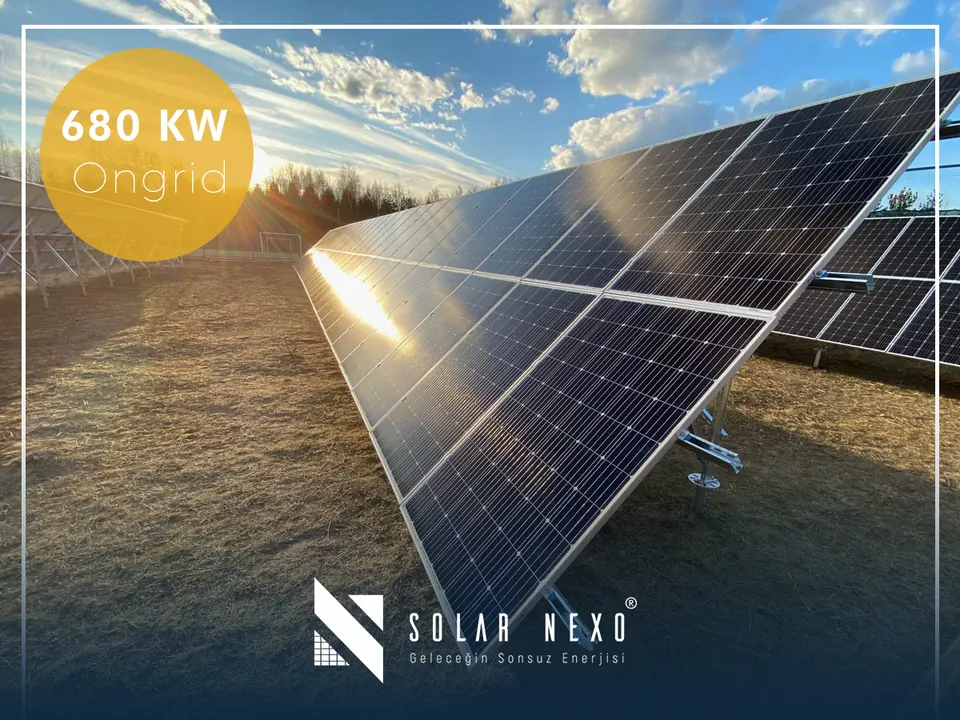
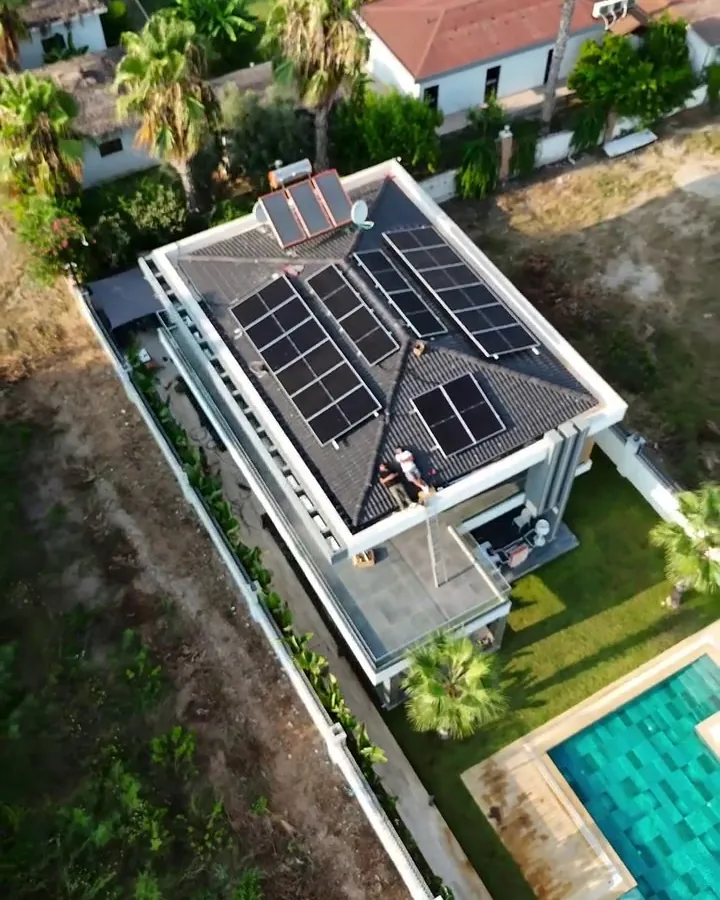
The residential installations Solar Nexo shared on its Instagram account (@solarnexotr) use 605 W TommaTech TOPCon panels. The shared installations are as follows:
- Döşemealtı: 36 panels of 605 W, a 20 kW hybrid inverter and a 30 kWh LiFePO4 battery.
- Manavgat: 20 panels of 605 W, a 15 kW hybrid inverter and a 15 kWh LiFePO4 battery.
- Belek: 24 panels of 605 W, a 20 kW hybrid inverter and a 15 kWh LiFePO4 battery.
- Döşemealtı: 10 panels of 605 W, an 11 kW off-grid inverter and a 15 kWh LiFePO4 battery.
According to the manufacturer's TT605-144TN10 datasheet, the values for this single-sided, half-cut n-type TOPCon model are: 605 Wp maximum power, 23.42% module efficiency, 52.58 V open-circuit voltage, 14.48 A short-circuit current and a −0.30 %/°C power temperature coefficient. Maximum system voltage is 1500 V DC and operating temperature is between −40 and +85 °C.
The mechanical side matters for Antalya conditions too. The panel measures 2278 × 1134 × 35 mm and weighs 29 kg; wind load resistance is stated as 2400 Pa and snow load resistance as 5400 Pa. In MGM records the greatest snow depth in Antalya is 5 cm; so snow load is not a design-determining factor in this region.
On the warranty side, the manufacturer gives a 15-year product warranty and a 30-year performance warranty. The linear performance curve starts at 99% in the first year and falls to 87.4% in year 30; that means a drop of about 0.4% a year (calculation). On the glass-glass G2G model, the product warranty is 25 years. So the sentence "panels have a 25-year product warranty" is not true for every model.
Example production calculation
The 20 panels in the Manavgat example come to 12.1 kWp (20 × 605 W). According to PVGIS 5.3 data, annual specific yield in Manavgat at optimum tilt facing south is 1,649 kWh/kWp (assuming 14% system loss). That gives a theoretical production band of about 20,000 kWh for the first year. The real value varies with shading, roof pitch, orientation, soiling and inverter choice. For Antalya as a whole you can look at our how much electricity do solar panels produce in Antalya article.
What to look at when choosing a TOPCon panel
The name of the technology alone is not a sufficient quality measure. When comparing quotations, check the following items:
- Datasheet currency: The panel's exact model code and datasheet version should be written in the quotation.
- Temperature coefficient: Because summer temperatures are high, around −0.30 %/°C or better is preferred.
- Warranty distinction: The product warranty (for example 15 years) and the performance warranty (for example 30 years) should be written separately.
- Manufacturing date: Under the unlicensed generation regulation, main equipment such as the panel, inverter and battery must have been manufactured within the last five years (the amendment dated 2 April 2026).
- Installation conditions: According to the datasheet, the panel must be mounted on a fire-resistant surface with enough ventilation left behind it. Installation contrary to the manual ends the warranty.
On roof types such as tile, trapezoidal sheet and concrete terrace, the supporting system and mounting feet are assessed separately. If you want to find out which panel suits your roof, you can use the solar energy calculation tool or contact us for a free site survey. Because regulation changes often, we recommend confirming the rules valid as of October 2026 with the distribution company before applying.
Conclusion
With a lower temperature coefficient, lower annual degradation and higher bifaciality values, a TOPCon panel offers measurable advantages over PERC. These advantages are visible in the datasheets of the two models and gain meaning in Antalya's hot summer months. Even so, a panel's power and technology deliver results when combined with correct sizing, proper installation and a quality inverter. When deciding, look not at a single label but at the product's full datasheet and warranty terms.
Frequently asked questions
What is the basic difference between a TOPCon panel and a PERC panel?
A TOPCon panel uses a tunnel oxide and doped polysilicon contact on n-type silicon, whereas a PERC panel mostly works on p-type silicon. In the datasheet examples reviewed, TOPCon has a better temperature coefficient, degradation rate and bifaciality. This comparison belongs to two models and may not hold for every product.
Are TOPCon panels more advantageous in Antalya's hot weather?
Yes, they offer an advantage, but a limited one. The Pmax temperature coefficient is −0.30 %/°C in the TOPCon example and −0.340 %/°C in the PERC example. At summer midday, when the cell reaches about 65 °C, power loss is about 12% against 13.6%. This calculation is based on the NOCT approach and is not a measurement; the real difference can vary with roof type, ventilation and wind.
How many years is the warranty on a 605 W TOPCon panel?
According to the TommaTech TT605-144TN10 datasheet, the single-sided model has a 15-year product warranty and a 30-year performance warranty. Power is guaranteed at 99% in year 1 and 87.4% in year 30. On the glass-glass G2G model the product warranty is 25 years. Check the warranty terms together with the exact model code in the quotation and ask in writing for the difference between product and performance warranty.
Does a TOPCon panel give bifacial gain on a roof?
Rear-side gain on a roof is generally limited, because little reflected light reaches the back of the panel. Bifacial gain depends on ground reflectivity and panel height. Ground-mounted plants and carport applications are more suitable. For this reason the extra cost and expected benefit of a bifacial model should be calculated project by project, according to roof or land conditions.
Does the manufacturing date of a TOPCon panel matter in an unlicensed application?
Yes. Under the amendment to the Unlicensed Electricity Generation Regulation dated 2 April 2026, main equipment such as the panel, inverter and battery must have been manufactured within the last five years. An application cannot be made with old or second-hand panels. Because regulation changes often, confirm the current rule before applying with AEDAŞ, the distribution company in Antalya, or your installer.
About how much do 20 panels of 605 W produce in a year in Antalya?
Twenty 605 W panels come to 12.1 kWp. According to PVGIS 5.3 data, annual specific yield in Manavgat at optimum tilt facing south is 1,649 kWh/kWp, which means a theoretical production of about 20,000 kWh. The real value varies with shading, orientation, tilt, soiling and inverter choice; for this reason a roof-specific calculation is made at the survey.
Is a TOPCon panel suitable for every roof?
Panel technology works independently of roof type, but the roof's load-bearing capacity and surface material must be assessed separately. According to the datasheet, the panel must be mounted on a fire-resistant surface with ventilation left behind it. On surfaces such as plastic or PVC, installation must not be done without a protective layer. Roof type and structural condition are always checked during the survey.
Sources
- TommaTech TOPCon n-type TT605-144TN10 datasheet
- TommaTech G2G bifacial TT605-144TNB10 datasheet
- Jinko Tiger Neo 72HL4-BDV datasheet
- NREL: Photovoltaic Degradation Rates, An Analytical Review
- Turkish State Meteorological Service (MGM), Antalya statistics
- PVGIS (European Commission JRC)
- Official Gazette, 2 April 2026 amendment to the Unlicensed Electricity Generation Regulation
Want a clear calculation for your roof?
The Solar Nexo team carries out a free site survey at your address in Antalya and designs the system that suits your roof, consumption and budget.