Short answer
Solar panel soiling is dust, pollen, sand, salt and bird droppings building up on the surface and reducing output. In Antalya, according to MGM, most rain falls between November and February, and July and August have only about 0.5 rainy days per month, so dirt accumulates in summer. A steeper tilt makes rain-cleaning easier; comparing output before and after rain reveals soiling.
Key takeaways
- According to MGM, annual rainfall in Antalya is about 1,032 mm over about 73 rainy days; rain is concentrated between November and February.
- July and August have about 0.5 rainy days per month; dirt builds up most in the dry period when production is high.
- According to PVGIS, July is 168 and August 167 kWh/kWp; summer soiling costs more kilowatt-hours.
- Water and dirt collect on low-tilt and flat roofs; the optimum tilt for central Antalya is 33°.
- A jump in output after rain and a difference between parallel strings are signs of soiling.
Solar panel soiling is a condition in which dust, pollen, sand, salt and bird droppings build up on the panel surface, reducing the light that reaches the cells and lowering production. Because rainfall in Antalya is concentrated in winter and there is almost no rain through the summer, soiling follows a seasonal pattern. In this article we describe the sources of dirt, the role of tilt, how to notice it in monitoring data and the measures you can take.
Why is solar panel soiling seasonal in Antalya?
According to Turkish State Meteorological Service (MGM) data for 1930-2025, total annual rainfall in Antalya is about 1,032 mm over about 73 rainy days, and most of it falls between November and February. The average number of rainy days in July and August is about 0.5 per month. So the panels are washed naturally all winter, but soiling builds up in the dry period from May to October.
The dry season is also when production is highest. According to PVGIS, 168 kWh/kWp in July and 167 kWh/kWp in August are expected in Antalya. Summer soiling is therefore more expensive than winter soiling: the same percentage loss corresponds to more kilowatt-hours in the high-production months. However, giving an exact loss percentage would be misleading; factors such as the type and thickness of the dirt and the tilt determine the result.
Sources of dirt: dust, pollen, sand, salt and more
Dust and sand
Roofs close to dirt roads, construction sites and areas where fields are ploughed produce fine dust. In rural and agricultural areas, for example around Korkuteli and Elmalı or in the open land of Döşemealtı, dust build-up can be more pronounced than in the city centre. In some years, fine dust carried from distant regions in summer and spring also leaves a thin layer on surfaces.
Pollen and plant residue
In the spring flowering period, especially on roofs near pine, olive and citrus groves, pollen and resin form a sticky film on the surface. Without rain, this film traps dust and builds up in layers.
Sea salt
In coastal areas such as Kemer, Alanya, Kaş and Kalkan, sea salt is carried from the air onto surfaces. When it dries it leaves a white residue; besides surface cleaning, the corrosion resistance of the metal structure and fasteners also matters.
Bird droppings and greenhouse-area dirt
Bird droppings are a local stain, but when one shades a single cell, the whole string that cell belongs to can be affected. In greenhouse regions (Kumluca, Finike, Demre), greenhouse plastic, fertiliser and spraying residues can also stick to the panel surface.
How does tilt affect soiling?
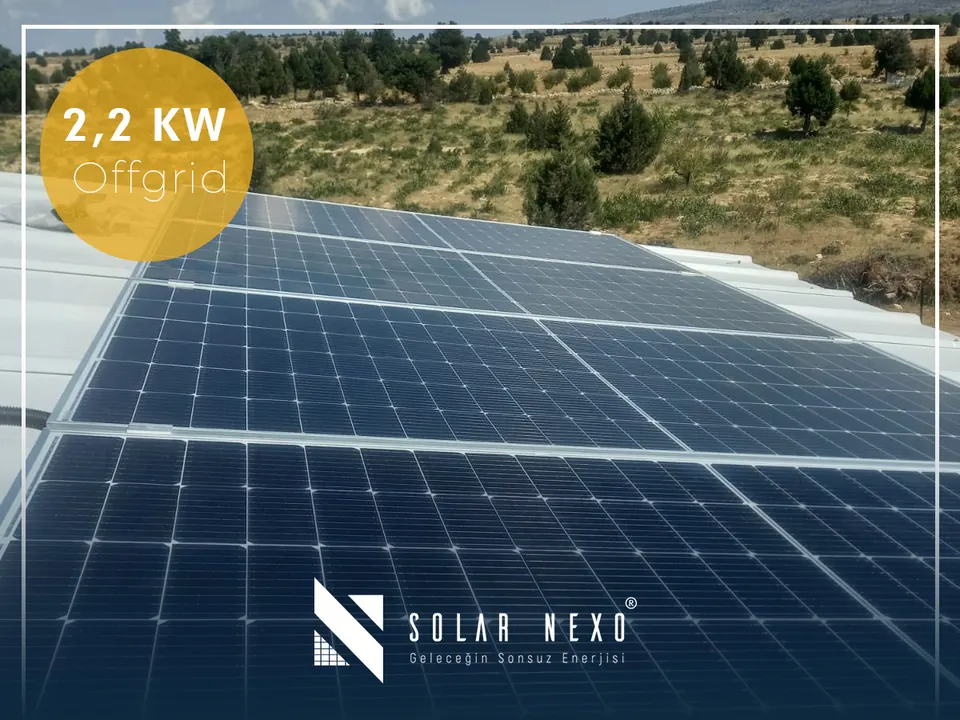
The steeper the surface, the more easily rain and wind carry dirt away. The optimum tilt PVGIS recommends for central Antalya is 33°; at this tilt, rain washes away a significant part of the fine dust on the surface. By contrast, on flat roofs or in systems installed at a very low tilt, water collects on the panel, dirt rings form as it dries and the need for cleaning increases.
The frame at the lower edge of the panel also plays a role. Water flow stops at the frame and mud collects there. When the row of cells in that area gets dirty, production can fall more than expected because the cells are connected in series. The height of the mounting system, the portrait or landscape layout of the panel and the tilt determine not only production but also soiling behaviour. For choosing angle and orientation, see solar panel tilt and orientation in Antalya.
| Condition | Soiling behaviour | Measure |
|---|---|---|
| Steep tilt, winter rain | Washed naturally | Check at the end of summer |
| Low tilt, flat roof | Water and dirt collect | More frequent cleaning, choice of tilt |
| Coast, salty air | White salt layer | Rinse with fresh water, check for corrosion |
| Around farmland and dirt roads | Heavy dust | Seasonal programme, monitoring |
| Area with many trees and birds | Local stains | Stain-by-stain intervention |
Soiling profile by area in Antalya
Antalya is not a single climate; the type of soiling changes by district. On villa and hotel roofs on the coast, salt and pollen stand out, while on greenhouse and farmed land in the plain, dust, greenhouse plastic and spraying residues are decisive. In mountain and high districts, rain and wind carry dirt away more easily, but local dust clouds can form during field-work periods. In the city centre, fine soot from traffic and construction dust dominate.
These differences directly affect the maintenance plan. Rinsing with fresh water several times a year because of salt on the coast, a check after the sowing and harvest periods in agricultural areas, and an end-of-summer check in the city centre are usually sensible starting points. Setting the programme by looking at the site during the survey is more accurate than a general calendar.
How do you tell soiling from monitoring?
It is not possible to look at the roof every day, but production data shows soiling indirectly. Watch for the following signs:
- A clear rise in output after rain. The difference in output before and after rain at the same irradiance is a measure of the soiling.
- Parallel strings on the same roof producing differently from each other; the string whose lower edge is dirtier stays lower.
- The daily curve slowly sliding downwards even though the weather is clear.
- In systems with a performance ratio chart, the ratio falling gradually in the dry period.
These signs can also have other causes; shading, degradation or inverter limiting can give a similar picture. To tell them apart, read our article on solar energy monitoring systems and the one on the causes of solar panel efficiency loss. The most reliable way to measure the effect of soiling on production is to compare output under the same irradiance conditions before and after cleaning.
A sample measurement plan could be: pick two clear days with similar irradiance, and note the inverter power at midday and the total daily production on the day before cleaning. Record the values of the day after cleaning in the same way. You cannot say that the difference between the two days is due only to soiling, because temperature and irradiance can also change; but a few repetitions let you see whether cleaning works and how often it is needed.
Prevention and cleaning strategy
Some of the measures are taken at the installation stage and some are applied during operation.
At the design and installation stage
The first steps are choosing a tilt that lets rain wash as much as possible, preferring panels whose frame edge does not hold water, and considering measures to keep birds from perching on the roof at the survey stage. If farmland or a dust source is nearby, frequent cleaning is added to the operating plan from the start.
During operation
The timing of cleaning is important: spraying cold water on a hot panel can cause thermal shock; for this reason early morning or late afternoon is preferred. Hard brushes and abrasive products scratch the anti-reflective coating on the surface; a soft brush and clean water, or the method recommended by the manufacturer, should be used. Climbing onto the roof is risky; on high and slippery roofs a professional team should be preferred. For method details, see solar panel cleaning.
There is no single correct calendar for cleaning frequency. One check at the end of spring, when the winter rains are over, and one at the end of summer is a reasonable start; after that, monitoring data guides you. The cost of cleaning should be considered together with the seasonal loss, not just once: in the high-production months even a small improvement may or may not cover the cost of cleaning; recording output before and after cleaning is enough to measure this.

Finally, remember that dirt on the panel surface is not always the only problem. On the same roof, fine dust may be building up on one side while shading, a connection loss or ageing is at work on the other. If the expected recovery is not seen after cleaning, the search must continue among the other causes.
When should you get professional help?
If a stain looks local and permanent, if a hot spot is suspected on the surface, or if production does not recover even after cleaning, the problem may not be only soiling. In that case the panel or the connection needs to be inspected. Solar Nexo can carry out such checks with its maintenance and technical support service in Antalya; you can request support through our contact page.
Conclusion
Solar panel soiling builds up in Antalya's dry summer season and affects the highest-production months. The self-cleaning effect of tilt with rain, a before-and-after-rain comparison from monitoring data, and properly timed gentle cleaning are the most effective trio. In risky conditions such as the coast, farmland and flat roofs, scheduled checks prevent unnecessary production loss.
Frequently asked questions
How much does solar panel soiling reduce output?
The loss varies with the type and thickness of the dirt, the tilt and rainfall, so giving one exact percentage would be misleading. Partial stains can have a bigger effect than an even thin layer of dust, because the cells are connected in series. The most reliable method is to compare output under the same irradiance before and after cleaning, repeat it a few times and look at the average.
Do solar panels clean themselves with rain in Antalya?
Partly. Most of Antalya's rain falls between November and February, and steeply tilted panels shed most fine dust with rain. However, July and August have only about 0.5 rainy days per month; dust, pollen and salt built up in summer do not go away on their own. On flat roofs, water can collect and leave dirt rings, so the choice of tilt matters.
What is the best time to clean panels?
It is recommended to clean panels when they are cool, that is, early in the morning or in the late afternoon. Spraying cold water on a hot surface can cause thermal shock. Hard brushes and abrasives can scratch the coating, so a soft brush and clean water, or the manufacturer's recommendation, should be preferred. Roof access carries a fall risk, so a professional team is safer, especially on slippery and high roofs.
How can I tell from monitoring data that my panels are dirty?
A clear rise in output after rain is the clearest sign. Parallel strings on the same roof producing differently, and the daily curve sliding down over time in clear weather, also suggest soiling. Because these symptoms can be confused with shading or inverter limiting, comparing output on days with similar irradiance before and after cleaning is the most reliable confirmation.
Do panels get dirty faster on the seaside?
On the coast, in areas such as Kemer, Alanya, Kaş and Kalkan, sea salt leaves a white residue on the surface when it dries. This residue can reduce light transmission. Salty air can also cause corrosion on the metal structure and fasteners. So both surface cleaning and corrosion checks should be planned together for coastal systems; rinsing with fresh water helps in this respect.
Is panel soiling worse on a flat roof?
Generally yes. At a low tilt, water collects on the panel, dirt rings form as it dries and the cleaning effect of rain is reduced. The optimum tilt for central Antalya is 33°; placement close to this tilt helps self-cleaning. On flat roofs, the use of tilted rails and more frequent checks should be planned, and this should be discussed at the survey stage.
Does bird dropping damage a panel?
Bird droppings do not permanently damage the panel, but they create a local shadow on the surface and, by affecting one cell, can reduce the output of the string it belongs to. If left a long time the stains dry and are hard to remove. Stain-by-stain cleaning is enough; measures to reduce bird perching on the roof can be considered at the survey stage, but chemical or abrasive products should not be used.
Sources
Want a clear calculation for your roof?
The Solar Nexo team carries out a free site survey at your address in Antalya and designs the system that suits your roof, consumption and budget.