Short answer
For solar panels in a heritage site, the definitive answer depends on the parcel's protection status; in Antalya areas such as Kaleiçi, Kaş and Olimpos, the competent board and the municipality conservation unit assess it. The safe order is status and conservation permission first, then the AEDAŞ application and installation. That the permit exemption replaces conservation permission has not been verified.
Key takeaways
- On a parcel with protected status, the competent body's opinion must be obtained first, then the grid application.
- That the planned-area permit exemption (Art. 59/2) replaces conservation permission has not been verified.
- Dark panels and low-profile mounting can improve visual compatibility; the decision rests with the board.
- A 3-year application ban can apply for a system operated before acceptance.
- According to PVGIS, annual specific production is 1,664 kWh/kWp in Kaş and 1,656 in Antalya city.
If you have a guesthouse in Kaleiçi, a stone house in Kaş or a share in land around Olimpos, the question of solar panels in a heritage site (sit alanı) matters to you directly. The general framework is this: work carried out in areas with protected status is subject to conservation legislation and the assessment of the competent boards, in addition to normal zoning procedures. In this article we explain the route to follow when planning a solar plant in Antalya's protected areas, separating what we could verify from official sources from what we could not.
What is a heritage site, and why are solar panels assessed separately?
A sit alanı (heritage or conservation site) is the general name for regions placed under protection because of their historical, cultural or natural value. The aim in these regions is to preserve the area's original silhouette, fabric and landscape. Because panels added to a roof can change this appearance, they are examined from a conservation point of view as well, unlike on an ordinary residential roof.
Which operation requires permission from which body in protected areas varies with the area's grade and the registration status of the building. In this guide we offer a general framework; the definitive parcel- or building-specific answer can only be given by the relevant municipality conservation unit, the Regional Conservation Board and the provincial directorate of culture and tourism. For this reason we do not issue a definitive "permission is required" or "not required" ruling.
Which areas in Antalya need attention?
Antalya is a province rich in historical and natural protected areas. The examples below show the places you should check first when planning a solar plant; the current status of each must be verified with the relevant body.
| Area | Why attention is needed | First step |
|---|---|---|
| Kaleiçi (Muratpaşa) | Historic fabric, tile roofs, protected buildings | Consult the municipality conservation unit and the Regional Conservation Board |
| Kaş old bazaar and surroundings | Traditional building fabric, views and silhouette | Query the parcel's conservation status |
| Olimpos and the Beydağları surroundings | Natural and archaeological protected areas | Confirm the land status and the permitting authority |
| Areas such as Kekova, Patara, Termessos | Archaeological, natural and cultural protection | Get the opinion of the competent directorate and board |
| Registered buildings | The building itself is under protection | A building-specific permit process is required |
This list is not exhaustive. Areas with protected status in Antalya are not limited to these; coastal, forest, national park and natural conservation areas can also fall under different bodies' authority. Which status your property has becomes clear with the title deed, zoning status and a query to the relevant body.
How does the permit process for solar panels in a heritage site work?
The typical steps for installing solar panels on a building or parcel in a protected area are as follows. These steps are a general framework; they may vary by body and area type:
- Status determination: The parcel's conservation grade, registration status and whether there is a conservation zoning plan are learned.
- Identifying the competent authority: It is learned which of the municipality conservation unit, the Regional Conservation Board or the relevant directorate is competent.
- Visual compatibility project: Projects showing the panel layout, color, height and effect on the facade or roof appearance are prepared. Visibility from the street is often decisive.
- Board assessment: The file is submitted to the relevant board. If the board finds it suitable, the implementation project is approved; if not, a revision or alternative may be requested.
- Distribution company application: For a grid-connected system in Antalya, the application is made on AEDAŞ's (the local electricity distribution company) LUS platform; for the documents, see our article on documents required for solar installation.
- Installation and acceptance: Running the system before acceptance can lead to the connection being cut and a 3-year application ban.
You cannot use a project that the conservation board has not permitted or has asked to be revised for an application to the distribution company. For this reason, getting the order right saves time: first the conservation approval, then the grid application and installation.
What should the file for solar panels in a heritage site contain?
The more complete the file submitted to the board, the faster the assessment moves. In general, the following information is expected to be prepared; the exact list should be obtained from the competent body:
- Documents showing the title deed, zoning status and conservation status.
- Photographs of the existing roof and facade and street views.
- Drawings and visualizations showing the panel layout, height and tilt.
- A technical explanation showing that the mounting system does not damage the structure.
- A civil engineer's assessment of the roof's load-bearing capacity.
In applications for solar panels in a heritage site, the visibility study is often the most critical document. Whether the panel can be seen from neighboring buildings, from the street and from angles facing historic buildings must be shown clearly. If this study is prepared together with the technical team, it becomes easier for both the board and the property owner to decide.
Does the planned-area permit exemption apply here?
Article 59/2 of the Planned Areas Zoning Regulation does not subject solar systems built for a building's own needs to a building permit, provided they do not affect the load-bearing system and consent is obtained under the Condominium Law (Kat Mülkiyeti Kanunu). However, this exemption is not a definitive answer on whether it removes the separate permit obligations in protected areas. Because we could not verify this with an official text, we do not use a statement such as "no permit is needed in a protected area either".
The safe approach is this: in a place with protected status, do not rely on the permit exemption; first get a written opinion from the competent body. The regulation also contains steps such as an implementation project, a technical responsibility undertaking and permission from the authority; in a protected area, a conservation assessment may be added to these.
Alternatives suited to installation
The conservation board may not find a panel on the roof suitable. In that case alternatives are assessed:
- Placement in unseen places: Rear roof surfaces not visible from the street, or the courtyard side. Orientation loss affects production; so the orientation and tilt loss must be calculated.
- Choosing a visually compatible panel: Manufacturer catalogs include dark-colored (Dark) 605 Wp options; for example the TommaTech 144TNFB (Dark) series. Such products can be discussed for visual compatibility, but the board's approval is decisive.
- Area outside the building: Installation on a garden, storage building or adjacent land that falls outside the protected area; if it is a different parcel, a separate application is needed.
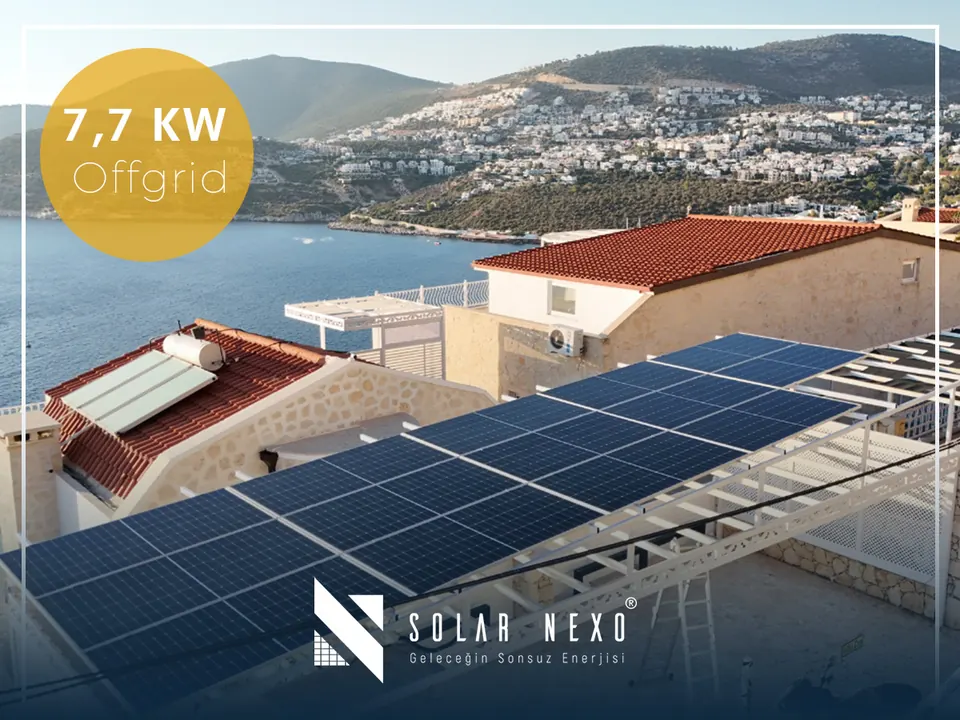
- Off-grid solution: An off-grid system does not need a distribution company application, but this still does not mean it is exempt from zoning, structural and conservation obligations.
In Antalya, the panel can be mounted at a low profile so as to blend with the tile and stone texture of the roof; but the roof type determines the mounting system. For roof types and mounting options, take a look at our article on solar panel mounting systems.
Notes for Kaş, Kemer and coastal areas
Around Kaş and Kalkan, some of the stone houses and villas may be near protected areas or the shoreline edge line. In these areas, views, silhouette and height limits matter. You can find general information for villa projects in our article on solar energy for villas in Kaş and Kalkan. For garden houses near forest and natural areas in Kemer, our article on off-grid solar in Kemer can guide you.
According to PVGIS data, annual specific production at the optimum tilt facing south is 1,664 kWh/kWp in Kaş and 1,656 kWh/kWp in Antalya city (JRC PVGIS 5.3, 14% system losses). In other words, even if you incur tilt or orientation loss because of conservation rules, production potential stays high; but the loss rate must be calculated specifically for the project. An engineer should calculate it rather than guessing.
Practical pre-application checklist
- Learn the conservation status of the parcel and the building in writing from the municipality and the relevant body.
- If board permission is required, start that process first; the grid application is the second step.
- Prepare photographs of the roof and a visibility study from the street.
- Main equipment must have been manufactured within the last five years (Art. 37/6, 2026); an unlicensed application cannot be made with old or second-hand equipment.
- Follow the application steps in general from our rooftop solar application guide.
At the survey, Solar Nexo assesses the roof type, visibility and possible placement options; obtaining conservation board permission, however, is a process for the property owner and the competent bodies. If your property is in a protected area, to plan the process early you can request a free site survey.
Conclusion
The key word in planning solar panels in a heritage site is order: first status determination and conservation permission, then the grid application and installation. In areas such as Kaleiçi, Kaş and Olimpos in Antalya, only the competent bodies can give the definitive answer; the safest course is to proceed on the assumption that a permit exemption does not replace conservation permission. With a visually compatible design, a solution can be sought in many projects, but every parcel is assessed on its own conditions.
Frequently asked questions
Can solar panels be installed in a heritage site?
In general, work in protected areas is assessed by conservation legislation and the competent boards; the definitive answer depends on the parcel's status. For this reason we say neither "it can be" nor "it cannot be". The safest order is to get a written opinion from the municipality conservation unit and the Regional Conservation Board and then move on to the AEDAŞ application. If the same parcel has an area without protected status, installing the system there requires a separate assessment and a separate application.
Can solar panels be installed in Kaleiçi?
Kaleiçi has protected status because of its historic fabric and roof changes may require conservation permission. We cannot verify the current rule; you must apply to the Muratpaşa Municipality conservation unit and the relevant board. Surfaces not visible from the street and a visual compatibility project matter in the assessment. When applying, preparing a photo of the roof, a visibility study from the street and a panel layout drawing speeds up the assessment.
Does the permit exemption apply in a protected area?
Article 59/2 of the Planned Areas Zoning Regulation exempts solar systems from a building permit under certain conditions; however, we could not verify whether it removes the separate permit obligations in protected areas. For this reason, do not start work in a place with protected status without a written opinion from the competent body. Instead of starting work relying on the permit exemption, written correspondence with the municipality conservation unit and the relevant board is far safer.
What happens after board permission is obtained?
After board permission, for a grid-connected system in Antalya the application is made on AEDAŞ's LUS platform; after the connection approval letter (çağrı mektubu) there are 90 days for project approval. The system must not be run before acceptance; otherwise the connection can be cut, the equipment removed and a 3-year application ban follows. If the board requests a revision, alternatives such as moving the layout to unseen surfaces or changing the panel can be assessed; this can lengthen the process.
Are there panel options that do not spoil the appearance?
Dark-colored (Dark) panels and low-profile mounting can improve visual compatibility. For example, the TommaTech 605 Wp product family includes the 144TNFB (Dark) series. Even so, the conservation board decides whether visual compatibility is sufficient; choosing a product does not mean a guarantee of permission. These options can slightly affect production; so calculate the balance between visual compatibility and efficiency per project with an engineer.
Is permission needed to install an off-grid system in a protected area?
Article 5/1/b of the regulation exempts facilities not connected to the grid from the license and company formation obligation; that is, no license or distribution company application is needed. However, this does not mean exemption from zoning, structural, fire and conservation obligations; get confirmation from the competent body. Especially in historic and natural protected areas, learning the land status in writing is the most important step to prevent the risk of the system being removed later.
How much does orientation and tilt loss reduce production in a protected area?
The loss varies with orientation, tilt and shade; a project-based calculation is needed instead of an estimate. According to PVGIS, annual specific production at the optimum tilt in Antalya city is 1,656 kWh/kWp. In a non-optimal layout this value falls; an engineer can calculate the amount of the drop with PVGIS. Tools such as PVGIS can be used to calculate the real loss per project; the technical team should do the calculation, and decisions should not be made by guesswork.
Sources
Want a clear calculation for your roof?
The Solar Nexo team carries out a free site survey at your address in Antalya and designs the system that suits your roof, consumption and budget.