Short answer
For solar panels in Kaş, annual specific production according to PVGIS 5.3 is 1,664 kWh/kWp, slightly above central Antalya (1,656). Because pool and air-conditioning loads in Kaş and Kalkan villas are high in summer, they match production well. Neat installation, salt-air resistance and possible protected-area permits should be checked early in design.
Key takeaways
- According to PVGIS 5.3, annual specific production is 1,664 kWh/kWp in Kaş and 1,656 kWh/kWp in central Antalya.
- For a 5 kWp villa system, annual production is calculated at about 8,320 kWh (PVGIS, optimal tilt, south).
- Summer pool and air-conditioning load coincides with summer production; running the pump by day increases self-consumption.
- No payment is made for energy fed from the battery to the grid; the battery is for your own consumption and outage backup.
- In protected zones such as heritage sites, permit requirements vary by plot; the zoning status should be learned in advance.
For villa owners planning solar panels in Kaş, here is the good news: according to PVGIS 5.3 data, Kaş's annual specific production is 1,664 kWh/kWp. That is slightly above central Antalya (1,656 kWh/kWp) and ranks near the top among the regions we examined. In other words, a system installed on a villa roof in Kaş and Kalkan works in one of Antalya's most productive spots as far as sunshine is concerned.
In villa projects, however, the real subject is design more than yield: aesthetics, the load profile of the rental season, pool and air-conditioning consumption, resistance to salty air and protected-area sensitivities. This article takes them in turn.
Solar panel yield in Kaş: what does PVGIS say?
PVGIS is the free calculation tool of the European Commission's Joint Research Centre. The values below were obtained assuming optimal tilt, south orientation and 14% system losses.
| Location | Annual specific production (kWh/kWp) | Annual production for a 5 kWp system (approx.) |
|---|---|---|
| Kaş | 1,664 | 8,320 kWh |
| Antalya centre | 1,656 | 8,280 kWh |
| Manavgat | 1,649 | 8,245 kWh |
| Alanya | 1,615 | 8,075 kWh |
The difference is small: there is about 0.5% between Kaş and central Antalya. So the choice of district alone does not settle the decision; roof orientation, tilt and shading are far more decisive. You can see the annual comparison of the six districts in the chart below.
The monthly distribution is estimated from central Antalya data: 99 kWh/kWp in January and 168 in July. We do not give a separate monthly series for Kaş; so it is reasonable to read the summer-to-winter ratio from the central Antalya chart.
Load profile for a villa: pool, air conditioning and the rental season
The load profile of villas in Kalkan and Kaş differs from a city home. In the summer months the pool pump, air conditioners and washing and dishwashing machines run heavily; out of season, consumption drops markedly. In rental villas, consumption depends on the guests' behaviour and fluctuates through the year.
This profile is a favourable match for solar energy: summer consumption is high and production is also highest in summer. Running the pool pump during daytime hours brings production directly together with consumption. A detailed explanation for pool pumps is in our article on pool pumps and solar energy.
Three questions need to be answered in design:
- Is the villa on a residential subscription or a commercial one? (Net metering rules vary accordingly.)
- Does the villa stand empty out of season? If consumption is low while it is empty, the surplus grows.
- Are there critical loads expected to work during a power outage? If so, a hybrid system and battery are considered.
Grid-connected or hybrid?
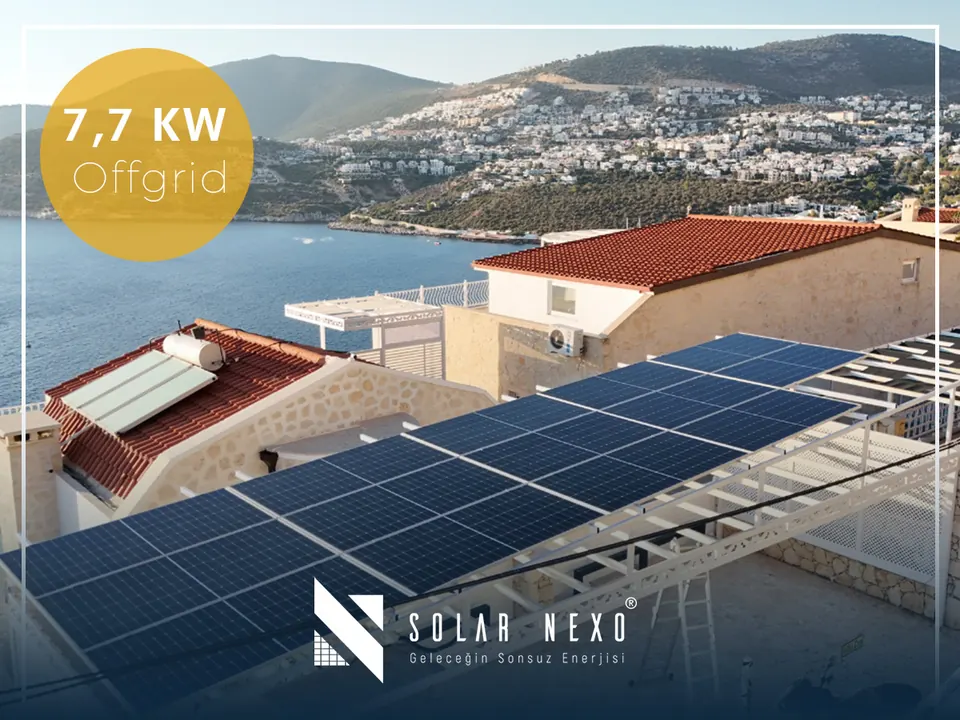
In some parts of Kaş and Kalkan, grid outages can be felt at peak summer load. For villa owners who rent out, an outage can directly affect guest satisfaction. For this reason a hybrid system (battery-backed) is an attractive option.
You can follow the working logic of such systems in the diagram below.
The Manavgat, Belek and Döşemealtı installations Solar Nexo shared on Instagram were also done with a similar hybrid logic; for example, in Belek, 24 TommaTech 605 W panels, a 20 kW hybrid inverter and a 15 kWh LiFePO4 battery were used. These figures are a reference; for your villa, scale is determined by load analysis. For more detail, see our article on the hybrid solar energy system.
There is also an important rule to know about batteries: no payment is made for energy fed from the battery to the grid. The purpose of the battery is to cover your own night-time consumption and provide backup during an outage; it is not for selling electricity.
Example calculation: a 10 kWp villa system
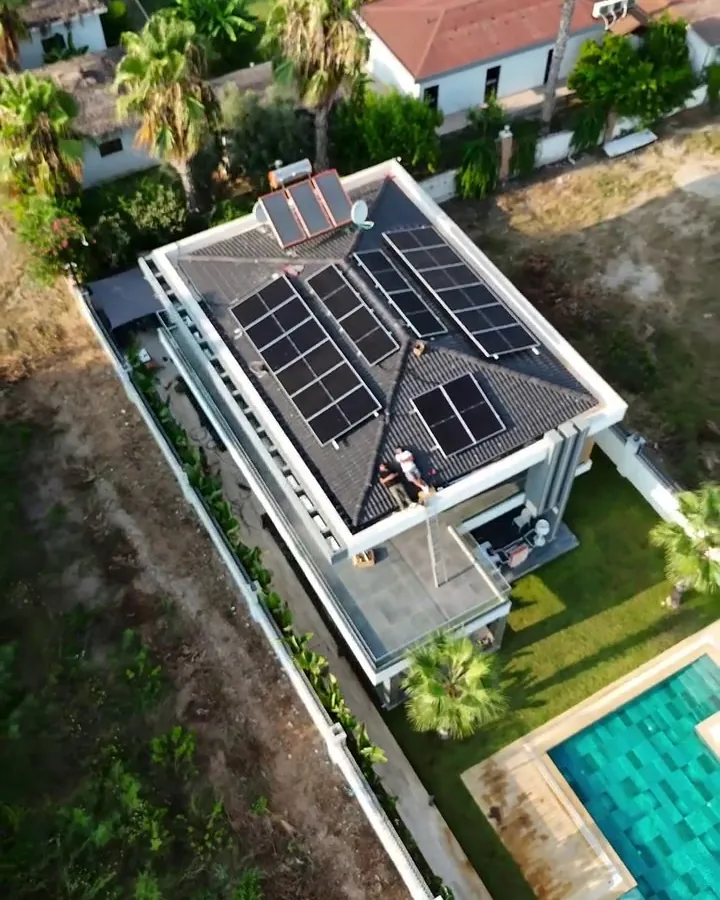
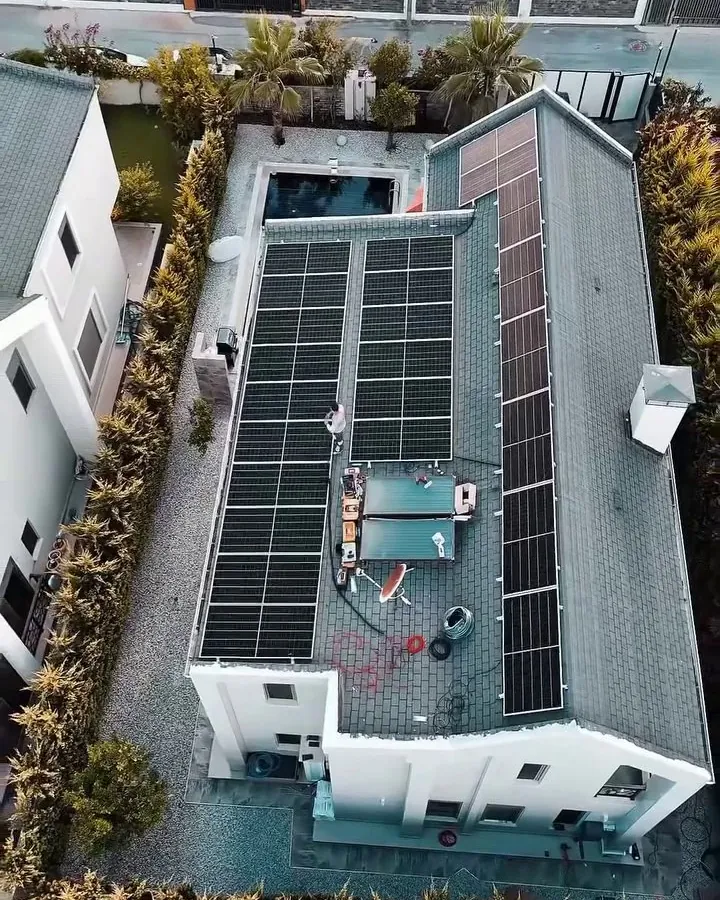
Let us take a 10 kWp system for a large villa. With 605 W panels this is about 17 panels (10.29 kWp). According to the PVGIS value, about 17,100 kWh per year (10.29 × 1,664) is expected from this system in Kaş. The calculation assumes optimal tilt and south orientation; on a real roof the value may fall because of orientation and shading.
How much of production is consumed inside the villa determines the efficiency of the investment. If the pool pump and air conditioning run by day in the summer months, self-consumption is high. If the villa stands empty out of season, most of the production goes to the grid as surplus. For a residential subscription, netting is monthly and the paid-generation limit does not apply to residential; for surplus energy, only the single-rate active energy unit price of the relevant tariff is paid. This price is lower than the total unit price on the bill. So as the self-consumption rate rises, payback time shortens; this is our interpretation. The current rules are valid as of October 2026 and may change.
We explain how the payback calculation is made, with its formula and variables, in a separate guide; our calculator is also ready for you to try with your own consumption. We do not quote prices, because cost items vary with roof type, equipment choice and battery preference.
Maintenance, cleaning and monitoring
Villa owners often live abroad or in another city. In that case remote monitoring is important: with mobile monitoring you can see daily production and possible faults. Solar Nexo lists 24/7 technical support and mobile monitoring among its services on its website. Because salt and dust can build up on roofs near the coast and the panel surface can become soiled in the rainless summer months, a visual check at least once a year and cleaning when needed is recommended. For cleaning methods, follow the manufacturer's recommendations; avoid hard brushes and abrasive chemicals.
Neat installation and protected-area sensitivity
In Kaş and Kalkan, the view and the roof appearance of villas matter. In terms of aesthetics, the following options are considered:
- Dark panel: The TommaTech 605 Wp series also has a 144TNFB (Dark) variant; a dark frame and back sheet may look more in keeping with the roof.
- Installation parallel to the roof pitch: When panels are installed parallel to the roof surface, the visual impact is reduced; however, moving away from the optimal tilt may reduce production.
- Neat alignment and cable concealment: Aligning the panels in order and routing cables out of sight markedly improves the look of the finished roof.
For villas within a heritage site, a natural protected area or a registered building, permission from the relevant municipality and conservation board may be needed for work on the roof. Which permission applies in which area varies by plot; before giving a definite answer, we recommend learning your zoning status from the municipality. For an explanation specific to this subject, you can look at our article on solar panels in a heritage site.
Sea air and durability
In villas near the coast, salty air increases the risk of corrosion in metal parts. Aluminium or suitably coated steel, stainless fasteners and quality connectors should be chosen for the mounting structure. The panel datasheet includes the manufacturer's test documents on this; do not choose without reading the warranty terms.
For mechanical strength, the 605 W TOPCon panel's datasheet states a wind load of 2400 Pa and a snow load of 5400 Pa. According to MGM data (the Turkish State Meteorological Service), the record wind speed in central Antalya has been 43.2 m/s; so on coastal roofs the mounting calculation should take wind load into account. Hail and storm events are also recorded on Antalya's western coast; these risks are considered in system design and the question of insurance is assessed.
Application and process
For a grid-connected villa system, the application in Antalya is made through Akdeniz Elektrik Dağıtım A.Ş. (AEDAŞ), the local electricity distribution company. AEDAŞ has accepted unlicensed generation applications only through the LUS platform since 1 October 2023. The process consists of the connection approval letter (çağrı mektubu), project approval, connection agreement and acceptance steps; each step has official time limits. The application itself and document preparation are included in the connection approval letter application step that Solar Nexo describes on its website. Because the regulation and tariffs can change, we settle the current terms as of October 2026 during the survey.
You can use our contact page for a free site survey, and you can examine our reference projects on the references page.
Conclusion
According to PVGIS data, Kaş and Kalkan are among Antalya's most productive areas, but success in villa projects depends on getting the load profile, aesthetics and durability decisions right. Match the heavy load of the rental season with daytime production, consider a hybrid option against outages, and check the possibility of a protected area early with zoning information. You can also try our calculator for estimated production and size.
Frequently asked questions
How much electricity do solar panels produce per year in Kaş?
According to PVGIS 5.3, a south-facing system at optimal tilt in Kaş produces about 1,664 kWh per kWp per year. For example, for a 5 kWp system this comes to about 8,320 kWh. Actual production may deviate from this value depending on shading, roof orientation, tilt and system losses. These values were produced with PVGIS 5.3's 14% system loss assumption; a calculation specific to your roof is made at the survey.
Does it make sense to install solar panels on a rental villa in Kalkan?
In rental villas, summer consumption is high, so solar energy matches well. However, if the villa stands empty out of season, consumption falls and the surplus grows. The subscription type, net metering rules and the villa owner's usage calendar directly affect the efficiency of the investment; so they should be assessed together at the survey. The periods the owner lives there and the length of off-season vacancy are decisive in choosing the size.
Can a solar system that works during a power outage be installed in Kaş?
Yes. Classic grid-connected on-grid systems shut down during an outage for safety reasons. For it to work during an outage, a system with a hybrid inverter and battery is needed. Critical loads (such as the refrigerator, lighting and pump) are backed up by connecting them to a separate panel. Battery capacity is calculated according to how long these loads need to run. Capacity and duration are calculated separately from the list of loads to be protected.
How do you choose solar panels for aesthetics in Kaş and Kalkan?
Panels with a dark frame and dark back sheet look more in keeping with the roof. The TommaTech 605 Wp series has a Dark variant. Installing the panel parallel to the roof pitch reduces visual impact but may reduce production relative to optimal tilt. Neat alignment and concealed cable routing also improve the look. Aesthetic choices should be shown clearly in the quote together with their production and cost effects.
Can solar panels be installed on a villa in a heritage site?
This varies by plot and protection status. For villas within a heritage site or registered building, permission from the relevant municipality and conservation board may be needed. For a definite answer, you need to learn your zoning status from the municipality and consult the competent authorities at the project stage; installation should not be carried out without permission. Matters such as owner or co-owner consent can also affect application documents.
Does salty air damage solar panels?
Salty air can increase the risk of corrosion, especially in the metal mounting structure and fasteners. Aluminium or suitably coated material, stainless fasteners and quality connectors should be chosen. Whether the panel's warranty terms contain a restriction on salty environments should be checked from the datasheet and warranty certificate. Regular checks matter as much as the choice of structure; an annual visual check is recommended.
Who makes the solar energy application in Kaş?
For grid-connected systems, the application is made through the LUS platform of AEDAŞ, the distribution company in Antalya. Solar Nexo offers the connection approval letter application step it describes on its website as part of its scope. As the applicant you need to prepare your documents; the current document list and time limits are settled during the survey. The process steps and official time limits follow the distribution company's guidelines.
Sources
Want a clear calculation for your roof?
The Solar Nexo team carries out a free site survey at your address in Antalya and designs the system that suits your roof, consumption and budget.