Short answer
A LiFePO4 battery is a lithium-ion battery whose cathode material is lithium iron phosphate. Thanks to its stable chemistry, long cycle life and high depth of discharge, it is widely used in hybrid and off-grid systems in Antalya. Cycle count, depth of discharge and warranty vary by manufacturer, so rely on the manufacturer's written datasheet and warranty document rather than dealer pages.
Key takeaways
- With 90% DoD, about 13.5 kWh is usable from a 15 kWh battery and about 27 kWh from a 30 kWh battery (calculation).
- A dealer page declares more than 6,000 cycles for the Pylontech US5000 at 25 °C and 90% DoD; sources contain contradictory figures such as 8,000 and 10,000.
- The product warranty on TommaTech LV batteries is 60 months; warranty varies by brand and model.
- No payment is made for energy fed from the battery to the grid; the battery must also have been manufactured within the last five years (2 April 2026 amendment).
- Because Antalya's summer heat can accelerate ageing, the battery should be installed in a cool, ventilated place.
A LiFePO4 battery is a type of lithium-ion battery that uses lithium iron phosphate as its cathode material, and it is one of the most widely preferred chemistries in solar energy storage. Thanks to its long cycle life, stable chemistry and tolerance of deep discharge, the lithium iron phosphate battery stands out as a home solar energy battery. In hybrid and off-grid systems in Antalya, especially in villas and rural homes, this battery type is preferred for using daytime production in the evening and at night.
What is a LiFePO4 battery and how does it work?
In all lithium-ion batteries, lithium ions move from one electrode to the other during charging and return during discharge. What makes the difference is the cathode material. In LiFePO4, the cathode is made of lithium iron phosphate. This structure is chemically stable; its tendency to release oxygen at high temperature is lower than in chemistries containing nickel and cobalt. For this reason it is generally preferred on safety grounds in installations close to living spaces such as homes and businesses.
A solar energy battery does not consist of cells alone. The cells are supplied as a module together with a battery management system (BMS), protection circuits and a communication interface. The BMS monitors cell voltages, temperature and current; if a limit is exceeded it protects the battery and communicates with the inverter.
Five basic concepts you need to know
- Capacity (kWh): The total energy the battery can store. Usable capacity is lower than nominal capacity.
- Depth of discharge (DoD): Shows how much of the battery can be used in one go. 90% DoD means about 13.5 kWh can be used from a 15 kWh battery (calculation).
- Cycle: One full charge and discharge loop. Cycle life tells you after how many cycles, at a given DoD and temperature, capacity falls to a certain level.
- Power (kW) and C-rate: Determines the power the battery can give or take at one time. Even if capacity is high, charge and discharge current is limited.
- BMS: The electronic control unit that protects the cells and talks to the inverter.
We described how these concepts match up with the inverter side in our hybrid inverter selection article.
Cycle life: look at the figures carefully
In LiFePO4 batteries, cycle life is markedly longer than in lead-acid batteries. For example, a dealer page declares more than 6,000 cycles at 25 °C and 90% depth of discharge for the Pylontech US5000. However, this is a dealer listing, not the manufacturer's official datasheet. In different sources, contradictory cycle figures such as 8,000 and 10,000, and warranty periods varying between 7 and 10 years, can be seen. For this reason do not read any cycle count as a guaranteed value.
Let us do a simple calculation. A battery doing one full cycle a day completes 6,000 cycles in about 16.4 years (6,000 ÷ 365; calculation). Real life depends on temperature, depth of discharge, charge rate and BMS settings. At the end of its cycle life the battery does not stop working; its capacity falls to a percentage set by the manufacturer. This threshold varies from manufacturer to manufacturer and is written in the warranty document.
On the warranty side, product-specific information is needed. For example, the product warranty on TommaTech LV batteries is 60 months. The performance warranty covers at least 60% of nominal energy for 24 months (or until the product-specific energy throughput is reached). Battery warranty differs by brand and model; the quotation should state the exact model and the warranty period and scope.
Safety and temperature: Antalya conditions
Safety depends on installation conditions as much as on battery chemistry. In Antalya the average maximum temperature in July is 34.2 °C and the record value has reached 45.0 °C (MGM, the Turkish State Meteorological Service, 1930-2025). High temperature speeds up ageing in lithium batteries. For this reason the battery should be positioned in a ventilated and, if possible, cool room or on a shaded wall, out of direct sun.
At low temperature, the situation reverses. Lithium batteries should not be charged at temperatures near freezing. On the coast this is not a problem; but in districts that are colder in winter, such as Korkuteli and Elmalı, the operating temperature range in the battery's manufacturer document must be checked.
- Keep the battery away from heat sources, direct sun and places exposed to humidity.
- Leave the gaps between modules that the manufacturer specifies.
- Include fire detection and suppression measures in the installation plan; for details see our solar plant fire safety article.
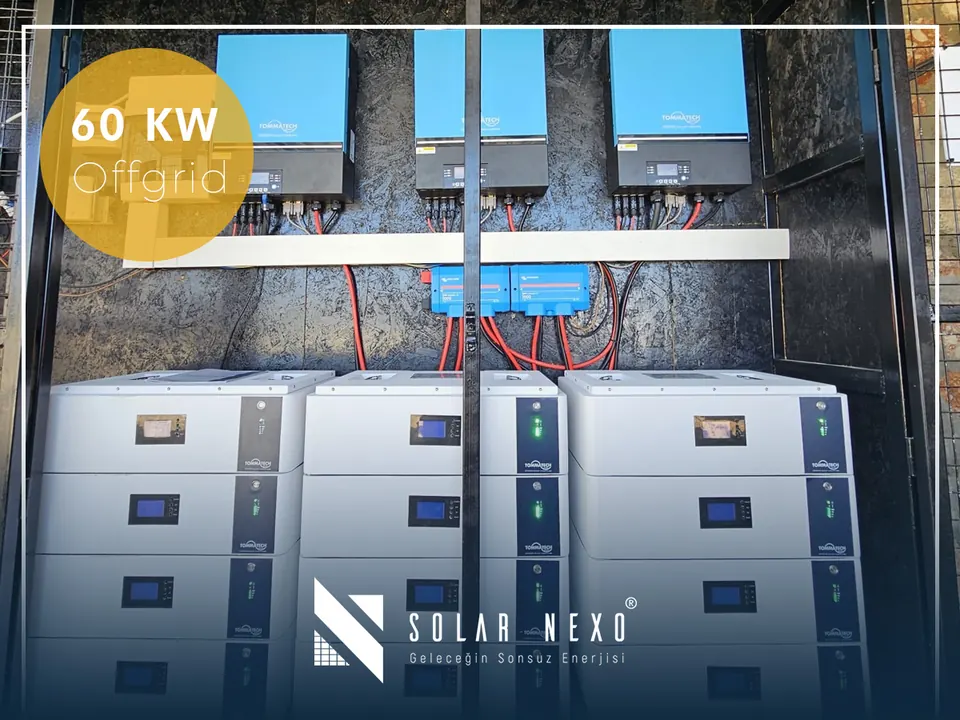
LiFePO4 battery examples in Solar Nexo installations
The installations Solar Nexo shared on its Instagram account (@solarnexotr) that use LiFePO4 batteries are as follows. The usable energy column is a calculation we made assuming 90% DoD; the real value varies with the DoD the manufacturer states.
| Location | System | Battery | Usable energy (90% DoD assumption) |
|---|---|---|---|
| Döşemealtı | 20 kW hybrid inverter | 30 kWh | about 27 kWh |
| Manavgat | 15 kW hybrid inverter | 15 kWh | about 13.5 kWh |
| Belek | 20 kW hybrid inverter | 15 kWh | about 13.5 kWh |
| Döşemealtı (off-grid) | 11 kW off-grid inverter | 15 kWh | about 13.5 kWh |
13.5 kWh of usable energy feeds an average evening and night load of 1.5 kW for about 9 hours (13.5 ÷ 1.5; calculation). In summer, while the air conditioner runs, this average rises and the time shortens. For this reason battery capacity must be chosen from the home's real evening and night consumption.
LiFePO4 versus other lithium chemistries
Nickel-manganese-cobalt (NMC) chemistries, common in electric vehicles and portable devices, store more energy per unit weight. In fixed solar energy systems, weight and volume are usually not decisive; so long life and safety come to the fore. LiFePO4 is a strong candidate in this field. Even so, each product should be assessed separately, and the name of the chemistry alone should not be treated as an indicator of quality.
Charging strategy and minimum reserve
In hybrid inverters, the battery's charge and discharge strategy can be set. In rural areas where outage risk is high, it makes sense to set aside part of the battery as a reserve: for example, a certain percentage of capacity is kept to be used only when the grid is cut. If only self-consumption is targeted, the battery fills in the daytime and empties in the evening. These settings are made at installation and can be updated if needs change. We also covered the outage scenario separately in our solar energy that works during a power outage article.
Regulation and warranty: what you need to know in a system with a battery
Under the 2 April 2026 amendment to the Unlicensed Electricity Generation Regulation, an unlicensed facility owner may install a storage unit up to the electrical capacity of the generation plant. Main equipment, including the batteries in the storage unit, must have been manufactured within the last five years. No payment is made for energy fed from the battery to the grid; a 10% tolerance is applied at acceptance. For how these rules are applied, get confirmation from the distribution company you apply to, as of October 2026.
In off-grid systems, because the facility is not connected to the distribution grid, no licence or distribution company application is needed; however, obligations such as zoning, structural and fire apply separately. We covered the logic of grid-independent systems in our what is an off-grid solar energy system article.
Checklist when choosing a LiFePO4 battery
- The manufacturer's official datasheet: are cycle count, DoD and temperature condition written together?
- Warranty: are the period, capacity threshold and energy throughput limit clearly stated?
- Inverter compatibility: have voltage class, charge and discharge current and communication protocol been confirmed?
- Operating temperature range: is it suitable for the Antalya summer and rural winter conditions?
- Manufacturing date: within the last five years?
- Fire and ventilation plan: have the installation location and gaps been defined?
- Maintenance: is there service support for BMS updates and regular checks? On maintenance you can also look at our solar energy battery maintenance article.
For a comparison of LiFePO4 and gel batteries, take a look at our lithium battery or gel battery article. To work out the battery capacity suited to your roof and consumption together, you can leave a free site survey request.
Conclusion
A LiFePO4 battery is a strong option in solar energy storage because of its long cycle life, stable chemistry and suitability for deep discharge. Even so, cycle count, warranty and DoD values vary from manufacturer to manufacturer; trust the official datasheet rather than figures on dealer pages. If attention is paid to temperature management, correct capacity selection and inverter compatibility in Antalya, the battery becomes a reliable part of a hybrid and off-grid system.
Frequently asked questions
What is a LiFePO4 battery and why is it preferred in solar energy?
LiFePO4 is a lithium-ion battery whose cathode material is lithium iron phosphate. Its chemistry is stable, its cycle life is long and its depth of discharge is high. For this reason it is preferred in home solar energy storage. Even so, cycle count and warranty vary by brand and model, and the official datasheet should be consulted. The name of the chemistry alone is not a quality guarantee.
How many cycles does a LiFePO4 battery last?
It varies with the manufacturer and conditions. A dealer page declares more than 6,000 cycles at 25 °C and 90% depth of discharge for the Pylontech US5000; however, contradictory figures such as 8,000 and 10,000 also exist in sources. At one cycle a day, 6,000 cycles is about 16.4 years (calculation). This is not a warranty period; real life depends on temperature and how it is used.
What does DoD (depth of discharge) mean?
DoD shows, as a percentage, how much of the battery can be used in one go. About 13.5 kWh can be used from a 15 kWh battery with 90% DoD. The DoD value should be written together with cycle life, because cycle count is given at a particular DoD and temperature condition. With higher DoD, usable energy rises, but the manufacturer declares the cycle count according to this condition.
Does a LiFePO4 battery cause problems in Antalya's heat?
High temperature can accelerate ageing in lithium batteries. In Antalya the average maximum temperature in July is 34.2 °C. The battery should be installed in a ventilated place out of direct sun, and the operating temperature range in the datasheet should be checked. A shaded and cool room is usually a suitable place. During installation, the gaps and ventilation conditions that the manufacturer specifies should be followed.
How many years is the warranty on a LiFePO4 battery?
Warranty varies by brand and model. For example, the product warranty on TommaTech LV batteries is 60 months. The performance warranty covers at least 60% of nominal energy for 24 months or until the product-specific energy throughput is reached. The warranty period, capacity threshold and scope should be requested in writing in the quotation. For the warranty to be valid, the manufacturer's installation and operating conditions must also be followed.
Can I sell the electricity in the battery to the grid?
Under the regulation, no payment is made for energy fed from the battery to the grid. The regulation amendment dated 2 April 2026 states that no payment is made for the part of the surplus remaining after net metering that is supplied from storage. The battery makes more sense for using the daytime surplus in your own consumption in the evening. Confirm the current form of the rules with the distribution company before applying.
How many hours does a 15 kWh battery power a home?
The duration depends on the load. With 90% DoD, about 13.5 kWh of usable energy feeds an average load of 1.5 kW for about 9 hours (calculation). If the air conditioner is running, the load rises and the time shortens. For the right capacity, real evening and night consumption should be calculated from the bill breakdown and the label power of the devices.
Sources
Want a clear calculation for your roof?
The Solar Nexo team carries out a free site survey at your address in Antalya and designs the system that suits your roof, consumption and budget.