Short answer
A pool pump can be run on solar energy, because filtration can be scheduled for the daytime and summer production in Antalya is at its peak. For example, a 1.1 kW pump running 8.3 hours a day uses about 3,350 kWh a year, which means about 2 kWp, or four panels. A variable-speed pump cuts consumption significantly. Real values vary with the pump and the pool.
Key takeaways
- Turnover time = pool volume ÷ pump flow rate; in the example, about 4.2 hours for 50 m³ and 12 m³/hour.
- A 1.1 kW pump running 8.3 hours uses about 9.2 kWh a day and about 3,350 kWh a year.
- Pump power is proportional to the cube of speed; at 60% speed the same water can be filtered with about 3.3 kWh (ideal calculation).
- According to PVGIS, 1 kWp of panels in Antalya produces 159-168 kWh between June and August.
- Heating is a separate load and must be added to the panel calculation separately.
A pool pump can be run on solar energy, because pool filtration is a load that can be done in the daytime, can be scheduled and, in the summer months, coincides with peak solar production. With so many villas with pools in Antalya and a long pool season, a pool pump solar energy solution comes up naturally, and the pump's electricity consumption is a bill item all year round. In this article we explain pump power, running hours, the effect of a variable-speed pump and the required panel capacity with worked examples.
Why is a pool pump compatible with solar energy?
The job of the pool pump is to keep the water clean by passing it through the filter. This can be done at any hour of the day; so it is possible to schedule the pump for the hours when the sun is strongest. According to PVGIS, 1 kWp of panels in Antalya produces 159 kWh in June, 168 kWh in July and 167 kWh in August; the months of heaviest pool use are also the months of highest production.
There are pool loads other than the pump: the salt chlorination (electrolysis) unit, LED lighting, the robotic cleaner, and heating and circulation systems. Heating is the largest of these loads and needs a separate calculation; in this article we deal only with the filtration pump.
How is pool pump running time calculated?
Running time is determined by pool volume and pump flow rate. One turnover (the time for the water to pass through the filter completely once) is found by dividing volume by flow rate. A hypothetical example: pool volume 50 m³, pump flow rate 12 m³/hour. One turnover takes about 4.2 hours. If two turnovers a day are targeted, about 8.3 hours of running is needed. The number of turnovers is determined by a pool specialist according to usage intensity, temperature and water quality; settle the exact value for your own pool with this specialist.
Suppose the pump's electrical power is 1.1 kW. Daily consumption is 1.1 kW × 8.3 hours = about 9.2 kWh, and if it runs 365 days, about 3,350 kWh a year. Dividing this by the 1,656 kWh/kWp that PVGIS gives for Antalya city centre gives about 2 kWp. With 605 W panels, that means four panels (2.42 kWp). In reality running time may be shorter in winter and the system may also cover other consumption; but this calculation is sufficient to show the scale of the pump.
Variable-speed pumps and energy savings
In centrifugal pumps, flow is proportional to speed while power is proportional to the cube of speed (the affinity laws). For this reason, running the pump slower but for longer uses far less energy to pass the same water through the filter. The table below compares filtering the same 100 m³ of water (two turnovers) for an ideal (friction-dominated) system:
| Pump speed | Flow rate | Electrical power | Running time | Daily energy |
|---|---|---|---|---|
| 100% | 12 m³/hour | 1.10 kW | 8.3 hours | about 9.2 kWh |
| 60% | 7.2 m³/hour | about 0.24 kW | 13.9 hours | about 3.3 kWh |
| 50% | 6 m³/hour | about 0.14 kW | 16.7 hours | about 2.3 kWh |
This table is an ideal calculation; in reality static head, filter resistance and motor efficiency change the result, and some pumps also have a minimum operating speed. Even so, the direction is clear: a variable-speed pump significantly reduces energy consumption. In the table, running time lengthens at slow speed; according to MGM (the Turkish State Meteorological Service), daily sunshine in Antalya is about 11.1 hours in June and 4.8 hours in December. That is, 13.9 hours of running at 60% speed exceeds the sun hours and part of the night is covered from the grid. Speed can be set to fit within the hours when the sun is effective.
Pool loads other than the pump
The pump is not the only load. The hypothetical table below shows typical additional loads on a pool and their daily energy. Real values should be taken from the device label.
| Load | Power | Daily duration | Daily energy |
|---|---|---|---|
| Salt chlorination unit | 0.15 kW | 8 hours | 1.2 kWh |
| LED pool lighting | 0.1 kW | 4 hours | 0.4 kWh |
| Robotic cleaner | 0.15 kW | 2 hours | 0.3 kWh |
These loads are not as large as the pump, but together they add about 1.9 kWh/day. Because lighting runs in the evening, it does not overlap with solar production; this part is covered from the grid or a battery. The chlorination unit runs while the pump runs, so it is included in the daytime schedule.
System design for a pool pump
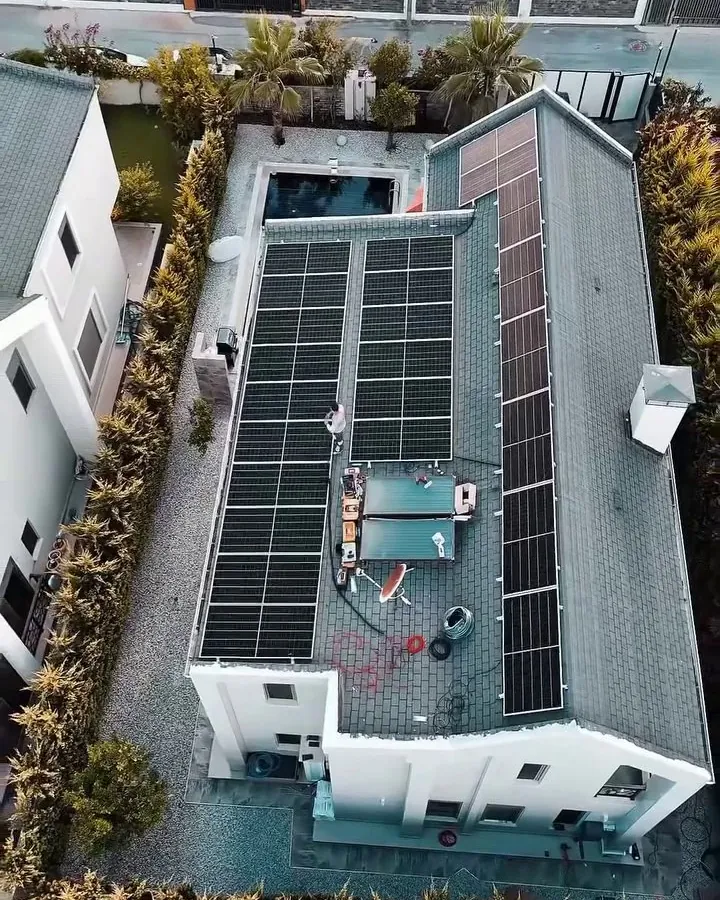
A pool pump can be run on solar energy directly through a DC pump; however, the common solution in villas is for the same system to feed the whole house. The villa's grid-connected (on-grid) solar system covers all consumption, including the pump; a timer relay or smart control is used to schedule the pump for midday. For a system that must also work during outages, a hybrid solution is needed; you can look at our hybrid system article.
The 26 kW off-grid pool villa reference on Solar Nexo's website is an example in which a comprehensive load list, including the pool pump, is covered entirely by solar. In such projects the pump, air conditioning and household loads are calculated together, because simultaneous operation determines inverter power. For comprehensive villa design you can look at our villa solar energy system design article.
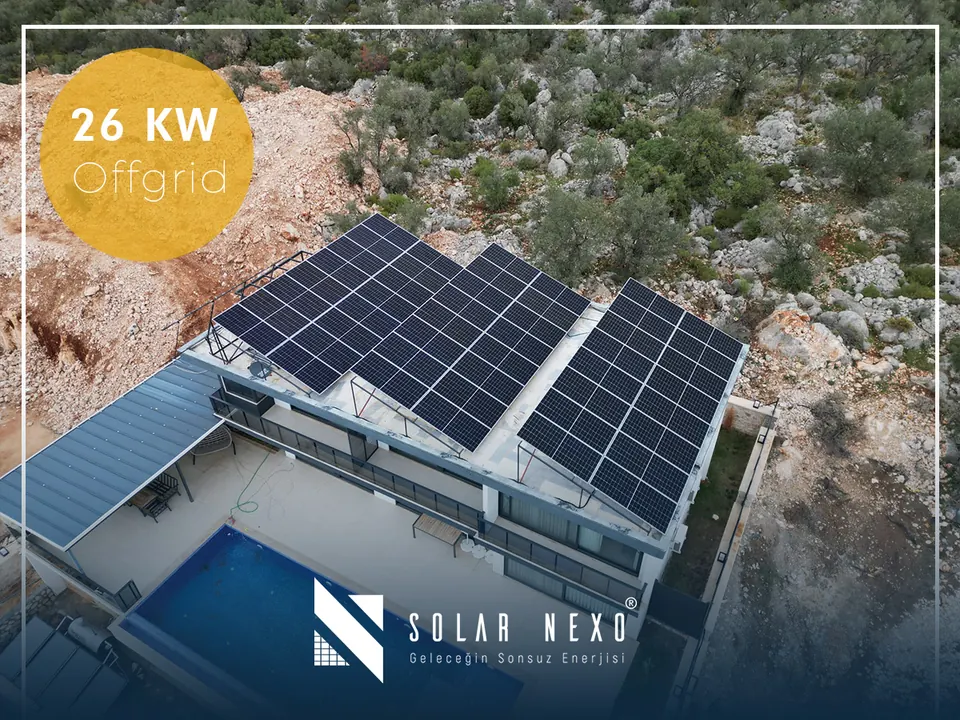
On the motor side, whether the pump is single-phase or three-phase matters. Most villa pumps are single-phase and draw several times the nominal current at start-up; the inverter and contracted capacity must suit this start-up. Variable-speed (inverter-driven) pumps soft-start, which also reduces this problem. When installing a new solar system, also considering replacing the old pump both reduces panel capacity and balances the total investment.
Regulation and application notes
If the villa is on a residential subscription, no residential generation or sales limit applies; the capacity limit is the contracted capacity, and for rooftop systems up to 25 kW the simplified procedure applies. For residential subscriptions, net metering is monthly. Because the pool pump runs in the daytime, it increases self-consumption; the cost avoided through self-consumption is the unit price that includes all components on the bill. Surplus is paid only at the active energy unit price, so the higher the self-consumption, the more efficient the system (interpretation).
In Antalya the application is made through AEDAŞ's (the regional electricity distribution company) LUS platform. Operating the system before its acceptance leads to disconnection; for this reason apply the pump schedule after the system is commissioned. For corrosion precautions in coastal villas such as Konyaaltı, you can look at our Konyaaltı villa solar panel article.
Practical tips
Reducing pump running time outside the pool season and maintaining the minimum filtration that preserves water quality in winter is common practice. In Antalya, production falls in winter (99 kWh per kWp in December) and pump time shortens as well; so the seasonal balance is preserved. When sizing the system, look not only at the pool's summer consumption but at the villa's annual consumption. This is because the panels will also feed air conditioning, the kitchen and lighting, not only the pool.
- Time schedule: Set the pump to run between 10:00 and 16:00; it then runs in the strongest production hours.
- Variable-speed pump: Replacing an old fixed-speed pump is the lowest-cost saving step, before the panel investment.
- Filter maintenance: A dirty filter increases resistance and raises the pump's energy consumption.
- Measurement: Measure pump consumption with a separate meter; choose panel size by measurement, not by guesswork.
- Heating: Pool heating is a separate and high load; assess it separately when calculating panel capacity.
On pool water quality and filtration requirements, follow the pool builder's recommendations; shortening filtration time to save energy can spoil water quality. Solar energy makes the pump's electricity cheaper, but it does not remove the scientific necessity of filtration. The right approach is to keep the required time and to cover the energy from the sun.
Conclusion
A pool pump on solar energy is a natural match: it runs in the daytime, can be scheduled and coincides with summer production. First make the pump efficient, then choose panel capacity for the remaining need. If you would like to work out the load calculation for your pool villa together, you can request a free site survey.
Frequently asked questions
Does a pool pump run on solar panels?
Yes. A pool pump is a load that can run in the daytime and can be scheduled, and it overlaps with solar production in summer. A villa's grid-connected solar system can cover all consumption, including the pump. Using a direct DC pump is also possible, but in villas a single system feeding the whole house is generally preferred; this way the pump hours can be set flexibly.
How many panels are needed for a pool pump?
It depends on the pump's power and daily running time. For example, a pump with 1.1 kW electrical power running 8.3 hours a day uses about 3,350 kWh a year; in Antalya that means about 2 kWp, or four 605 W panels. You should calculate with your own pump's label value and real running hours and have the result verified at the survey.
How many hours a day should a pool pump run?
It depends on pool volume, pump flow rate, temperature and usage intensity. Turnover time is found by dividing volume by flow rate; for example, with a 50 m³ volume and 12 m³/hour flow, one turnover is about 4.2 hours. The number of daily turnovers is set by a pool specialist and can be changed by season. In solar system design, this time is scheduled for midday.
How much does a variable-speed pool pump save?
In centrifugal pumps, power is proportional to the cube of speed. Under ideal conditions, lowering speed to 60 percent and extending the time can bring daily energy for the same amount of water down from about 9.2 kWh to 3.3 kWh. The real value varies with static head, filter resistance and pump model; for that reason measurement is needed.
Can pool heating be done with solar panels?
Electric pool heating is a high load and raises panel capacity considerably. In this article we dealt only with the filtration pump. Heating consumption must be calculated separately, with operating hours and season determined. If a heating load is added, inverter capacity and contracted capacity must also be checked; otherwise the system will be smaller than expected.
Is a hybrid system necessary for a pool villa?
Because the pump runs in the daytime, an on-grid system is mostly sufficient. If you want the pump, air conditioning and other loads to run during an outage, or your evening consumption is high, a hybrid system with a battery is considered. The decision depends on outage frequency and your night load. A hybrid system is more complex than an on-grid system and requires a higher investment.
How do I schedule the pool pump for solar hours?
With a timer relay or smart controller you can usually set the pump to run between 10:00 and 16:00. If you use a variable-speed pump, the speed and time profile is set to fit within the hours when the sun is effective. Tracking solar production in the monitoring app and updating the schedule by season raises self-consumption and reduces energy drawn from the grid.
Sources
Want a clear calculation for your roof?
The Solar Nexo team carries out a free site survey at your address in Antalya and designs the system that suits your roof, consumption and budget.