Short answer
In solar panel design for Konyaaltı, what decides a villa is the pool pump and air-conditioning load, the corrosion effect of sea air and neat installation. The PVGIS value for central Antalya is 1,656 kWh/kWp per year and 168 kWh/kWp in July. Because daytime loads coincide with the sun, on-grid may be enough; for outage backup, a hybrid system and battery are considered.
Key takeaways
- According to PVGIS 5.3, 1 kWp in central Antalya produces about 168 kWh in July, which is about 5.4 kWh/kWp per day (calculation).
- In an example villa, a 1.5 kW pool pump running 8 hours a day uses 12 kWh and three air conditioners running 8 hours a day use 24 kWh; the summer daily load comes to about 36 kWh (hypothetical).
- Salt in sea air increases the risk of corrosion in fasteners; ask about the mounting structure material and the manufacturer's documents.
- No payment is made for energy fed from the battery to the grid; the battery is for backup and shifting self-consumption.
- For facilities tied to a residential subscription, netting is monthly and, as of October 2026, no production or sales limit applies.
For solar panels in Konyaaltı, the first question villa owners usually ask is: how many panels cover the summer load created by the pool pump and air conditioners? Below we answer this with PVGIS data in a hypothetical but traceable calculation; then we cover the effect of sea air, neat installation options, the hybrid and battery decision and the AEDAŞ application. The figures rely on sources valid as of October 2026 and are settled by a survey specific to your roof.
Production potential for solar panels in Konyaaltı
In PVGIS, Konyaaltı corresponds to the central Antalya area. According to PVGIS 5.3, annual specific production at optimal tilt (33°) and south orientation is 1,656 kWh/kWp. The monthly distribution favours summer: July 168, August 167, June 159, December 99 kWh/kWp. Converting the July value to a day gives 168 / 31 ≈ 5.4 kWh/kWp per day (calculation). This means that on summer days 1 kWp of panels produces about 5.4 kWh.
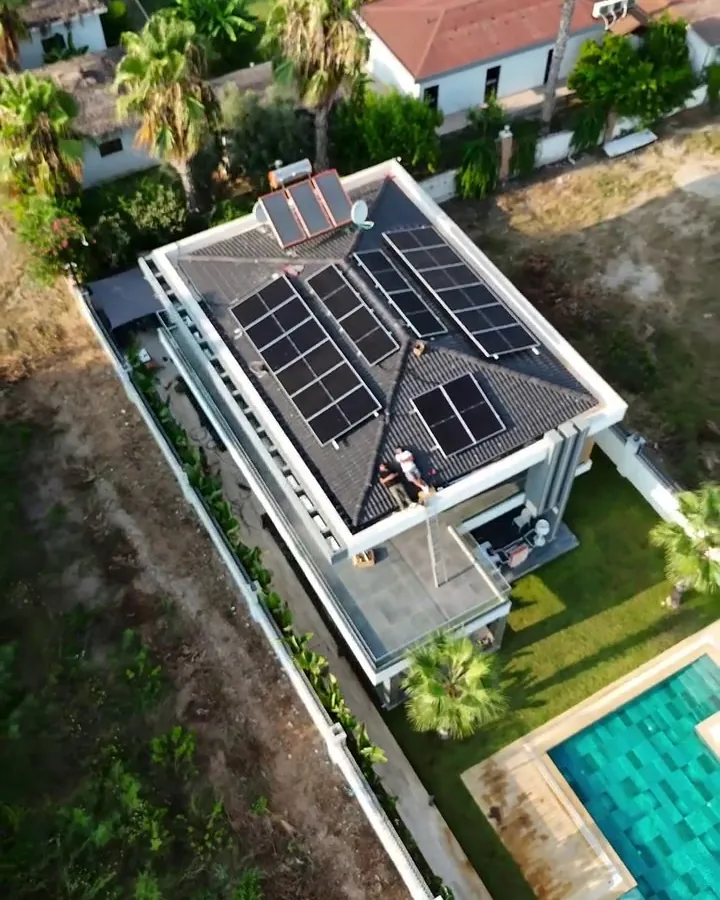
These figures include 14 percent system losses; the orientation, tilt and shading of the villa roof change the result. On villas with sea views, roofs often face the view, that is, directions that deviate from south; so measuring orientation and tilt at the survey is important. We covered the effect of orientation on production in the angle and orientation article. Because villa roofs on slopes sit at different levels, neighbouring buildings and trees above can create morning or evening shade; for villas on the coastal strip, wind load and salt are assessed together.
How many kWp is a pool pump and air-conditioning load?
The calculation below is hypothetical; use the rated power and real running hours of your own appliances. Example villa: a pool pump with 1.5 kW of electrical power runs 8 hours a day; three inverter air conditioners with 1 kW of electrical power each run 8 hours a day.
| Load | Power | Duration | Daily consumption |
|---|---|---|---|
| Pool pump | 1.5 kW | 8 hours | 12 kWh |
| 3 air conditioners | 3 × 1 kW | 8 hours | 24 kWh |
| Total | 36 kWh |
Since 1 kWp produces about 5.4 kWh/day in July, covering this load on summer days takes about 36 / 5.4 ≈ 6.7 kWp; that means about 11 panels of 605 W (6.66 kWp) (calculation). In reality air conditioners do not run at full power continuously, the pump may also run at night, and the house uses other appliances too. For this reason this calculation gives direction, not sizing. A detailed treatment of the pool pump is in the article on pool pumps and solar energy.
Pump type matters too. Fixed-speed pumps run at high power for a short time; variable-speed (VFD) pumps can run at lower power for longer, giving a load profile better suited to solar production. Motor loads such as air conditioners and pumps can draw several times their nominal current at start-up; for this reason the inverter's surge power capacity is checked in hybrid or off-grid systems.
Shifting the pump schedule to daytime hours is the cheapest way to align production with consumption. For facilities tied to a residential subscription, netting is monthly and, as of October 2026, no production or sales limit applies; however, the payment for surplus energy is based on the single-rate active energy unit price, not the total unit price on the bill. So the higher the self-consumption, the more efficiently the system is used.
Sea air and salt: what it means for panels and mounting structure
On Konyaaltı's coastal strip, salt in the air can accelerate corrosion on metal surfaces. The most sensitive points are the panel frame, clamps, screws and bolts, earthing connections and connectors. In salt-mist areas the following are recommended:
- Using aluminium rails and stainless steel fasteners,
- Applying insulation against contact corrosion between different metals,
- Asking the manufacturer whether a salt-mist corrosion test certificate exists,
- Checking the IP protection class of connectors and cable trays (for example, the panel junction box is IP68),
- Having the surface cleaned and connections checked at the end of summer.
Because most of Antalya's rainfall comes between November and February, rain does not naturally wash away the salt and dust that build up in summer; the cleaning plan needs to be made accordingly. Leaving a ventilation gap behind the panel also reduces the effect of summer heat; a TOPCon panel with a temperature coefficient of −0.30 %/°C is at an advantage in power loss with temperature (datasheet value).
Neat installation on a villa
For villa owners, appearance is also a criterion. In terms of aesthetics, the following are considered: panels laid parallel to the roof pitch and neatly aligned, a preference for uniform black-framed, dark-cell panels, cables routed under the roof or through a concealed duct, and the inverter and battery located in a technical room out of sight. On flat terraces, a tilted frame can be planned so that it stays below the parapet height. An aesthetic choice does not require sacrificing efficiency; however, technical criteria such as shading and ventilation gap take precedence over visual concerns. If both technical and visual options are drawn together at the survey, the decision is easier to make.
For buildings in a protected zone or heritage site, additional permission may be needed. We covered this in our article on heritage sites; you should confirm your own plot's situation with the municipality and the relevant board.

Hybrid system and battery: the decision for a Konyaaltı villa
In a villa, outage backup matters for critical loads such as the refrigerator, security system and pump. A hybrid inverter and LiFePO4 battery meet this need. In the sample villa installations Solar Nexo shares on Instagram, the following combinations appear: in Manavgat, 20 panels of 605 W, a 15 kW hybrid inverter and a 15 kWh battery; in Belek, 24 panels of 605 W, a 20 kW hybrid inverter and a 15 kWh battery; in Döşemealtı, 36 panels of 605 W, a 20 kW hybrid inverter and a 30 kWh battery. These are not Konyaaltı projects; they only show what kind of equipment balance can be built at villa scale.
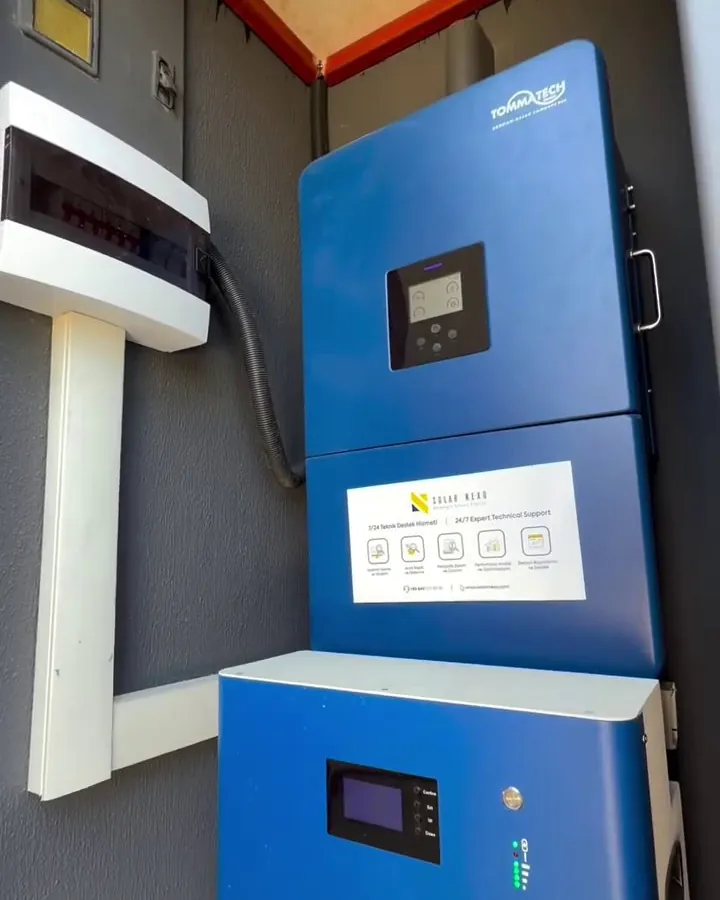
Under the regulation, an unlicensed facility owner can install a storage unit up to the electrical power of the generation facility; however, no payment is made for energy fed from the battery to the grid, and batteries must also have been manufactured within the last five years. In other words, the battery is a tool for backup and shifting self-consumption, not a source of income.
Battery size depends on which loads you want to run during an outage. For example, if critical loads such as the refrigerator, lighting, security cameras and pool pump total 1.5 kW and run for 10 hours overnight, the energy needed is 1.5 × 10 = 15 kWh (hypothetical calculation). Taking the usable capacity and depth of discharge in the manufacturer's declaration into account, a somewhat higher nominal capacity is chosen. Backing up the whole villa, air conditioners included, enlarges both inverter power and battery capacity markedly; for this reason a critical-load panel arrangement is a frequent choice. We covered the options separately in the hybrid solar energy article.
Another important topic for villa roofs is maintenance. In the summer months when rainfall is low, dust, pollen and salt build up on the panel surface; soiling reduces production. Cleaning at least once a year, preferably at the end of summer, with a soft brush and clean water, and checking connectors and connections is recommended. A monitoring system shows deviation from expected production early. Avoid cleaning panels with abrasive materials and do not spray water during the hot hours.
Application and permit
In Konyaaltı, the application is made through AEDAŞ's LUS portal. For rooftop systems up to 25 kW, the system cannot exceed the contracted power. In planned areas, solar systems built for the building's own needs that do not affect the load-bearing system are not subject to a building permit; however, a project, permission from the authority and, if required, condominium consent are needed. You can find the application steps in the rooftop solar application article. Also remember that main equipment such as panels, inverters and batteries must have been manufactured within the last five years and that the system must not be switched on before acceptance is complete; otherwise the connection can be cut.
Conclusion
For a solar panel investment in Konyaaltı, the right set-up for a villa is determined by the daily distribution of load, materials resistant to sea air, aesthetics and outage needs. The figures are only a start; they are settled with roof measurement and consumption data. You can request a free site survey for your villa through our contact page.
Frequently asked questions
How many kW of solar panels does a villa in Konyaaltı need?
It depends on your pool pump, air conditioners and other loads. In an example calculation, a summer load of 36 kWh a day takes about 6.7 kWp, that is, about 11 panels of 605 W (calculation). This is a hypothetical example that gives direction; real sizing is done at the survey with the last 12 months of bills, the appliance list, running hours and roof measurement.
Does sea air damage solar panels?
Salt on the coast can increase the risk of corrosion in the frame, fasteners and connectors. You can reduce this risk with stainless fasteners, suitable mounting structure material, manufacturer corrosion documents and end-of-summer cleaning. At the survey, the roof's distance from the sea, the prevailing wind direction and the panel's mounting height should also be assessed; these directly affect corrosion exposure, and manufacturer documents support this assessment.
Does it make sense to run a pool pump on solar energy?
It generally does, because the pump can be run by day and need rises just as production peaks in summer. Moving pump hours to the middle of the day raises self-consumption. Example: a 1.5 kW pump running 8 hours a day uses 12 kWh; covering that takes about 2.2 kWp of panels (12 / 5.4 ≈ 2.2, calculation). If you use a variable-speed pump, you can set running hours more flexibly.
Is a battery necessary for a villa in Konyaaltı?
It is not necessary. A grid-connected on-grid system can cover daytime loads and is usually more economical, but it shuts down when the grid goes out, for safety reasons. A battery is chosen for backup power during outages and to support evening consumption. Because no payment is made for energy fed from the battery to the grid, the battery investment should be assessed against your need for backup, outage frequency and evening consumption profile; you can settle this together at the survey.
Is a permit needed to install solar panels on a villa roof?
In planned areas, solar systems that do not affect the load-bearing structure and are built for the building's own needs are not subject to a building permit; however, preparing a project, an engineering responsibility undertaking and permission from the authority are required. There may be additional permissions in a protected zone. For your plot's situation you need to consult the municipality and the relevant body; a civil engineer's assessment of the roof's load-bearing capacity is also recommended.
How much do solar panels produce in Konyaaltı?
According to PVGIS 5.3, 1 kWp in the central Antalya area at optimal tilt and south orientation produces about 1,656 kWh per year. About 168 kWh is expected in July and 99 kWh in December. Actual production varies with roof orientation, shading and soiling; theoretical annual production for 5 kWp is about 8,280 kWh (5 × 1,656). On roofs facing a sea view that deviate from south, this value may fall.
Sources
Want a clear calculation for your roof?
The Solar Nexo team carries out a free site survey at your address in Antalya and designs the system that suits your roof, consumption and budget.