Short answer
In solar energy plants in Gazipaşa, the part that most often lowers production is the inverter. Solar Nexo replaced 5 faulty inverters at an existing plant in Gazipaşa after a technical inspection; this is a service job, not a new installation. Regular monitoring, annual maintenance and keeping warranty documents protect production; the distribution company should be consulted before a replacement.
Key takeaways
- Solar Nexo's job in Gazipaşa is the replacement of 5 faulty inverters at an existing plant; it is a service job, not a new installation.
- According to PVGIS 5.3, annual specific production is 1,615 kWh/kWp in neighbouring Alanya and 1,656 kWh/kWp in central Antalya.
- The standard warranty on TommaTech on-grid and hybrid inverters is 5 years from the invoice date; the panel's performance warranty is 30 years.
- How the rule that main equipment must have been manufactured within the last five years (Art. 37/6) applies to a replacement at an existing facility should be asked of AEDAŞ.
- Regularly comparing monitoring data catches silent production losses early.
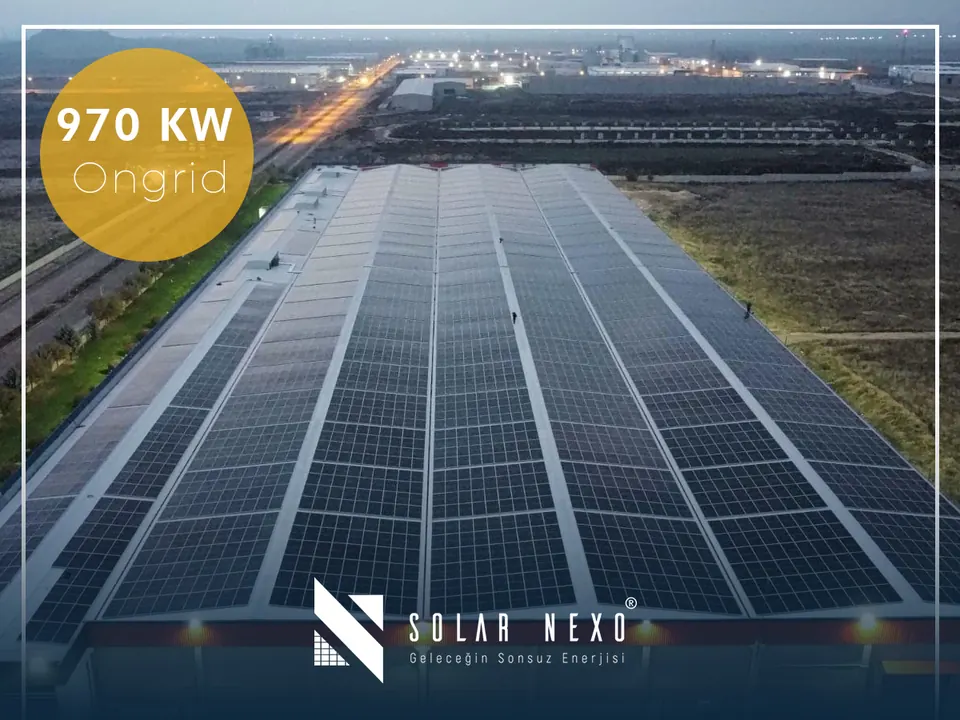
In solar energy in Gazipaşa there is a fact that is often overlooked: a solar power plant has value not on the day it is installed, but for as long as it keeps producing years after installation. The most common cause of silently falling production is not the panels, but the inverter. A service job Solar Nexo shared on Instagram shows exactly this: at an existing solar power plant in Gazipaşa, a technical inspection was carried out and 5 faulty inverters were replaced.
An important note: this is not a new plant installed by Solar Nexo in Gazipaşa; it is a service job done at an existing facility. Starting from that example, this article explains how maintenance, inverter replacement and new installation should be handled for system owners in Gazipaşa.
Solar energy potential in Gazipaşa
We do not give a separate PVGIS 5.3 value for Gazipaşa. For neighbouring Alanya, annual specific production is 1,615 kWh/kWp, and for central Antalya 1,656 kWh/kWp. Because Gazipaşa lies on the coastal strip between the two, production of the same order of magnitude is expected. A site-specific shading, orientation and tilt calculation is made at the survey.
An example calculation: a 100 kWp plant produces about 161,500 kWh per year with the Alanya value (100 × 1,615). Sustaining this production over the years depends on maintenance. Although the panels have a linear performance warranty, the inverters, cabling and connectors are separate sources of faults.
Why do inverters stand out in existing plants?
The inverter is the hardest-working electronic part of a solar system. It runs at high power all day, heats up and is exposed to grid fluctuations. For this reason it is far shorter-lived than the panel. For example, the standard warranty on TommaTech on-grid and hybrid inverters is 5 years from the invoice date, while the panel has a 30-year performance warranty. In other words, an inverter replacement may come up during a system's life.
The inverter is decisive for efficiency too. For example, the Huawei SUN2000-10KTL-M1 has a maximum efficiency of 98.6% and a European weighted efficiency of 98.1%; that is, a good inverter loses only a few percent in conversion. A faulty or low-efficiency inverter, however, can cost a serious share of production.
| Component | Typical warranty (example) | Effect of a fault |
|---|---|---|
| Panel | TommaTech 144TN: 15 years product, 30 years performance | A single panel causes limited production loss |
| On-grid / hybrid inverter | TommaTech: 5 years (from invoice date) | The whole connected panel string can stop |
| Battery (LV) | TommaTech: 60-month product warranty | Backup and night use are affected |
Warranty periods vary by brand and model; keep your own system's warranty certificate and invoice date.
The service example in Gazipaşa: what was done?
The job Solar Nexo shared is the replacement of 5 faulty inverters following a technical inspection at an existing plant. Because the details of the work (brand, power, cause of fault) were not included in the post, we do not speculate here. In a service job of this kind, the general flow goes as follows:
- Technical inspection: Production data, fault logs, string voltages and currents and insulation measurements are examined.
- Fault diagnosis: It is determined which device stopped and why; problems from cables, connectors and panels are separated out.
- Device selection: A new inverter is chosen according to the existing string voltage, power and communication compatibility.
- Replacement and commissioning: The old device is removed, the new one connected, settings made and the monitoring system checked.
- Recording and reporting: The work done is documented.
For the symptoms of inverter faults and their solutions, you can look at our article on inverter faults.
Regulation and compliance notes for inverter replacement
At a grid-connected plant with a connection agreement, replacing an inverter can affect the power at the connection point and the protection settings. The regulation has a condition that main equipment (panels, inverters, batteries) must have been manufactured within the last five years (Unlicensed Electricity Generation Regulation, 2026 text, Art. 37/6). We cannot say definitively how this rule applies to an inverter replacement at an existing facility or whether notification to the distribution company is required; we recommend consulting Akdeniz Elektrik Dağıtım A.Ş. (AEDAŞ, the local electricity distribution company) on this before the work.
In addition, when choosing a new inverter, the string voltage, maximum current and number of MPPTs must be compatible with the existing panel layout. An incompatible choice both lowers efficiency and can damage the device. If you are considering a capacity increase or reconfiguration, the regulation's limits need to be checked; a detailed explanation is in our article on refurbishing old solar plants.
Maintenance programme: how often, and what is checked?
The purpose of maintenance is to catch small problems before they turn into faults. A simple annual programme might look like this:
- Monitoring data: Compare production with similar days and with the expected value; investigate if there is deviation.
- Inverter: Fault codes, cooling channels and fan condition, ventilation clearance.
- DC side: Heating at connectors, cable wear or rodent damage, string voltage.
- Mounting structure: Loosening connections, corrosion, slippage after wind.
- Panel surface: Dust, bird droppings and partial shade; gentle cleaning when needed.
You can also look at our article on solar energy system maintenance for the whole maintenance programme. On its website Solar Nexo lists the Maintenance and Technical Support step and 24/7 technical support as services.
Silent production loss: an example calculation
An inverter fault does not always show up as a complete stop. In a multi-string (multi-inverter) plant, one inverter dropping out lowers only part of total production, and it may take time to notice. Let us give a hypothetical example: a 100 kWp plant runs with 5 inverters, each connected to a 20 kWp panel group. When one inverter fails, 20 kWp is out of service.
With the Alanya value (1,615 kWh/kWp), the annual production of the 20 kWp group is about 32,300 kWh (20 × 1,615). The loss from this group approaches about 100 kWh per day in summer (20 × 5 kWh/kWp). If the fault goes unnoticed for a month, the loss from this inverter alone amounts to several thousand kWh. A monitoring system catches this difference in the first days. So an "inverter replacement" is not only a renewal job but also an example showing the return on regular monitoring.
Questions to ask when choosing a service company
If you will get service support for your existing plant, ask these questions in writing:
- Which measurements are made in the technical inspection, and are the results given as a report?
- Can a spare inverter or substitute device be provided, and what is the lead time?
- Is a separate warranty given for installation workmanship?
- Are the old and new serial numbers documented when a device is replaced?
- Is there a support line that can be reached in an emergency?
The answers to these questions help you compare not only price but the quality of the service. In the written quote, ask for labour, device and transport items to be shown separately; that way you can see whether different quotes really cover the same scope. For other criteria to look at when choosing a company, see our article on criteria to consider when choosing a solar company.
For those considering a new installation in Gazipaşa
If you are planning a new system, pay attention to the following for both the first installation and the operating period in later years: First, look not only at the panel price but at the inverter brand, warranty period and service support. Second, ask for the system to be monitorable; if a fall in production is not monitored, it may go unnoticed for weeks. Third, ask about the company's local service capacity. For grid-connected systems in Gazipaşa, the application is made through AEDAŞ's LUS platform in Antalya, and the official time limits depend on the regulation.
You can use our contact page for a free site survey; for general information, you can look at our solar energy in Antalya page.
Finally, ask for all of these steps to be recorded: measurement reports, device serial numbers and warranty documents make every future service job easier for you.
Conclusion
A solar energy investment in Gazipaşa does not end with installation. The service example in which Solar Nexo replaced 5 faulty inverters at an existing plant shows how important maintenance and timely intervention are for protecting production. If you have an existing system, check your monitoring data regularly, keep your warranty documents and consult the distribution company before a replacement; if you are planning a new installation, assess the inverter and service support from the start.
Frequently asked questions
How much do solar panels produce per year in Gazipaşa?
We do not give a separate PVGIS value for Gazipaşa. According to PVGIS 5.3, annual production of 1,615 kWh/kWp is expected in neighbouring Alanya and 1,656 kWh/kWp in central Antalya; Gazipaşa will be at a level between the two. Actual production varies with shading, orientation and tilt. You can estimate annual production roughly by multiplying your plant size in kWp by the value.
Did Solar Nexo build a plant in Gazipaşa?
No. The Gazipaşa job Solar Nexo shared on Instagram is the replacement of 5 faulty inverters at an existing solar power plant after a technical inspection. This is a service job, not a Solar Nexo installation. You can request a free site survey for a new installation. For service and maintenance requests, you can reach us via the details on the contact page.
How long does an inverter last before it fails?
We cannot give a specific period; lifetime depends on brand, model, ambient temperature and load. An inverter has a shorter warranty than a panel: for example, the standard warranty on TommaTech on-grid and hybrid inverters is 5 years from the invoice date. Because a replacement may be needed over a system's life, it is reasonable to allow for this in the budget. That is why keeping the warranty certificate and invoice date is important.
Does the distribution company need to be notified of an inverter replacement?
We cannot say that definitively. The regulation has a condition that main equipment must have been manufactured within the last five years, and the power and protection settings in the connection agreement may change. Before a replacement, talking to AEDAŞ, the distribution company in Antalya, is the right way to clarify any notification or compliance requirement. Getting written information before the work prevents disputes that might arise later.
How many times a year should solar energy system maintenance be done?
The general recommendation is a comprehensive check at least once a year: inverter, DC connectors, mounting structure and panel surface. In addition, monitoring data should be followed regularly. In areas with heavy dust, pollen and bird droppings, surface cleaning may be needed more often. Manufacturer instructions and warranty terms must be followed. Keeping maintenance records also makes warranty claims easier.
How do I tell that production has dropped?
The most practical way is to compare mobile monitoring data with similar days and with expected production. If there is a marked difference between two equally sunny days, an inverter fault, shade, soiling or a cable problem should be investigated. In systems without monitoring, a loss may go unnoticed for weeks; so ask for a monitoring system from the start. Replacing a device without determining the cause of low production can create unnecessary expense.
Can I replace the inverter at an old plant with a more powerful one?
It may be technically possible, but string voltage, number of MPPTs and the power limit in the connection agreement must be compatible. A capacity increase is also subject to the regulation and the distribution company's conditions. So the existing system should first be technically inspected, and then a written engineering assessment obtained. In short, technical assessment first and a decision afterwards is the soundest method.
Sources
Want a clear calculation for your roof?
The Solar Nexo team carries out a free site survey at your address in Antalya and designs the system that suits your roof, consumption and budget.