Short answer
Antalya's climate affects solar panel performance in two ways: about 2,967 hours of sunshine a year increase production, while high temperature reduces efficiency. At 34 °C ambient and 1,000 W/m² irradiance the cell reaches about 65 °C; a TOPCon panel with a coefficient of −0.30 %/°C loses about 12% of power and a PERC panel with −0.34 %/°C about 13.6%.
Key takeaways
- According to MGM (the Turkish State Meteorological Service), Antalya has about 2,967 hours of sunshine a year and about 73 rainy days; the claim of "300 sunny days a year" is not in MGM data.
- According to GEPA (Turkey's solar energy potential atlas), annual irradiation is about 1,650 kWh/m²; it is about 8% above the Turkish average.
- For 34 °C ambient, 1,000 W/m² and a NOCT of 45 °C, cell temperature comes to about 65 °C (calculation).
- In this condition TOPCon (−0.30 %/°C) loses about 1.6 points less power than PERC (−0.34 %/°C) (comparison of two example models).
- Leaving air circulation behind the panel protects both efficiency and the manufacturer's conditions.
Antalya's climate affects solar panel performance in two directions: abundant sun increases production, while high temperature reduces panel efficiency. In Antalya, panels have an annual production potential of 1,656 kWh/kWp (PVGIS 5.3); however, at summer midday cell temperature can rise above 60 °C, and that means a measurable loss against nominal power. This article takes up the effect of heat, humidity and salty air on panels with figures and engineering facts.
The general rule is this: climate can be managed with the right panel choice and the right mounting. What matters is to account for summer heat and coastal humidity at the start of design and to choose equipment for these conditions. The problem is making decisions without knowing these effects.
What does Antalya's climate offer solar panels?
According to MGM's measurements for 1930-2025, total annual sunshine duration in Antalya is about 2,967 hours (calculated from the sum of the monthly values). According to the GEPA (Ministry of Energy and Natural Resources) atlas, annual global radiation is about 1,650 kWh/m². The Turkish average is 2,741 hours of sunshine and 1,527.46 kWh/m² of irradiation (Ministry, 26 December 2024). On that basis, Antalya's irradiation is about 8% above the Turkish average.
On the rainfall side, according to MGM, total annual precipitation is about 1,032 mm and the number of rainy days is about 73; most of the rain falls between November and February. In July and August the monthly average number of rainy days is about 0.5. In other words, summer months are dry; this means panels are not cleaned by rain on their own. The often-heard statement "300 sunny days a year in Antalya" is a claim that does not appear in MGM data; we use the measured values above.
Temperature and panel efficiency: the TOPCon advantage
Panel power falls as cell temperature rises. This drop is given by the temperature coefficient in the panel's datasheet. In July the average temperature in Antalya is 28.6 °C and the average maximum is 34.2 °C; the record high is 45.0 °C (MGM, 1930-2025). A panel cell runs much hotter than the ambient temperature.
A calculation with the NOCT approach goes as follows (an estimate, not a measurement): cell temperature ≈ ambient + (NOCT − 20) / 800 × irradiance. For ambient 34 °C, irradiance 1,000 W/m² and NOCT 45 °C, cell temperature comes to about 65 °C. In that case the power loss relative to STC (25 °C) depends on the coefficient:
| Technology (example model) | Pmax temperature coefficient | Approx. power loss at 65 °C |
|---|---|---|
| TOPCon (TommaTech 144TN10, Jinko Tiger Neo) | −0.30 %/°C | about 12% |
| PERC (LONGi Hi-MO 5 example) | −0.34 %/°C | about 13.6% |
The difference is about 1.6 points: TOPCon loses slightly less in this hot condition. This is a comparison of two example models; do not generalise to all TOPCon and PERC products. To see the difference between TOPCon and PERC in detail, you can look at our article on what TOPCon panels are. The Pmax coefficient in the datasheet of the 605 W TommaTech TOPCon panel used in the installations Solar Nexo shared on Instagram is −0.30 %/°C.

Why is summer production still the highest despite the heat?
The temperature loss is real, but in Antalya summer production is far above winter's. According to PVGIS 5.3, July is 168 and August 167 kWh/kWp, while December and January are 99 kWh/kWp. The reason is irradiation: according to GEPA data, daily global radiation is 6.93 kWh/m² in June and 6.65 in July but 1.92 kWh/m² in December; that is, summer irradiation is about 3.5 times winter's. Because the temperature loss is in the 12-14% band while the irradiation difference is several-fold, net production in summer is still far above winter's. Because PVGIS takes temperature and low-irradiance losses into account in its calculation, the annual values given already include this effect.
There is a practical consequence here: on cool, clear days, that is, in April-May and October, panel efficiency is closer to the nominal value. In these months instantaneous power can be high; inverter sizing is also done for these peak values. For a detailed seasonal look, see our article on solar panel performance in the winter months.
An example calculation: the effect of temperature on a 10 kWp system
Let us think of a 10 kWp system. At summer noon, with cell temperature at about 65 °C, power falls about 12% in TOPCon panels with a coefficient of −0.30 %/°C: 10 kWp × 0.88 ≈ 8.8 kW (excluding other losses). For a PERC panel with −0.34 %/°C, it comes to 10 × 0.864 ≈ 8.64 kW. The difference at that instant is about 160 W. This difference arises in the hottest hours of the year; its effect on annual energy is therefore far below this instantaneous difference. So when choosing a panel, one should look not only at the temperature coefficient but also at efficiency, warranty and degradation rate.
Why does ventilated mounting matter?
Air circulation behind the panel directly affects cell temperature. Panels mounted flush against the roof or with a narrow gap run hotter. The TommaTech datasheet also requires the panel to be mounted over a fire-resistant surface with adequate ventilation left behind it. On roofs that are not fire-resistant, such as plastic or PVC, installation should not be done without a fire protection layer; mounting contrary to the installation manual voids the warranty.
In practice the following are recommended:
- Leave a gap between the underside of the panel and the roof in line with the manufacturer's recommendation.
- On flat roofs, air flow already improves when a tilted frame is used.
- Allow wind to pass at the edges of panel arrays; avoid cramped layouts.
- Install the inverter in a ventilated place out of the sun; inverter temperature also affects efficiency and life.
For mounting types, take a look at our article on solar panel mounting systems.
Humidity, rainfall and salty air
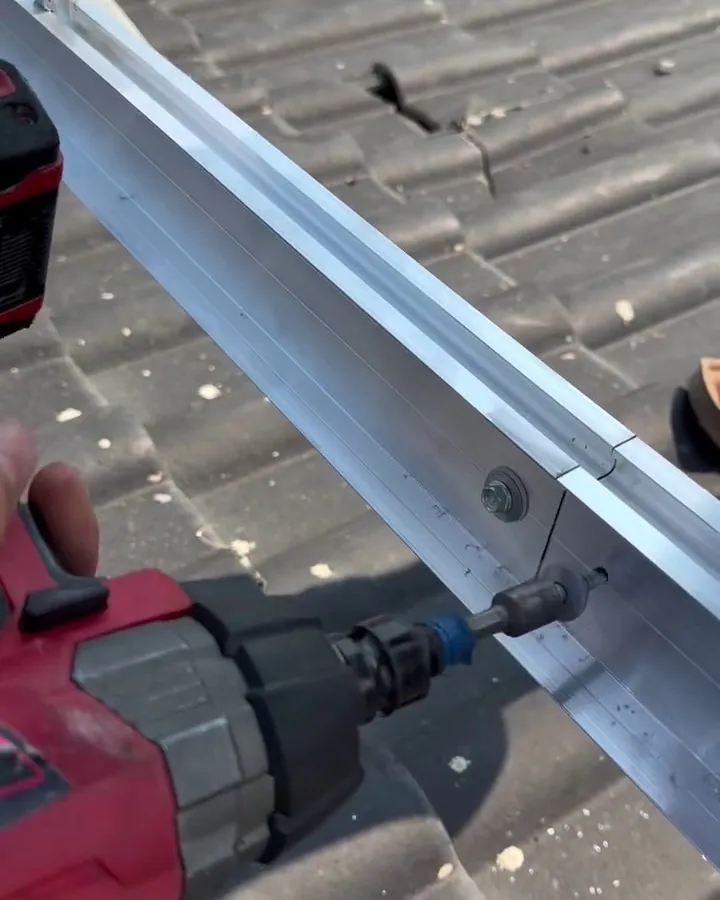
In Antalya, summer humidity is high especially on the coastal strip. Humidity and salty air affect the metal parts more than the panel itself: the mounting structure, fasteners, cables and connectors. In the panel datasheet, an IP68-class junction box protects against humidity and dust. However, for installations near the coast take the following measures:
- Choose aluminium or suitably coated (galvanised) mounting structure.
- Use stainless fasteners; watch for galvanic corrosion that forms when different metals touch each other.
- Make sure connectors are sound, good quality and correctly crimped.
- Do a visual check at least once a year.
We cannot give the effect of salty air numerically; it depends on distance from the coast and wind direction. Check whether the warranty certificate has any restriction about salty environments. For soiling and cleaning, see our article on solar panel cleaning.
Wind, snow and hail
According to MGM, the fastest wind recorded in Antalya is 43.2 m/s (22 January 1998) and the highest snow depth is 5 cm (7 January 1993). The 605 W TOPCon panel's datasheet states a wind load of 2400 Pa and a snow load of 5400 Pa; these values are the panel's own strength, and the mounting structure and installation must be calculated separately. Hail, storm and tornado events are recorded on the western coast (Kumluca, Finike, Demre); because we could not find a province-level hail-frequency statistic at MGM, we do not give a numerical hail risk.
A summary for choosing a system suited to the climate in Antalya
This list is useful for turning climate information into concrete decisions:
- Compare panels with a low temperature coefficient from the datasheet.
- Ask for ventilated mounting that follows the manufacturer's instructions.
- In areas near the coast, choose corrosion-resistant mounting structure.
- Request a mounting-structure calculation for wind load.
- Follow production regularly with a monitoring system.
For a wider Antalya framework, you can look at our solar energy in Antalya page, and for a survey request our contact page.
Conclusion
Antalya's climate is advantageous for solar energy, but if high temperature and salty air are not taken into account, efficiency and life can fall. Panels with a low temperature coefficient such as TOPCon, ventilated mounting and corrosion-resistant materials are the basic tools for managing these effects. Every site's conditions differ; distance from the coast, wind direction, roof material and shading change the result. A definitive assessment is made with an on-site survey.
Frequently asked questions
Does Antalya's heat damage solar panels?
It does not damage them, but it temporarily reduces efficiency. Panel power falls as cell temperature rises. At 34 °C ambient and 1,000 W/m² irradiance the cell reaches about 65 °C; a panel with a coefficient of −0.30 %/°C loses about 12% against nominal power. This loss comes back when the panel cools. The real factors that shorten a panel's life are poor mounting, cable heating and inadequate ventilation.
Is a TOPCon panel better than PERC in a hot climate?
According to two example models, yes, slightly better. The Pmax temperature coefficient is −0.30 %/°C in the TOPCon examples and −0.34 %/°C in the PERC example; at a cell temperature of 65 °C the loss comes to about 12% against 13.6%. This is a comparison of two models and should not be generalised to all products. When choosing a panel, look not only at the temperature coefficient but also at warranty and efficiency.
How many sunny days does Antalya have per year?
There is no statistic like "300 sunny days" at MGM. According to MGM data, Antalya has about 2,967 hours of sunshine a year and about 73 rainy days. In July and August the monthly average number of rainy days is about 0.5; that is, summers are dry. These data are based on the 1930-2025 measurement period and can vary from year to year.
Why is an air gap left behind the panel?
Air circulation lowers cell temperature and maintains efficiency. In addition, the TommaTech datasheet states that the panel must be mounted on a fire-resistant surface with adequate ventilation and that mounting contrary to the installation manual can void the warranty. For this reason the gap must be left according to the manufacturer's instruction. Be sure to read the manufacturer's installation manual before mounting. Following the mounting conditions in the warranty certificate also protects you in a possible warranty claim.
Does salty air damage solar panels?
Salty air can increase the risk of corrosion, especially in the metal mounting structure, fasteners and connectors; the panel itself is designed to be protected against humidity and dust. Aluminium or galvanised structure, stainless fasteners and regular checks are recommended. We cannot give its effect numerically. Material compatibility between the panel and the mounting structure is also important for corrosion.
Do snow or storms affect panels in Antalya?
In central Antalya, MGM has recorded a maximum snow depth of 5 cm and a fastest wind of 43.2 m/s. The 605 W TOPCon panel's datasheet gives a wind load of 2400 Pa and a snow load of 5400 Pa. The mounting structure should be calculated for wind, and hail risk on the western coast should be assessed separately. These values are the panel's own strength; the mounting structure and anchoring are calculated separately.
Is panel cleaning needed in summer?
Rainfall is very low in summer; in Antalya the monthly average number of rainy days in July and August is about 0.5. For this reason dust and pollen can build up on the panel surface. The soiling level can be seen from monitoring data and by eye; cleaning should be done with gentle methods that follow the manufacturer's recommendation. If there is a sudden drop in monitoring data, shade or a fault should be investigated as well as soiling.
Sources
Want a clear calculation for your roof?
The Solar Nexo team carries out a free site survey at your address in Antalya and designs the system that suits your roof, consumption and budget.