Short answer
An inverter is the device that converts the direct current (DC) produced by solar panels into the alternating current (AC) used in homes and on the grid. With MPPT it runs the panels at their most efficient point, stays in sync with the grid and protects the system. In Antalya three main types are used: on-grid, off-grid and hybrid; the choice depends on grid, battery and load.
Key takeaways
- An inverter converts DC to AC; it also handles MPPT, grid synchronisation, protection and monitoring.
- In the Huawei SUN2000-10KTL-M1 datasheet, maximum efficiency is 98.6% and European weighted efficiency is 98.1%.
- The standard warranty on TommaTech on-grid and hybrid inverters is 5 years from the invoice date.
- In the Manavgat example shared by Solar Nexo, 12.1 kWp of panels is paired with a 15 kW hybrid inverter; the ratio is about 0.81 (calculation).
- In an unlicensed application, the inverter must have been manufactured within the last five years (2 April 2026 amendment).
The short answer to "what is an inverter?" is this: it is the device that converts the direct current (DC) produced by solar panels into the alternating current (AC) used in homes and on the grid. A solar inverter also keeps the panels at their most efficient operating point (MPPT), works in sync with the grid and protects the system. Three main types are used in systems installed in Antalya: on-grid, off-grid and hybrid inverters.
What is an inverter and what does it do in the system?
A solar panel produces direct current when it receives light. Air conditioners, refrigerators and lighting in homes run on alternating current. The inverter performs this conversion. But its job is not limited to converting:
- MPPT: Draws maximum power by continuously adjusting the voltage and current of the panel array.
- Grid synchronisation: On-grid and hybrid inverters monitor the grid's voltage and frequency and disconnect themselves if they are out of range.
- Protection: Protects the system against overvoltage, overcurrent, leakage current and high temperature.
- Monitoring: Shows production, consumption and fault records through an app.
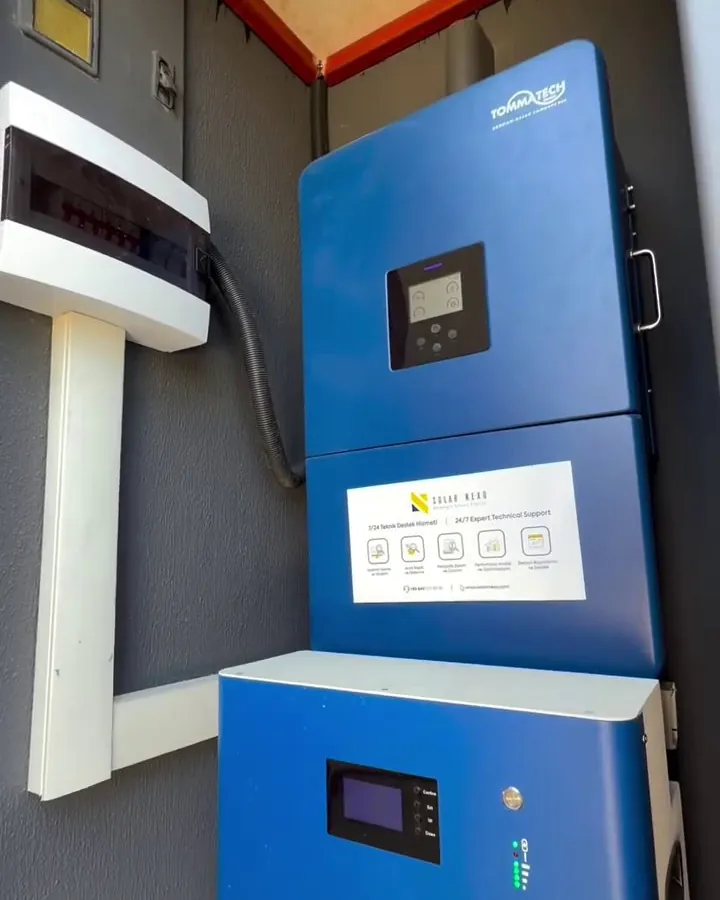
For this reason the inverter is the second most critical component of the system after the panels. You can see its place in the system in the diagram below.
The MPPT answer to "what is an inverter?"
MPPT is the most technical but most important part of the question "what is an inverter?". On a panel's current-voltage curve, maximum power is obtained at only a single point. This point shifts as irradiance and temperature change. The MPPT (Maximum Power Point Tracking) algorithm finds and tracks this point within seconds.
If an inverter has more than one MPPT input, panel arrays facing different directions can work independently. On tile roofs in Antalya, placing panels on both the south and west surfaces is common. On such a roof, a single-MPPT inverter has to compromise between the two surfaces; a two-MPPT inverter optimises each surface separately.
Types of inverters: on-grid, off-grid and hybrid
| Type | Grid connection | Battery | When the power goes out |
|---|---|---|---|
| On-grid (grid-connected) | Yes | None | Shuts down for safety |
| Off-grid (independent of the grid) | None | Required | Operates independently |
| Hybrid | Yes | Can be connected | Can run with the battery and backup output |
| Microinverter | Yes | Usually none | Shuts down for safety |
An on-grid system is the plainest; it consists of panels, an inverter and a grid connection. If the power goes out, the inverter shuts down too, to protect grid technicians. An off-grid inverter runs without a grid and has to balance production and consumption with a battery. A hybrid inverter combines the two: it works with the grid, charges the battery and can supply backup power in an outage. We covered the difference between the three systems in detail in our on-grid, off-grid and hybrid difference article.
String, central and microinverters
The second half of the question "what is an inverter?" is where and how it is used. In a string inverter, panels are connected into series strings and each string goes to one MPPT input; this is the most common solution in residential and rooftop commercial projects. A central inverter gathers many strings into a single large unit in megawatt-scale ground-mounted plants. A microinverter is fitted behind each panel and manages each panel separately. This approach is considered on roofs with shading problems; however, because the number of devices rises, the maintenance approach changes too.
Efficiency and Antalya heat: the derating effect
Inverter efficiency shows how much of the input power is passed to the output. For example, in the Huawei SUN2000-10KTL-M1 datasheet, maximum efficiency is 98.6% and European weighted efficiency is 98.1%. At this level, loss in inverter conversion stays around 2%.
Let us see the effect of an efficiency difference with a simple calculation. A 12.1 kWp system produces about 20,000 kWh a year in Manavgat according to PVGIS 5.3 data. In such a system, every 1% difference in inverter efficiency is worth about 200 kWh/year (calculation; PVGIS's 14% system loss assumption already includes inverter loss).
Summer temperatures in Antalya are high. According to MGM (Turkish State Meteorological Service) data, the average maximum temperature in July is 34.2 °C. Inverters can limit power (derating) when they overheat. For this reason the inverter's operating temperature range, protection class and mounting location (shade, ventilation, a wall that does not take direct sun) are important. The maximum operating temperature and derating curve in the datasheet must always be checked.
Mounting location and ventilation
The same inverter behaves differently in a cool, shaded technical room and on a wall in direct sun. In solar inverter installation, a ventilation gap should be left around the device, and a suitable protection class (IP) should be chosen where it is exposed to direct sun and rain. In humid coastal areas such as Kemer, Alanya or Manavgat, this protection class and the sealing of cable entries matter even more.
Panel-to-inverter power ratio in Solar Nexo installations
The installations Solar Nexo shared on its Instagram account (@solarnexotr) show that inverter selection is not made solely according to panel power. In installations with 605 W panels, the ratio of panel power to inverter power is as follows (a calculation from the shared panel and inverter numbers):
| Location | Panel power | Inverter | Panel / inverter ratio |
|---|---|---|---|
| Döşemealtı | 36 × 605 W = 21.78 kWp | 20 kW hybrid | about 1.09 |
| Manavgat | 20 × 605 W = 12.1 kWp | 15 kW hybrid | about 0.81 |
| Belek | 24 × 605 W = 14.52 kWp | 20 kW hybrid | about 0.73 |
| Döşemealtı (off-grid) | 10 × 605 W = 6.05 kWp | 11 kW off-grid | about 0.55 |
In hybrid and off-grid systems, the inverter must also cover the peak power of loads running at the same time, such as the air conditioner, pump and oven, and the battery charge current. For this reason panel power may stay below inverter power. In on-grid systems, choosing panel power slightly above inverter power is common engineering practice; however, this ratio is set according to the project, the inverter's MPPT voltage range and the maximum DC input the manufacturer allows.
Criteria to look at when choosing an inverter
- Power and phase: Residential is mostly single-phase; businesses and large villas are three-phase. The number of phases must match the subscription type.
- Number of MPPTs and voltage range: If there are strings facing different directions on the roof, at least two MPPTs are needed. String voltage must fit the inverter's input range.
- Maximum input current: The short-circuit current of high-power panels such as 605 W (for example 14.48 A) must not exceed the current limit of the MPPT input.
- Efficiency and operating temperature: Look at maximum and European weighted efficiency and the derating curve.
- Battery compatibility: In a hybrid inverter, battery voltage, charge and discharge current and the communication protocol must be checked. For details, see our hybrid inverter selection article.
- Monitoring and service: Remote monitoring, local service support and access to spare parts determine downtime.
- Warranty: The standard warranty on TommaTech on-grid and hybrid inverters is 5 years from the invoice date; warranty length varies by brand and model.
On shaded roofs, microinverter and power optimizer solutions should also be considered as an alternative.
Regulation and service: what to watch for with inverters
Under the 2 April 2026 amendment to the regulation, main equipment such as the panel, inverter and battery must have been manufactured within the last five years. For this reason an unlicensed application cannot be made with a second-hand or old-stock inverter. In systems with batteries, no payment is made for energy fed from the battery to the grid; the hybrid inverter should be configured with this limit in mind.
Because an inverter is an electronic device, it may need servicing over time. As Solar Nexo, we also carried out the replacement of 5 faulty inverters in an existing solar plant in Gazipaşa after a technical check; this was a service job, not our installation. For fault symptoms and solutions you can look at our inverter faults and solutions article.
To determine the right inverter type and power for your system, you can request a free site survey.
Conclusion
If you ask what an inverter is, we can say it is the converter, protector and manager of a solar energy system. The panels produce the electricity, and the inverter makes this electricity usable and safe. Which of the on-grid, off-grid and hybrid types is suitable depends on the grid situation, outage frequency and your need for a battery. In selection, look not only at the watt value but also at the MPPT structure, input current, efficiency curve, temperature behaviour and service support. The regulation is as described as of October 2026 and may change.
Frequently asked questions
What is an inverter and why is it needed in a solar energy system?
An inverter is the device that converts the direct current (DC) produced by the panels into the alternating current (AC) used at home and on the grid. In addition, with MPPT it runs the panels at their maximum power point, monitors grid voltage and frequency and protects the system against conditions such as overcurrent. Without an inverter, panel electricity cannot be used in any device; so inverter selection is one of the most important steps of system design and should be made according to the panel layout on the roof.
What is the difference between on-grid, off-grid and hybrid inverters?
An on-grid inverter works connected to the grid and has no battery; it shuts down when the power goes out, for safety. An off-grid inverter works without a grid and requires a battery. A hybrid inverter works with the grid while also being able to charge a battery and supply backup power in an outage. The choice depends on outage frequency, battery need and grid access; for most homes with a grid in Antalya the discussion is between on-grid and hybrid.
What is MPPT and how many MPPT inputs are needed?
MPPT is the algorithm that tracks the maximum power point by continuously adjusting the current and voltage of the panel array. If there are panels facing different directions on the roof, at least two MPPT inputs are preferred, because each surface is optimised separately. On a single-direction, shade-free roof, a single MPPT is often enough. The voltage range and current limit of the inputs must be checked together with panel selection.
Can inverter power be smaller than panel power?
Yes, especially in hybrid and off-grid systems. In the shared Manavgat example, 12.1 kWp of panels is paired with a 15 kW hybrid inverter, and in the Döşemealtı off-grid example 6.05 kWp of panels with an 11 kW inverter. This is because the inverter must also cover the peak power of loads running at the same time and the battery current. These ratios are calculations from shared numbers and differ project by project.
How efficient should an inverter be?
According to the datasheet example, the Huawei SUN2000-10KTL-M1 has a maximum efficiency of 98.6% and a European weighted efficiency of 98.1%. When choosing, look not only at maximum efficiency but also at European weighted efficiency and the derating curve at high temperature. This curve matters in Antalya's hot summers, because if the inverter cuts power at high ambient temperature, part of the production is lost, and this loss is often not noticed at first glance.
How many years is the inverter warranty?
Warranty varies by brand and model. The standard warranty on TommaTech on-grid and hybrid inverters is 5 years from the invoice date. The panel warranty is separate and usually much longer. The quotation should state in writing the inverter's exact model code, the warranty period, the scope of the warranty and local service support. Warranty extension options can also be asked about separately, depending on the manufacturer.
Does the inverter keep working when the power goes out?
A standard on-grid inverter does not; it shuts down for the safety of grid technicians. A hybrid inverter, if it has a battery and a backup output connection, can keep supplying the home during an outage. An off-grid system is independent of the grid anyway. If backup supply is wanted, the inverter and battery must be chosen accordingly; the total power of the loads to be backed up (air conditioning, pump, refrigerator) must be calculated in advance.
Sources
Want a clear calculation for your roof?
The Solar Nexo team carries out a free site survey at your address in Antalya and designs the system that suits your roof, consumption and budget.