Short answer
Hybrid inverter selection rests on four criteria: AC output power for the loads, the number of MPPTs plus voltage and current range at the panel input, battery voltage and communication compatibility, and phase structure. In Antalya, air conditioning, the pool pump and outage risk shape the load list. Under the regulation, no payment is made for energy fed from the battery to the grid.
Key takeaways
- The Voc of a 605 W panel is about 56 V at 0 °C; on a 1000 V input inverter, a maximum of 17 panels can be connected per string (calculation).
- Charging a 30 kWh battery at 5 kW takes about 6 hours.
- In the shared installations, a 20 kW inverter is paired with both a 30 kWh and a 15 kWh battery; battery capacity is chosen from consumption.
- No payment is made for energy fed from the battery to the grid (2 April 2026 amendment).
- The standard warranty on TommaTech on-grid and hybrid inverters is 5 years, and the product warranty on LV batteries is 60 months.
Hybrid inverter selection rests on four main criteria: AC output power, panel input (number of MPPTs, voltage and current range), battery compatibility and phase structure. These four criteria are interdependent; a mistake in one affects the others. In Antalya, the air-conditioning and pool pump load in summer, and the risk of outages in rural areas, are the two real needs that decide the choice. In this article we walk through hybrid inverter selection step by step, with calculation examples.
Why is hybrid inverter selection harder than the others?
An on-grid inverter works only between the panels and the grid. A hybrid inverter manages four-way energy flow between the panels, the battery, the grid and the household load. For this reason the panel side, the battery side and the backup output side must each be verified separately. We described the general logic of inverters in our what is an inverter article; here we focus on the hybrid type.
The most common purposes of a hybrid system in Antalya come down to two: using the surplus energy produced in the daytime in the evening, and keeping critical loads running during a grid outage. For the general framework of a hybrid system you can look at our hybrid solar energy system article.
Step 1: Determine AC output power from your loads
The inverter's continuous output power must cover the total of the loads that can run at the same time. Motorised devices such as air conditioners, pumps and refrigerators draw a starting current several times their nominal current when they start. That is why the inverter's short-term overload (surge) capacity is stated separately in the datasheet.
A simple method: list the loads that run at the same time in the home, mark those with high starting current and calculate the worst-hour scenario. Separating the loads to be fed from the backup output from main consumption prevents the inverter power from being unnecessarily inflated. In Antalya in summer, air conditioning, pool pump and water heating loads stack up in the afternoon; for this reason it is safer to calculate the peak consumption hour not from the annual average but from July and August evenings. Your bill breakdown and the label power of the devices you use are the starting point for this calculation.
- Villa: two or three air conditioners, a pool pump, kitchen appliances and lighting.
- Rural home: a water pump, a refrigerator and lighting.
- Business: refrigeration, till systems and lighting.
Step 2: Check the panel input and MPPT structure
At the panel input, three values are verified together: maximum DC input voltage, the MPPT operating voltage range and the input current limit.
Take the 605 W TommaTech TT605-144TN10 panel as an example: Voc 52.58 V, Vmp 43.95 V, Isc 14.48 A and a Voc temperature coefficient of −0.260 %/°C. When the air temperature drops to 0 °C, Voc rises by about 6.5% to about 56 V per panel (calculation). On an inverter with a maximum input voltage of 1000 V, a maximum of 17 panels can be connected in one string (17 × 56 V ≈ 952 V). On hot summer days, when the cell reaches about 65 °C, voltage falls; the string voltage must not drop below the lower limit of the MPPT range.
On the current side, the panel's Isc (14.48 A) must stay below the maximum current limit of the MPPT input. High-power panels approach this limit more quickly. In addition, if there are strings facing different directions on the roof, at least two MPPT inputs are needed; this is directly related to the roof orientation decision.
Step 3: Verify battery compatibility
On the battery side, four things must be compatible together:
- Voltage class: Low-voltage (48 V class) and high-voltage battery systems connect to different inverter inputs; the two cannot be used in place of each other.
- Charge and discharge current: The inverter's maximum battery current must not exceed the current the battery allows.
- Communication: The communication protocol between the battery management system (BMS) and the inverter must be compatible. This information is in the manufacturer's compatibility list.
- Capacity and power balance: If battery capacity (kWh) and inverter power (kW) are chosen out of proportion, the battery either charges slowly or falls short.
A simple example for charging time: filling a 30 kWh battery at 5 kW takes about 6 hours (30 ÷ 5). In Antalya in July, average daily sunshine is 11.7 hours (MGM, the Turkish State Meteorological Service); daytime hours are enough to fill the battery. In winter, with average sunshine of 4.8 hours in December, the same battery fills much later.
For the properties of a LiFePO4 battery, see our what is a LiFePO4 battery article.
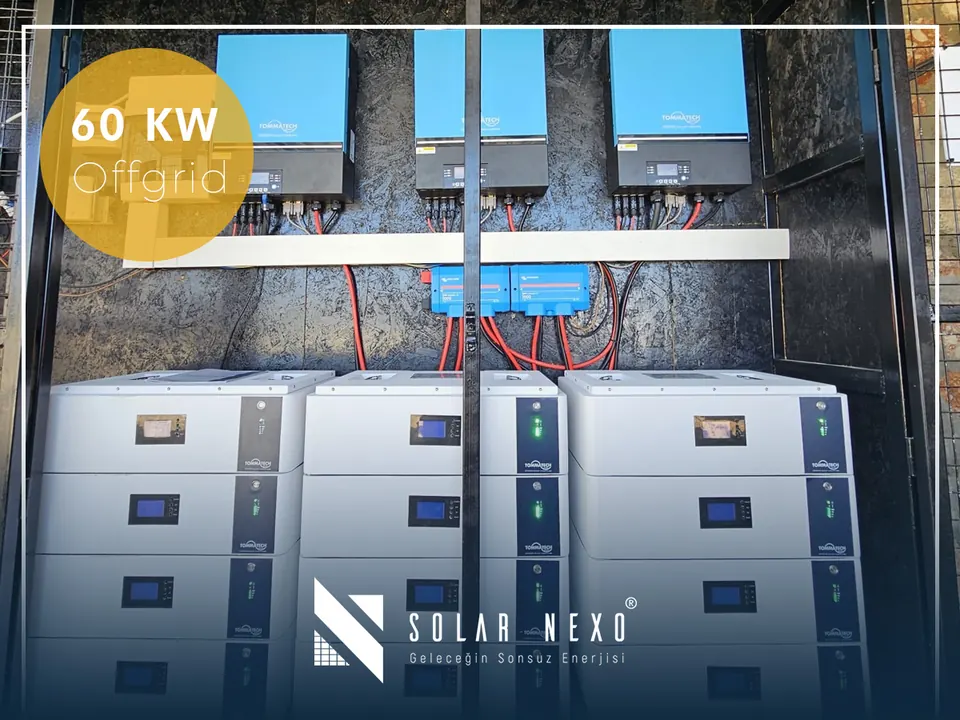
Inverter and battery pairing in Solar Nexo example installations
The residential installations Solar Nexo shared on its Instagram account (@solarnexotr) show that different output powers and battery capacities are used in selection:
| Location | Panels | Inverter | Battery (LiFePO4) |
|---|---|---|---|
| Döşemealtı | 36 × 605 W | 20 kW hybrid | 30 kWh |
| Manavgat | 20 × 605 W | 15 kW hybrid | 15 kWh |
| Belek | 24 × 605 W | 20 kW hybrid | 15 kWh |
| Döşemealtı (off-grid) | 10 × 605 W | 11 kW off-grid | 15 kWh |
The same 20 kW inverter is paired with a 30 kWh battery in Döşemealtı and a 15 kWh battery in Belek. This shows that battery capacity is chosen not by inverter power but by the home's evening and night consumption. Every home is different; the ratios above are not a recipe to copy.
Step 4: Phase structure and backup output
On a single-phase subscription a single-phase inverter is preferred, and on a three-phase subscription a three-phase inverter. A three-phase inverter can directly feed loads such as three-phase pumps and air conditioners. On the backup output two points matter: the total power of the backup load and the transfer time from the grid to the battery. The transfer time is stated in the datasheet; for sensitive electronics it should be short. You can find the logic of a system that works during outages in our solar energy that works during a power outage article.
Regulation: what you need to know about systems with batteries
Under the 2 April 2026 amendment to the Unlicensed Electricity Generation Regulation, an unlicensed facility owner may install a storage unit up to the electrical capacity of the generation plant. Main equipment such as the panel, inverter and battery must have been manufactured within the last five years. No payment is made for the part of the surplus energy remaining after net metering that is fed from the battery to the grid; a 10% tolerance is applied at acceptance.
For this reason the hybrid inverter's settings must be made so that the battery is not discharged to the grid. In non-residential facilities where hourly net metering applies, consuming the daytime surplus in the same facility in the evening can make economic sense; this is an interpretation. For residential subscriptions, net metering is monthly. For how the rules are applied, get confirmation from the distribution company you apply to in Antalya, as of October 2026.
Checklist and warranty
- Were the inverter's AC power and surge capacity chosen from the load list?
- Is the string voltage within the inverter's input range at both low and high temperature?
- Are the battery voltage class, current and communication compatible with the inverter (confirmed with the manufacturer's compatibility list)?
- Does the number of phases suit the subscription type?
- Are the warranty periods written separately? The standard warranty on TommaTech on-grid and hybrid inverters is 5 years, and the product warranty on TommaTech LV batteries is 60 months; it varies by brand and model.
Common mistakes in hybrid inverter selection
- Looking only at price and watt value: Two inverters of the same power can differ greatly in battery current, surge capacity and efficiency curve.
- Choosing the battery independently of the inverter: If battery-inverter communication compatibility is left to be sorted out afterwards, time is lost during commissioning.
- Not drawing up a backup load list: A user who wants to back up the whole house may have to settle for a system designed only for the refrigerator and lighting.
- Not accounting for summer heat: Mounting the inverter in a place with direct sun and poor ventilation can lead to power limiting in Antalya's hot months.
- Not leaving room for expansion: Those who want to add a battery or panels in the future should ask from the start about the inverter's support for additional modules and parallel operation.
Most of these mistakes can be prevented at the survey stage with on-site measurement and load analysis.
For the hybrid inverter and battery combination suited to your home, you can look at our hybrid system service or request a free site survey.
Conclusion
Hybrid inverter selection means verifying output power, panel input, battery compatibility and phase structure together. Comparing three numbers in the datasheet is not enough; the load list, temperature, battery communication and regulation must be evaluated together. A good choice meets today's need and leaves room to add a battery or panels later.
Frequently asked questions
What should I look at first when choosing a hybrid inverter?
The first step is to determine AC output power from the load list. The starting current of motorised devices such as air conditioners, pumps and refrigerators can be several times their nominal current, so the inverter's continuous power and short-term overload capacity should be checked together. Then the panel input, battery compatibility and phase structure are verified; finally the backup load and regulatory compliance are checked.
How many MPPT inputs should a hybrid inverter have?
If there is a single shade-free panel array facing one direction on the roof, one MPPT may be enough. If there are strings facing different directions, such as south and west, at least two MPPTs are preferred, so that each string works independently. The voltage range and maximum current limit of the inputs must be checked together with the panel values. For example, the short-circuit current of a 605 W panel is 14.48 A.
Does every hybrid inverter work with every battery?
No. The battery voltage class (low or high voltage), charge and discharge current and the communication protocol with the battery management system must be compatible with the inverter. This compatibility must be confirmed from the compatibility list published by the manufacturer. An incompatible combination may not work or may affect the warranty; for this reason ask for the inverter and battery in the same quotation, with a compatibility document.
How much battery is needed for a 20 kW hybrid inverter?
Inverter power does not determine battery capacity. In the installations Solar Nexo shared, the same 20 kW hybrid inverter is paired with a 30 kWh LiFePO4 battery in Döşemealtı and 15 kWh in Belek. Capacity is calculated from the home's evening and night consumption and backup load need; the result differs for every home. Loads such as the pool pump and air conditioning raise capacity noticeably in Antalya.
Can a hybrid inverter sell battery energy to the grid?
It may be technically possible, but under the regulation no payment is made in return. Under the regulation amendment dated 2 April 2026, no payment is made for the part of the surplus energy after net metering that is fed from the battery to the grid. For this reason it is recommended that you have the inverter settings made so that the battery is not discharged to the grid. Confirm the rules with the distribution company before applying.
Should I buy a single-phase or three-phase hybrid inverter?
The choice is made to suit your subscription type. On a single-phase subscription a single-phase inverter is enough. On a three-phase subscription, and with three-phase pump, air-conditioning or business loads, a three-phase inverter is preferred. Confirmation should be obtained before applying on phase balance and the distribution company's technical conditions. The installer does this check for you at the survey.
How many years is the hybrid inverter warranty?
Warranty varies by brand and model. The standard warranty on TommaTech on-grid and hybrid inverters is 5 years from the invoice date. For batteries, for example, the product warranty on a TommaTech LV battery is 60 months; the scope of the battery warranty differs by brand and model. The quotation should state the warranty period and scope of the inverter and battery separately.
Sources
Want a clear calculation for your roof?
The Solar Nexo team carries out a free site survey at your address in Antalya and designs the system that suits your roof, consumption and budget.