
Short answer
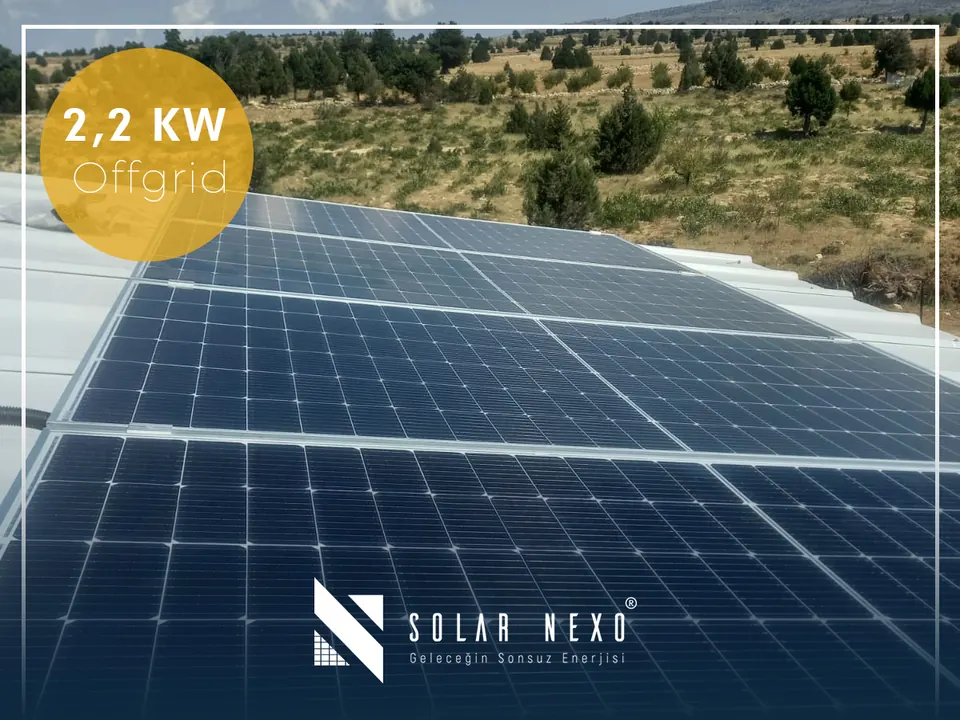
Solar Nexo is a solar company in Antalya based in Kepez. This reference project is a compact 2.2 kW off-grid battery system installed at a rural site. A small panel array, an inverter with a charge controller and a battery bank are designed to supply lighting, a refrigerator and basic household loads without the grid.
Project summary
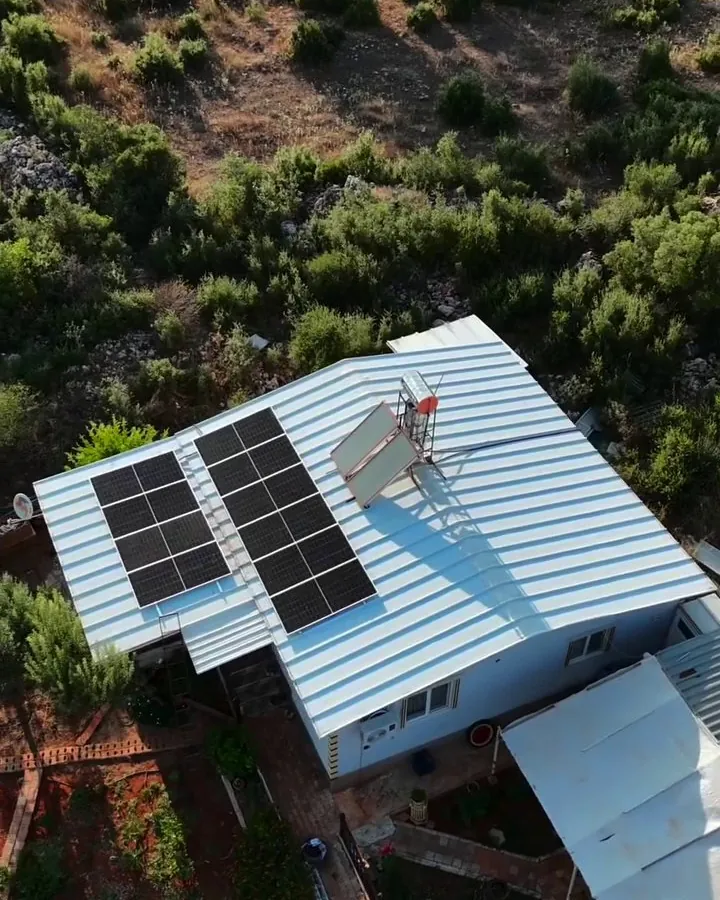
One of Solar Nexo's reference projects is a compact 2.2 kW battery system installed at a rural site. The system is designed for low-power uses where running a long grid line is not necessary. Location and date information is not given on this page.
System components
- Power: 2.2 kW (taken as panel power)
- Panel array: small-scale photovoltaic array
- Inverter and charging: off-grid inverter, MPPT charge control
- Storage: battery bank; type and capacity are not specified
Why was this system designed this way?
The advantage of a small system: simple architecture
Compact systems such as 2.2 kW involve little complexity. A few panels, an MPPT charge controller, a battery bank and an inverter form the basic chain. Fewer components mean fewer points of failure, and maintenance needs are low.
Load budget discipline
In a compact off-grid system, the most important step is the load budget. Example (general, not project data): items such as 100 W for LED lighting, about 1 kWh per day for a refrigerator and half an hour of operation per day for a small water pump are added up. The total daily energy is then compared with panel production and battery capacity. High-power devices (electric heaters, large air conditioners) are not suitable at this scale.
Why off-grid in a rural area?
On land far from the grid line, the cost of poles, cables and connection can exceed the cost of a small system. In this case an off-grid solution is direct and independent. No licence or distribution company application is required; however, obligations such as zoning, structural and fire requirements are a separate matter (Regulation on Unlicensed Electricity Generation, Art. 5/1/b, text of 12.05.2019).
Typical production
For 2.2 kWp, the PVGIS reference gives a daily average production potential of about 10 kWh, falling to about 7 kWh in January.
Expansion and durability
Compact systems can be designed so that they can later be expanded with a new panel or an additional battery module; for this, the inverter's DC input voltage and charge current limit are chosen with a margin from the start. Temperature, dust and humidity conditions also matter in rural areas; the battery bank is kept in a shaded, ventilated enclosure and checked visually on a regular basis.
Estimated production
In the PVGIS calculation (European Commission JRC, PVGIS 5.3) for Antalya city centre conditions, assuming optimum tilt and 14% system losses, the annual specific yield is 1,656 kWh/kWp. With the PVGIS reference for Antalya city centre conditions, this means a theoretical production potential of about 3,643 kWh/year for 2.2 kW of power.
| Period | Specific yield (kWh/kWp) | Estimated production (kWh) |
|---|---|---|
| January (lowest) | 99 | 218 |
| July (highest) | 168 | 370 |
| Annual | 1,656 | 3,643 |
Because battery capacity is limited in a compact system, part of the production may be curtailed. The value in the table is a theoretical potential. The "2.2 kW" value in the table is taken as panel power. These values are a theoretical PVGIS calculation; actual production varies with roof or land orientation, tilt and shading.
Installation and commissioning process
During the site survey, shading of the land, panel layout and the load list are assessed. In small systems the panel array can also be installed on a ground structure instead of a roof. During installation, DC protection and earthing are carried out, and battery parameters are set at commissioning. Maintenance and 24/7 technical support continue afterwards.
For a similar system
It is suitable for vineyard houses, farm buildings or small rural structures without a grid connection. If your loads are low-power and well defined, the system is cost-effective.
- Off-grid systems service page
- Solar Nexo reference projects
- Solar energy calculation tool
- Contact us for a free site survey
- What is an off-grid solar energy system
- Solar battery maintenance
Questions about this project
What can a 2.2 kW off-grid system run?
Low-power loads such as lighting, a refrigerator, a television, device chargers and a small water pump can run. High-power devices such as electric heaters or large air conditioners are not suitable for this scale. First, a load budget should be prepared to determine the daily kWh requirement. For higher-power devices, the system needs to be enlarged or the loads separated with a load schedule; it is best to determine this at the design stage.
How many kWh does a 2.2 kW system produce per year?
For Antalya city centre conditions, using the PVGIS reference value of 1,656 kWh/kWp, a theoretical potential of about 3,643 kWh/year is calculated. The actual value varies with orientation, tilt and shading. Because production is curtailed once the battery is full, the energy actually used may be lower. The most important factors determining real production are panel orientation, tilt and shading; the result is clarified by measuring these three during the site survey.
In a rural area, is off-grid or a grid connection more sensible?
If the grid line is far away, the investment in poles and cables can exceed the cost of a small solar system; in that case off-grid is more practical. If consumption is high and continuous, running a line may be more suitable. A site survey is recommended for the decision. Line distance, load size and maintenance preference decide it; during the survey the two options are compared side by side.
Related guides
Estimated yields are theoretical values based on PVGIS 5.3 data (EU Joint Research Centre); actual output depends on roof orientation, tilt, shading and temperature.
Considering a similar system?
The Solar Nexo team visits your property, reviews your consumption and roof, and designs the right system for you free of charge.