
Short answer
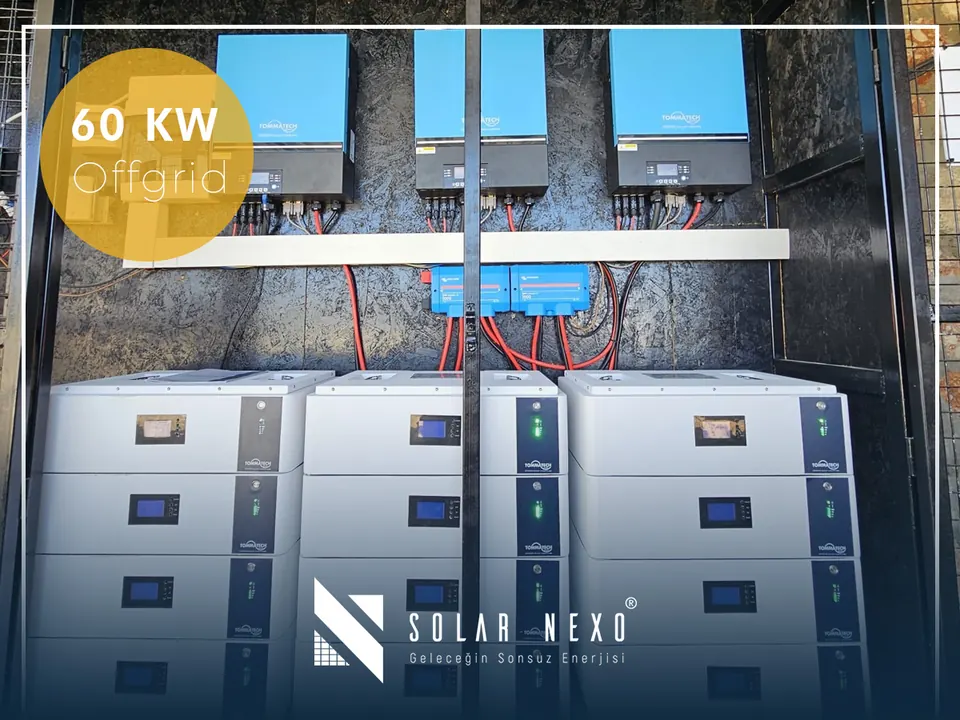
Solar Nexo is a solar company in Antalya based in Kepez. This reference project is a 60 kW off-grid energy room. Inverters operating in parallel and a lithium battery bank are installed to supply high-power loads without the grid; the system is designed with an off-grid architecture and has a modular, expandable structure.
Project summary
This reference project is a 60 kW off-grid energy room. Instead of a single large inverter, inverters operating in parallel and a lithium battery bank are used. Location and date information is not given on this page.
System components
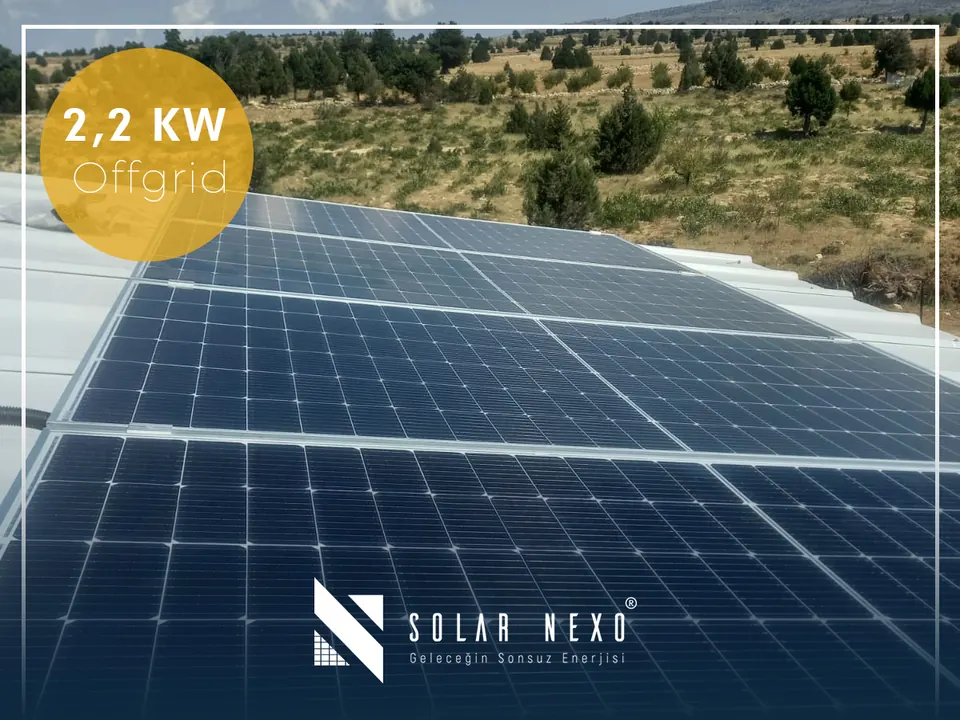
- Power: 60 kW (taken as panel power)
- Inverters: off-grid inverters connected in parallel
- Storage: lithium battery bank; capacity is not specified
- Energy room: inverters, batteries, DC-AC distribution and protection equipment
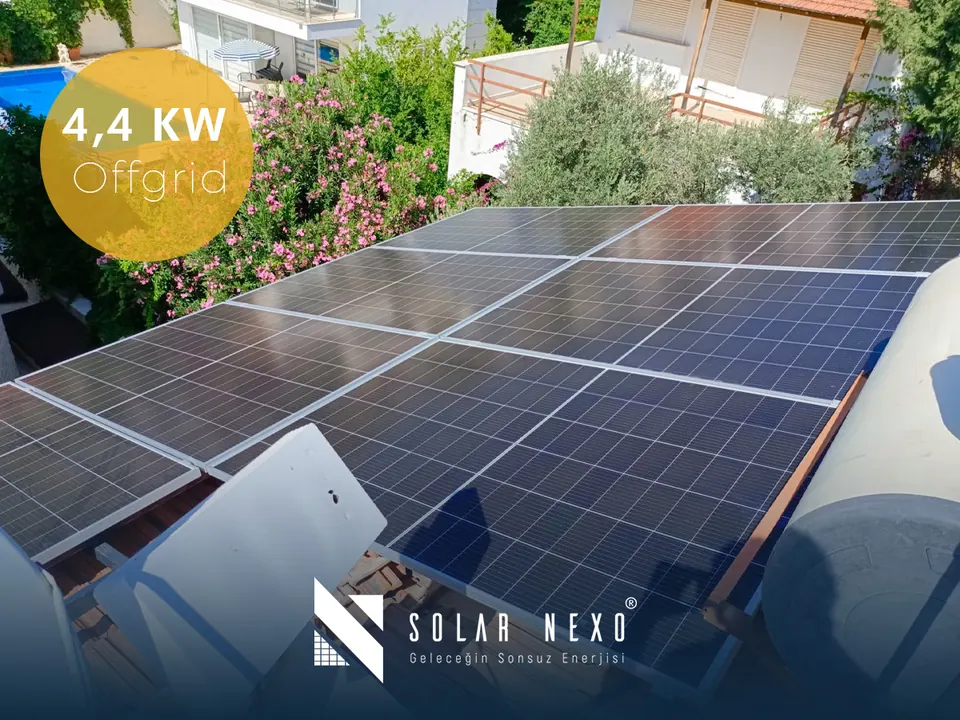
- Panel array: photovoltaic panels
Why was this system designed this way?
Why parallel inverters?
The power of an off-grid system should not be limited by the upper limit of a single device. Running several inverters of the same model in parallel and in sync increases total power in a modular way. For three-phase loads, distribution is balanced across the phases. When one unit fails, the remaining units can continue to operate at lower power; this is an advantage in terms of continuity compared with a single large inverter.
Lithium battery bank and BMS
Lithium iron phosphate batteries offer a high usable depth of discharge, high current capacity and low maintenance requirements. In large banks, each module's management system (BMS) communicates with the main controller; voltage and temperature imbalance are monitored. To keep current sharing balanced, cable lengths and busbars are designed symmetrically.
Energy room engineering
In the 60 kW class, batteries and inverters are gathered in a shared room. Room ventilation, cable cross-sections, DC fuses and isolators, earthing and fire detection are parts of the design. Installing the equipment in line with its installation manual, as the datasheet requires, is also necessary for the warranty.
Load management
For large loads (pumps, compressors, cooling), starting current and load priorities are determined. Critical loads are supplied from a separate board; if the battery state of charge falls, non-critical loads can be shed automatically.
Expandability and redundancy
In a parallel architecture, an additional inverter module can be added later to increase total power. The design aims to be able to supply critical loads with the remaining capacity in case one unit fails; this approach is called N+1 redundancy. Because the batteries are also modular, bank capacity can be increased as the load grows; for this, busbars and fuse ratings are chosen with a margin from the start.
Estimated production
In the PVGIS calculation (European Commission JRC, PVGIS 5.3) for Antalya city centre conditions, assuming optimum tilt and 14% system losses, the annual specific yield is 1,656 kWh/kWp. With the PVGIS reference for Antalya city centre conditions, this means a theoretical production potential of about 99,360 kWh/year for 60 kW of power.
| Period | Specific yield (kWh/kWp) | Estimated production (kWh) |
|---|---|---|
| January (lowest) | 99 | 5,940 |
| July (highest) | 168 | 10,080 |
| Annual | 1,656 | 99,360 |
Monthly theoretical potential for 60 kWp: January 5,940 kWh, July 10,080 kWh. In an off-grid system, consumption and battery capacity limit the energy actually used. The "60 kW" value in the table is taken as panel power. These values are a theoretical PVGIS calculation; actual production varies with roof or land orientation, tilt and shading.
Installation and commissioning process
During the site survey, the load inventory (motors, cooling, lighting), site conditions and the location of the energy room are determined. In the project, the parallel inverter and battery configuration, cable cross-sections and protection scheme are prepared. During installation and commissioning, parallel synchronisation and BMS communication are tested. Monitoring, a maintenance plan and 24/7 technical support continue afterwards.
For a similar system
It is suitable for high-power facilities (farms, businesses, large homes) that the grid does not reach or where it is unreliable. Preparing a detailed load profile is the most critical step in sizing.
- Off-grid systems service page
- Solar Nexo reference projects
- Solar energy calculation tool
- Contact us for a free site survey
- What is an inverter and what types are there
- What is a LiFePO4 battery
- Solar energy monitoring systems
Questions about this project
What is a parallel inverter and what is it for?
It is the synchronised operation of more than one inverter of the same model. It increases total power in a modular way, and when one unit fails the others can keep running. In three-phase systems it provides balanced distribution across the phases. This way, the system can be expanded by adding a new inverter as needs grow, and the failure of a single device does not stop the whole facility.
How much does a 60 kW off-grid system produce per year?
For Antalya city centre conditions, using the PVGIS reference value of 1,656 kWh/kWp, a theoretical potential of about 99,360 kWh/year is calculated. Actual production varies with orientation, tilt and shading; in an off-grid system the energy used is limited by consumption and battery capacity. In Antalya city centre, July has a theoretical potential of about 10,080 kWh and January about 5,940 kWh; the seasonal difference is balanced through load management.
Why is the BMS important in a lithium battery bank?
The BMS monitors the voltage, temperature and current of each cell group; it prevents overcharging, deep discharge and imbalance. In large banks, communication between modules keeps current sharing balanced and helps preserve battery life. For this reason, BMS communication is an integral part of the commissioning test and is tracked continuously with remote monitoring.
Related guides
Estimated yields are theoretical values based on PVGIS 5.3 data (EU Joint Research Centre); actual output depends on roof orientation, tilt, shading and temperature.
Considering a similar system?
The Solar Nexo team visits your property, reviews your consumption and roof, and designs the right system for you free of charge.