Short answer
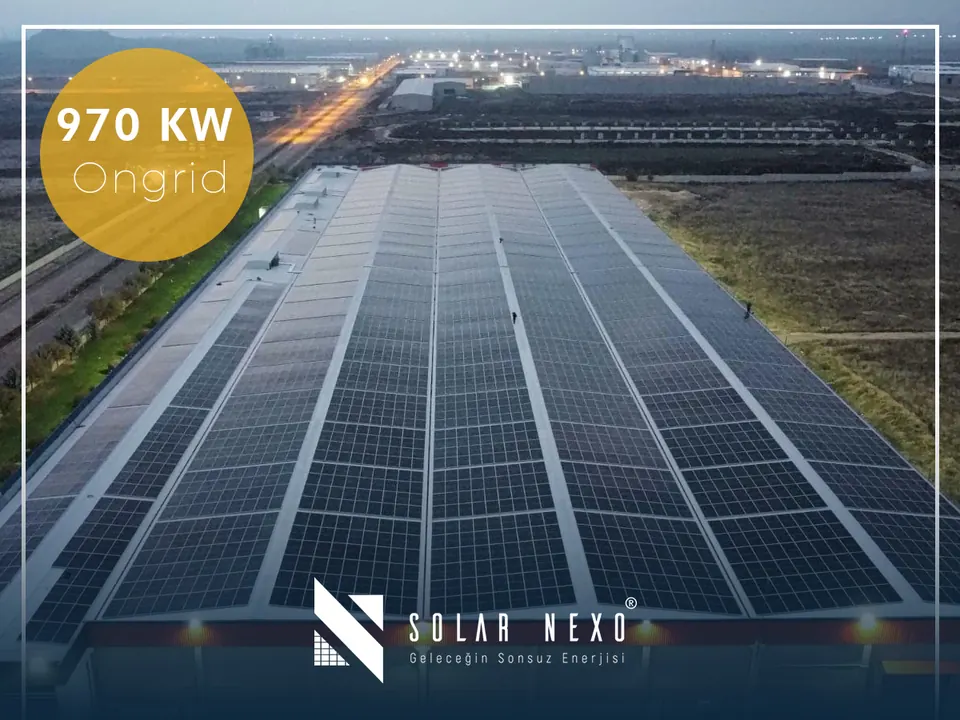
A villa system that Solar Nexo shared on Instagram can serve as an example of solar energy installations in Manavgat: 20 TommaTech 605 W panels (12.1 kWp), a 15 kW hybrid inverter and a 15 kWh LiFePO4 battery. According to PVGIS, annual specific production in Manavgat is 1,649 kWh/kWp; theoretical annual production for this installation is about 19,950 kWh.
Key takeaways
- According to PVGIS 5.3, annual specific production in Manavgat is 1,649 kWh/kWp.
- The Manavgat installation shared by Solar Nexo has 20 × 605 W panels, that is, 12.1 kWp of installed power.
- Theoretical annual production for 12.1 kWp is about 19,950 kWh (12.1 × 1,649, calculation); actual production varies with the roof.
- The system has a 15 kW hybrid inverter and a 15 kWh LiFePO4 battery; the battery is used for outage backup and night consumption.
- No payment is made for energy fed from the battery to the grid; the battery is for backup and shifting self-consumption.
In solar energy installations in Manavgat, villas, hotels and greenhouses stand out; in this article we start from a real Manavgat installation shared on Solar Nexo's Instagram account (@solarnexotr): a system with 20 TommaTech 605 W panels, a 15 kW hybrid inverter and a 15 kWh LiFePO4 battery. We interpret the technical values with PVGIS data, pass on notes about installation day and list the points to watch for anyone considering a similar system. We do not share customer information; we give only a technical summary.
Solar energy in Manavgat: PVGIS potential
According to PVGIS 5.3, annual specific production in Manavgat at optimal tilt and south orientation is 1,649 kWh/kWp; this value includes 14 percent system losses. For comparison, central Antalya is 1,656 and Alanya 1,615 kWh/kWp. In other words, Manavgat gives almost the same production as central Antalya (a difference of about 0.4 percent, calculation).
Manavgat's geography is varied: villas and hotels around Side and Kızılağaç on the coastal strip, and farmland inland. On the coast, salt and humidity are more decisive; inland, dust and pollen. This difference is taken into account in panel selection and the cleaning plan. Around Side, tourist facilities, pensions and summer homes are dense; in the summer season, air-conditioning, pool and kitchen loads all rise. This seasonal load matches the summer production peak and makes it easier for a hybrid system to use in the evening the energy it produces by day.
Technical summary of the installation
The components of the shared Manavgat installation are as follows; the calculations are ours:
| Component | Value | Note |
|---|---|---|
| Panels | 20 × 605 W TommaTech | 12.1 kWp (20 × 605 W) |
| Hybrid inverter | 15 kW | Manages grid, panels and battery |
| Battery | 15 kWh LiFePO4 | Backup and night consumption |
| Theoretical annual production | about 19,950 kWh | 12.1 × 1,649 (PVGIS, calculation) |
| Theoretical monthly average | about 1,660 kWh | 19,950 / 12 (calculation) |
One point needs emphasising here: theoretical production rests on the assumption that the roof is at optimal tilt and south orientation. Without knowing the real roof's orientation, tilt and shading, nothing definite can be said about this installation's real production. So 19,950 kWh is an upper reference.
The panel itself also gives information: according to the TT605-144TN10 (n-type TOPCon, half-cut) datasheet, efficiency is 23.42 percent, the Pmax temperature coefficient is −0.30 %/°C, and the warranty is 15 years for the product and 30 years for performance. In summer heat this low temperature coefficient matters. You can find the details of TOPCon technology in the TOPCon panels article.
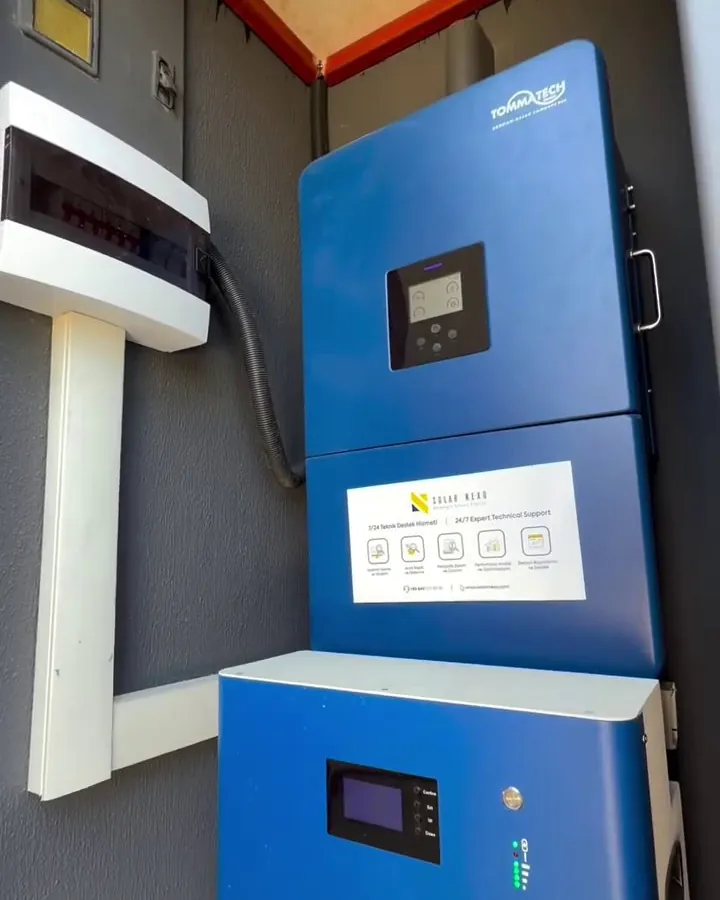
To understand the sizing logic of the system, let us look at two ratios. Panel power is 12.1 kWp and inverter power is 15 kW; that is, the panel-to-inverter ratio is about 0.81 (12.1 / 15, calculation). In hybrid systems it is common for the inverter to be chosen higher than the panel power, because the inverter handles not only panel production but also the battery's charge-discharge power and instantaneous loads. We do not know the exact reason for the choice in this installation; the comment above is general engineering knowledge.
The second ratio is the size of the battery relative to production. With PVGIS values, the theoretical daily production of the 12.1 kWp panel group is as follows (central Antalya monthly values are used, because this article does not give separate monthly values for Manavgat):
| Month | Monthly production (kWh) | Daily average (kWh) | 15 kWh battery as a share of daily production |
|---|---|---|---|
| July | about 2,033 | about 65.6 | about 23 percent |
| December | about 1,198 | about 38.6 | about 39 percent |
The calculation: for July, 168 × 12.1 = 2,033 kWh, which is 2,033 / 31 ≈ 65.6 kWh per day; for December, 99 × 12.1 = 1,198 kWh, about 38.6 kWh per day. That is, about a quarter of daily production in summer and about 39 percent in winter fits into the battery. This shows that the battery is sized not to store all of the production, but to cover evening and night loads.
Installation day: what was done on the roof?
In the Instagram frames the mounting flow looks like this: first aluminium rails are installed on the roof, then the panels are fixed to the rails with clamps, cables are organised, and the inverter and battery are placed in the technical area. It should be noted that each stage needs its own care: rails are fixed so as not to damage the waterproofing, a ventilation gap is left under the panels and DC cables are routed with UV-resistant material.

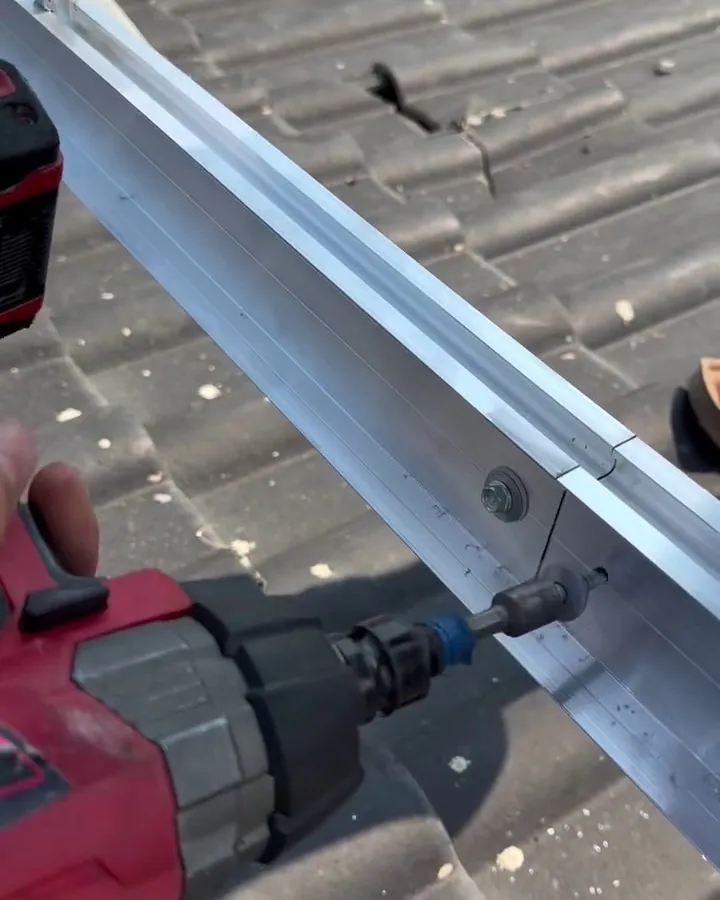
The choice of rail and mounting structure depends on the roof type; mounting systems and roof types are compared in the mounting systems article.
Cabling and connection quality is also an invisible but critical job. On the DC side, cable cross-section is chosen according to the distance between panels and inverter; insufficient cross-section causes voltage drop and heating. Connecting MC4 connectors of the same brand with the correct crimping process reduces fire risk. Roof type also affects mounting: in Manavgat, villas commonly have pitched tiled roofs and flat terraces; for the first, hooks and rails are used, for the second a tilted frame or ballast. Which one is chosen is decided at the survey by the roof's condition.
What do the hybrid inverter and battery do?
A hybrid inverter manages panel production, the grid and the battery with a single device. During the day, production first covers the house's consumption; the surplus fills the battery and, if necessary, is fed to the grid. In the evening and at night the battery steps in. If the grid goes down, the system can operate so as to feed critical loads; this differs from standard on-grid systems, because they shut down during an outage for safety reasons.
How long does a 15 kWh battery provide backup? That depends on the load profile. For example, if the total of critical loads is 1 kW, it can theoretically supply about 15 hours at nominal capacity; if the load is 3 kW, about 5 hours (without accounting for usable capacity and depth of discharge, calculation). So a firm answer to the question "how many hours?" can be given once the load list has been drawn up.
Two notes matter regarding regulation: an unlicensed facility owner can install a storage unit up to the electrical power of the generation facility; however, no payment is made for energy fed from the battery to the grid, and batteries must have been manufactured within the last five years. We explained battery technology in the LiFePO4 battery article. Cycle life and warranty periods vary by manufacturer; for example, a TommaTech low-voltage battery document gives a product warranty of 60 months. So the battery warranty needs to be read per brand and model.
Maintenance after installation is also important. Cleaning surfaces where salt (on the coast) or dust (inland) builds up at the end of summer, checking inverter and battery ventilation and regularly examining monitoring data protect efficiency. Performance clearly below the expected production value is a sign of soiling or a fault.
When planning a similar system in Manavgat
- Load list: List pool pump, air-conditioning, kitchen and lighting loads hour by hour.
- Roof measurement: Orientation, tilt, shading and load-bearing capacity are determined at the survey; the structural assessment should be made by a civil engineer.
- Equipment age: Panels, inverter and battery must have been manufactured within the last five years.
- Application: Made through AEDAŞ's LUS portal (AEDAŞ is the local electricity distribution company); for rooftop systems up to 25 kW, the system cannot exceed the contracted power.
- Acceptance: Do not switch on the system before acceptance is complete; the connection can be cut.
Similar installations have also been done in Döşemealtı and Belek; the articles on the Döşemealtı hybrid system and solar panels in Belek and Serik show different scales.
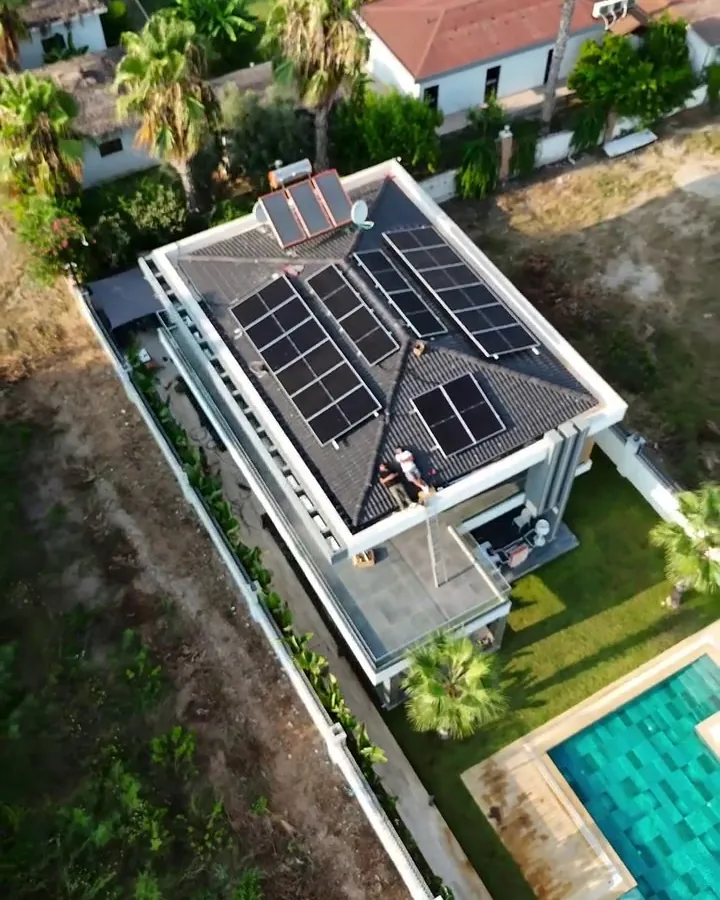
Finally, the lesson to draw from the shared installation is this: the same brand of panel and an inverter of similar power give different results on different roofs. In Manavgat, the production of two villas can diverge because of roof orientation, shading and usage habits. So do not apply a neighbour's figure or an example from the internet directly to your own system; at the survey, have your own calculation made with your roof's measurements, your last 12 months of consumption and your outage expectations.
Regulation: net metering as of October 2026
Villas are mostly on residential subscriptions. For facilities tied to a residential subscription, netting is monthly and no production or sales limit applies; for non-residential facilities, hourly netting applies from 1 May 2026. The payment for surplus energy is determined on the basis of the single-rate active energy unit price, not the total unit price on the bill. Because rules may change, confirmation should be obtained from AEDAŞ before applying.
Conclusion
For solar energy in Manavgat, the PVGIS value is 1,649 kWh/kWp; the shared 12.1 kWp hybrid installation is an example at villa scale. This example is not a template; every roof needs its own measurement. For your villa or business, you can request a free site survey through our contact page.
Frequently asked questions
How much electricity do solar panels produce per year in Manavgat?
According to PVGIS 5.3, 1 kWp of panels in Manavgat at optimal tilt and south orientation produces about 1,649 kWh per year. For a 12.1 kWp system, theoretical annual production comes to about 19,950 kWh (12.1 × 1,649, calculation). Actual production varies with roof orientation, shading and soiling; this value is an upper reference.
How many kWp are 20 panels of 605 W?
20 panels of 605 W total 12,100 W, that is, 12.1 kWp. With the PVGIS specific production for Manavgat, theoretical annual production is about 19,950 kWh. The area the panels cover is about 52 m² (20 × 2.28 × 1.13 m, calculation); more roof area is needed for rail lines and maintenance walkways.
How many hours does a 15 kWh battery power a house?
The duration depends on the load profile. Theoretically it can supply about 15 hours for a 1 kW critical load and about 5 hours for 3 kW; depth of discharge and efficiency losses shorten this. The exact duration is calculated once the load list has been drawn up and critical loads determined; the usable capacity and depth of discharge in the manufacturer's datasheet should also be taken into account.
What is the difference between a hybrid inverter and an on-grid inverter?
An on-grid inverter makes panel production compatible with the grid and shuts down when the grid goes out, for safety reasons. A hybrid inverter manages the panels, grid and battery together; it can feed critical loads during an outage and stores surplus production in the battery. This flexibility also brings battery cost and a more complex installation; if you do not need it, on-grid may be a simpler solution.
Can I sell the energy in the battery to the grid?
No. Under the regulation, no payment is made for the part of the surplus remaining after netting that comes from the battery. The battery is for outage backup and for consuming the day's production in the evening. Also, the storage unit's electrical power cannot exceed the generation facility's electrical power and batteries must have been manufactured within the last five years; this information is based on the regulation of April 2026.
Where do you apply for solar panels in Manavgat?
Because Manavgat is in Antalya province, the application is made to the grid operator AEDAŞ, through the LUS platform since 1 October 2023. For rooftop systems up to 25 kW, the documents include ID, title deed or document of right of use, unique code and a statement on the activity ban. The current list should be confirmed with AEDAŞ; Solar Nexo supports the application process.
Sources
Want a clear calculation for your roof?
The Solar Nexo team carries out a free site survey at your address in Antalya and designs the system that suits your roof, consumption and budget.