
Short answer
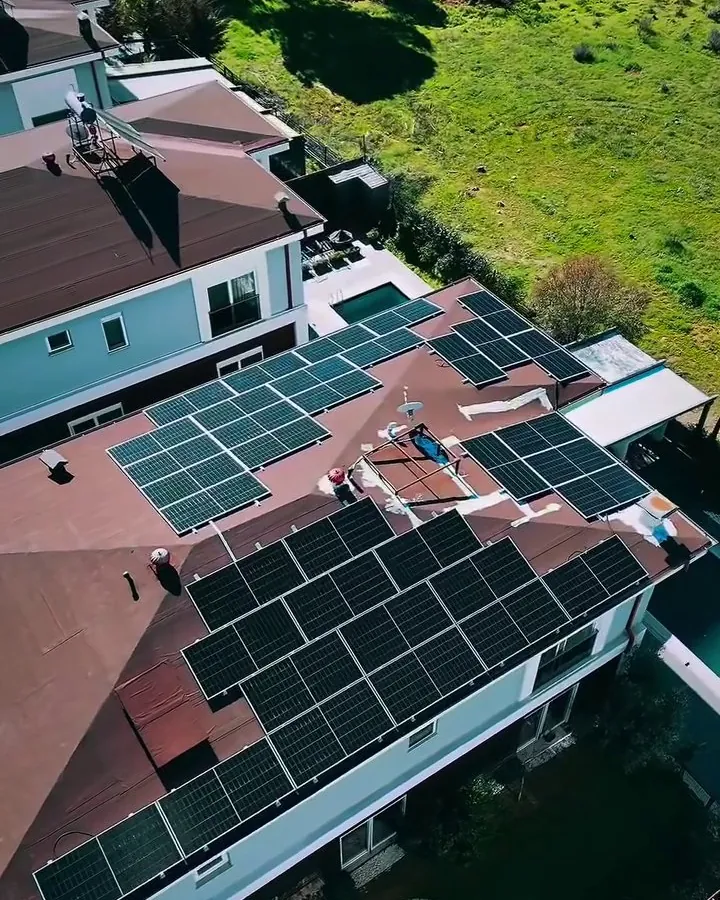
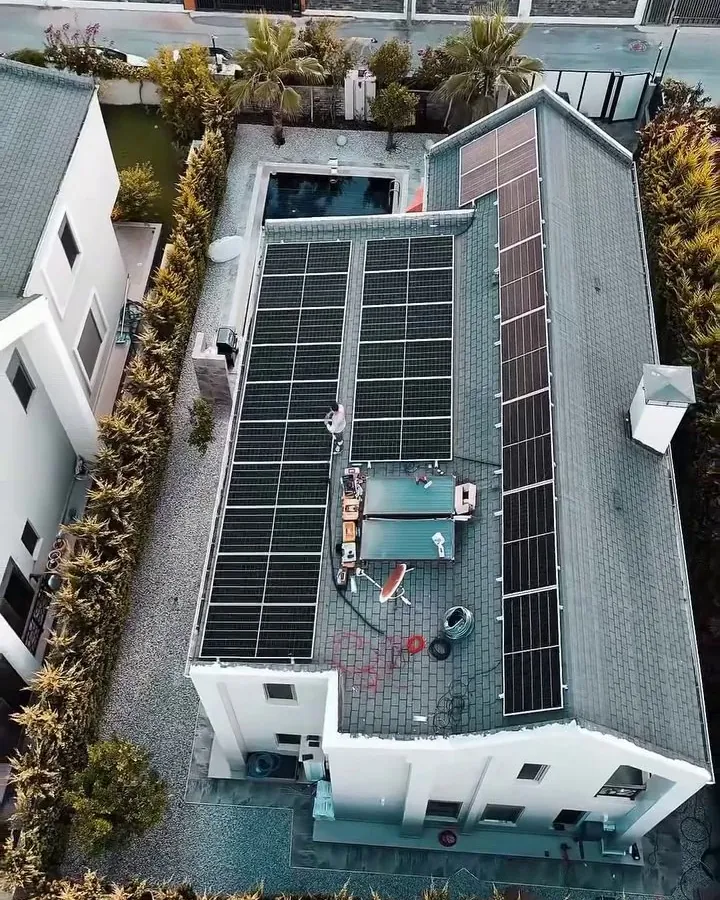
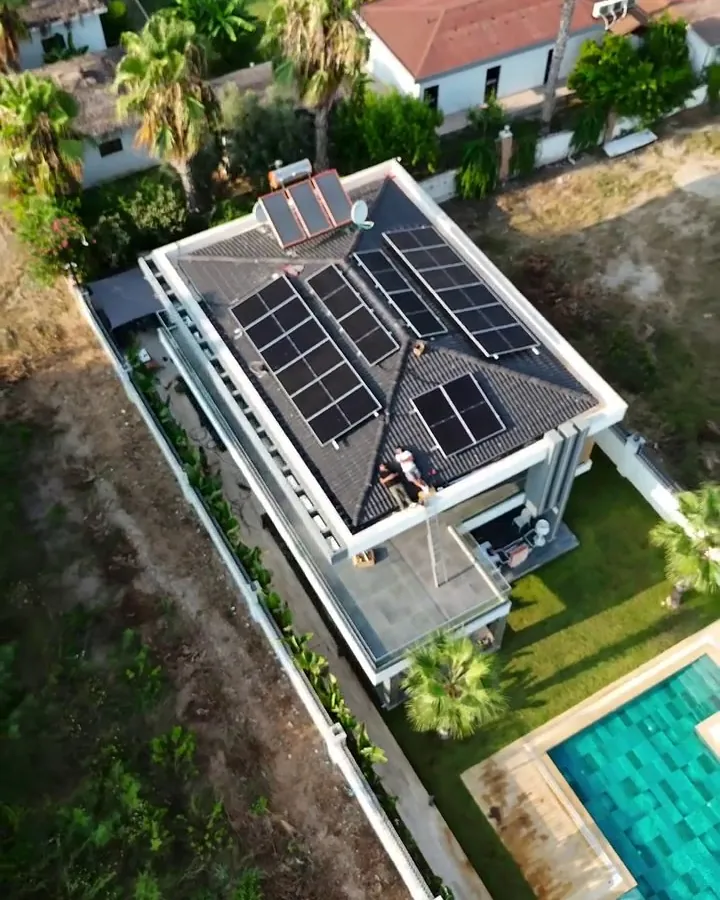
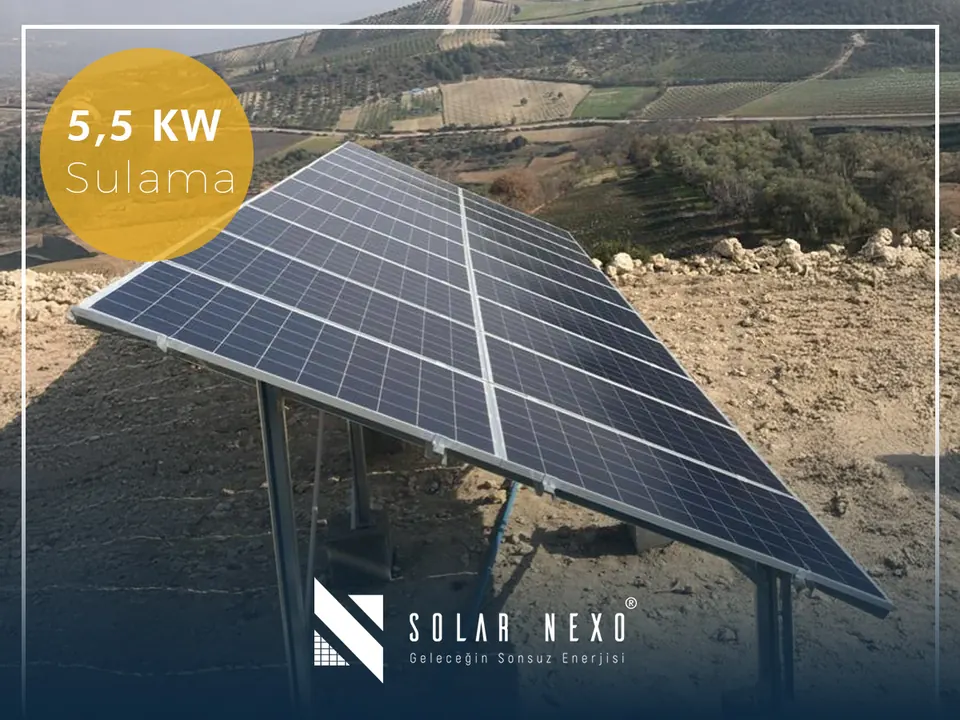
Solar Nexo is a solar company in Antalya based in Kepez. This reference project is a 5.5 kW solar-powered agricultural irrigation system. The panel array, pump drive and pump work together; when water-tank storage is used instead of batteries, daytime production is turned into irrigation.
Project summary
This reference project is a 5.5 kW solar energy system installed for agricultural irrigation. The panel array feeds the pump directly through a pump drive. Location and date information is not given on this page.
System components
- Power: 5.5 kW (taken as panel power)
- Panel array: photovoltaic panels
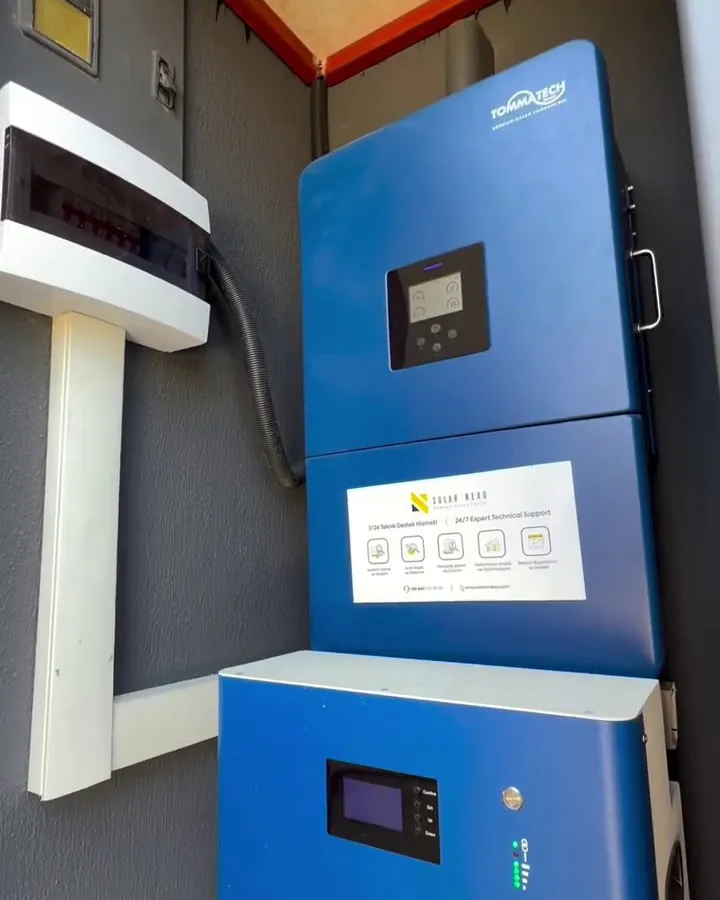
- Pump drive: solar pump drive; type is not specified
- Pump: pump suitable for irrigation; model is not specified
- Storage: water-tank logic instead of batteries
Why was this system designed this way?
Pump and panel matching
The basic relationship in an irrigation system is between hydraulic power and electrical power. Hydraulic power is calculated as P = ρ · g · Q · H (ρ water density, Q flow rate, H total dynamic head). General example (not project data): at 10 m³ per hour and 40 m of head, hydraulic power is about 1.1 kW; if combined pump and motor efficiency is about 50%, the electrical input rises to about 2.2 kW. Panel power is chosen above the pump power so that the pump can keep running even in the hours when the sun is weak.
DC or AC pump drive
A DC pump drive converts the panel output to a voltage suitable for the pump motor; it tracks the panel output with MPPT and adjusts motor speed according to sun intensity. For an AC pump, a solar frequency drive is used; standard induction motors can be run. The motor type, well depth and the existing pump are decisive in the choice. The open-circuit voltage of the panel array must not exceed the drive's maximum DC input.
Storage-based irrigation logic
In irrigation, water is stored instead of energy: water pumped during the day is taken into a high tank and distributed by gravity at night or in cloudy weather. This removes the need for batteries; the system is simpler and has a low maintenance load. Tank volume is chosen according to daily irrigation demand.
Regulatory context
According to the 11.08.2022 text of the unlicensed generation regulation, agricultural irrigation facilities can install a plant of up to twice their contracted power (Art. 5/1/h). The Ministry of Agriculture and Forestry's Communiqué No. 2024/15 covers the period 01.01.2024-31.12.2026; interest-subsidised loans may be considered for renewable energy investments. Current conditions should be confirmed with the relevant institution.
Simple maintenance, long life
Because a storage-based irrigation system has no batteries, the maintenance load is low: the panels are wiped periodically, the filter at the pump inlet is kept clean, and the level switch and drive are checked. When the water level in the well drops, protection against the pump running dry is essential; this protection directly affects pump life.
Estimated production
In the PVGIS calculation (European Commission JRC, PVGIS 5.3) for Antalya city centre conditions, assuming optimum tilt and 14% system losses, the annual specific yield is 1,656 kWh/kWp. With the PVGIS reference for Antalya city centre conditions, this means a theoretical production potential of about 9,108 kWh/year for 5.5 kW of power.
| Period | Specific yield (kWh/kWp) | Estimated production (kWh) |
|---|---|---|
| January (lowest) | 99 | 544 |
| July (highest) | 168 | 924 |
| Annual | 1,656 | 9,108 |
Monthly theoretical potential for 5.5 kWp: January 545, July 924 kWh. In the irrigation season, summer production coincides with the period of highest demand. The "5.5 kW" value in the table is taken as panel power. These values are a theoretical PVGIS calculation; actual production varies with roof or land orientation, tilt and shading.
Installation and commissioning process
During the site survey, well depth, the existing pump, flow demand and parcel layout are examined. In the design, pump-panel matching and drive selection are carried out. During installation, the panel structure, drive, pump connection and level switch are installed; a flow and pressure test is carried out after commissioning. Maintenance and 24/7 technical support continue.
For a similar system
It is suitable for farm parcels, orchards and greenhouses where the power line is far away or costly. Sharing your well data (depth, flow rate) speeds up sizing.
- Solar-powered irrigation systems service page
- Solar Nexo reference projects
- Solar energy calculation tool
- Contact us for a free site survey
- Solar-powered agricultural irrigation systems
- Agricultural irrigation solar plant application
Questions about this project
Is a battery needed in a solar-powered irrigation system?
Generally not. In irrigation, water is stored instead of energy: water pumped during the day is taken into a tank and distributed by gravity at night. This solution is simpler, needs little maintenance and lasts longer. If batteries are used, cost and maintenance increase; for this reason, water-tank storage is generally more economical for irrigation. Exact values are clarified during the free site survey with project-specific data, and this estimate is updated.
How is panel power chosen for a pump?
First, hydraulic power (flow rate and total dynamic head) is calculated, and the electrical input is found using pump and motor efficiency. Panel power is chosen above the pump power so that it keeps working in weak sunlight; general practice sets this ratio. The drive's maximum DC input voltage must be higher than the open-circuit voltage of the panel array; otherwise the drive may be damaged.
How much does a 5.5 kW irrigation system produce per year?
For Antalya city centre conditions, using the PVGIS reference value of 1,656 kWh/kWp, a theoretical potential of about 9,108 kWh/year is calculated. The actual value varies with orientation, tilt and shading; production coincides with irrigation demand in the summer months. The irrigation season is summer, and summer production is about 1.7 times winter production; this makes a good match with irrigation demand.
Related guides
Estimated yields are theoretical values based on PVGIS 5.3 data (EU Joint Research Centre); actual output depends on roof orientation, tilt, shading and temperature.
Considering a similar system?
The Solar Nexo team visits your property, reviews your consumption and roof, and designs the right system for you free of charge.