
Short answer
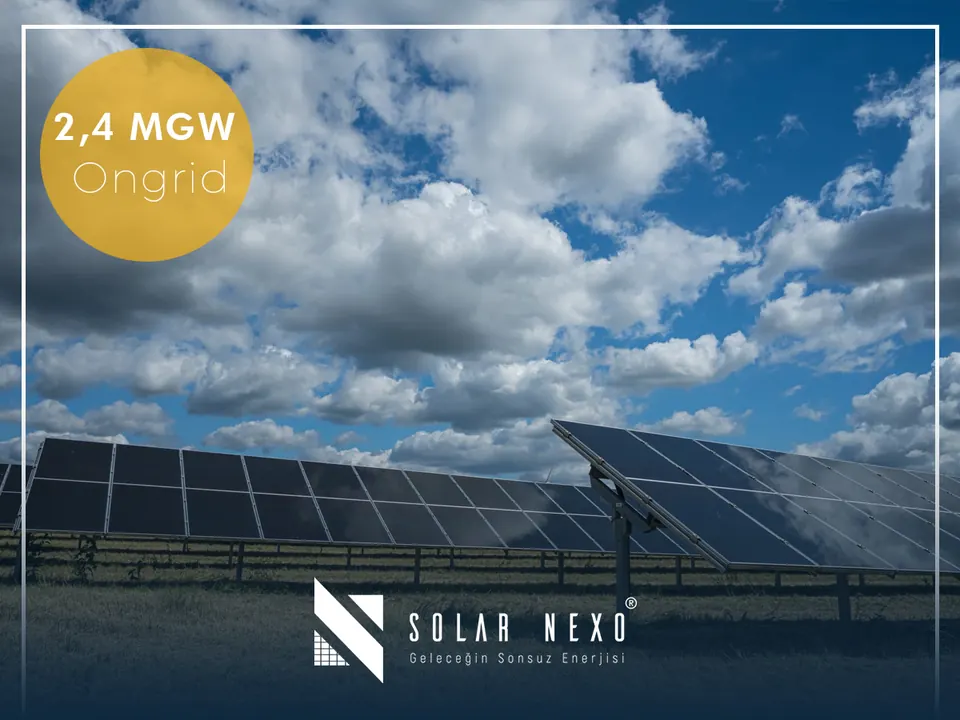
Solar Nexo is a solar company in Antalya based in Kepez. This reference project is a 2.4 MW ground-mounted solar power plant. The plant, made up of ground-mounted panel rows, grid-connected inverters, a transformer and a monitoring system, treats its production under the net metering rules of the associated consumption facilities.
Project summary
This reference project is a 2.4 MW solar power plant built on open land. Because there is no roof limit, layout, tilt and orientation can be chosen optimally; in return, topics such as the soil survey, access and security come to the fore. Location and date information is not given on this page.
System components
- Power: 2.4 MW (2,400 kW, taken as panel power)
- Panel array: ground-mounted photovoltaic panels
- Inverters: grid-connected inverters
- Transformer and connection: medium-voltage connection and protection
- Site: perimeter security, drainage, monitoring
Why was this system designed this way?
The advantage of a ground-mounted plant
On open land, panel tilt and orientation are chosen freely. For Antalya city centre, the PVGIS optimum tilt is 33° facing south; under the same conditions, an annual production of 1,656 kWh/kWp is calculated. On a roof this optimum often cannot be achieved.
Soil survey and foundations
The panel structure is set on driven profiles (posts), screw piles or concrete foundations, depending on the soil's bearing capacity. The soil survey, pile driving test and water drainage are core inputs of the project. On sloping land, the panel rows are adapted to the topography.
Row spacing and shading
So that the front row does not shade the row behind it, the distance between rows is calculated according to the winter sunrise and sunset. As row spacing shrinks, installed power density increases but shading loss also increases; the design strikes this balance. Access is left beneath and between rows for maintenance and vegetation control.
Security and lightning
On open land, a perimeter fence, lighting and a camera system may be needed. The lightning protection and earthing network spreads across the whole site. Storm and hail events are on record in Antalya; the structure is calculated for wind load.
Regulatory framework
According to the 02.04.2026 text of the unlicensed generation regulation, annual production cannot exceed twice the total annual consumption of the associated consumption facilities. The regulatory status of this project is not stated; the distribution company should be consulted before applying.
Operation and monitoring
In ground-mounted plants, remote monitoring and an alarm system are a necessity, because the site is not always under observation. Inverter-level production data is compared with weather station irradiance measurements to calculate the performance ratio. Periodic scanning with a thermal camera detects problems such as a failed diode or a loose connection early.
Estimated production
In the PVGIS calculation (European Commission JRC, PVGIS 5.3) for Antalya city centre conditions, assuming optimum tilt and 14% system losses, the annual specific yield is 1,656 kWh/kWp. With the PVGIS reference for Antalya city centre conditions, this means a theoretical production potential of about 3,974,400 kWh/year for 2.4 MW of power.
| Period | Specific yield (kWh/kWp) | Estimated production (kWh) |
|---|---|---|
| January (lowest) | 99 | 237,600 |
| July (highest) | 168 | 403,200 |
| Annual | 1,656 | 3,974,400 |
Monthly theoretical potential for 2.4 MWp: January 237,600 kWh, July 403,200 kWh. On open land, vegetation cover and dust soiling should be monitored. The "2.4 MW" value in the table is taken as panel power. These values are a theoretical PVGIS calculation; actual production varies with roof or land orientation, tilt and shading.
Installation and commissioning process
During the site survey, land slope, soil structure, shading and the distance to the connection point are assessed. In the project, the layout, cable route and transformer-connection design are carried out; the necessary applications are made. Installation proceeds in sequence with pile driving, the structure, panels and cabling; commissioning tests follow. The maintenance plan and 24/7 technical support continue afterwards.
For a similar system
It is suitable for businesses without enough roof space or for investors with land associated with their consumption. Access to the land and the distance to the grid should be assessed early.
- On-grid systems service page
- Solar Nexo reference projects
- Solar energy calculation tool
- Contact us for a free site survey
- Difference between rooftop and ground-mounted solar plants
- Solar plant lightning and storm protection
Questions about this project
What is the difference between a ground-mounted and a rooftop solar plant?
With ground-mounted plants, tilt and orientation are chosen freely and maintenance access is easy; in return, the soil survey, perimeter security and the distance to the grid add cost. A rooftop plant uses the existing structure, but it has structural and orientation constraints. For building a plant where there is no roof, the land's soil, slope and distance to the grid are decisive in this choice.
How much does a 2.4 MW ground-mounted plant produce per year?
For Antalya city centre conditions, using the PVGIS reference value of 1,656 kWh/kWp, a theoretical potential of about 3,974,400 kWh/year is calculated. The actual value varies with row-spacing shading, orientation and dust soiling. This figure is a theoretical potential; the row-spacing calculation, which prevents the front row from shading the one behind, directly affects real production.
How is lightning protection done at a ground-mounted solar plant?
An earthing network is installed across the whole site; the structure and inverters are bonded to equipotential, and surge arresters are used on the DC and AC sides. The lightning protection design is made according to the size of the site and the soil resistivity. In addition, equipotential bonding of the structure and the choice of surge arresters are essential for both personal safety and equipment protection.
Related guides
Estimated yields are theoretical values based on PVGIS 5.3 data (EU Joint Research Centre); actual output depends on roof orientation, tilt, shading and temperature.
Considering a similar system?
The Solar Nexo team visits your property, reviews your consumption and roof, and designs the right system for you free of charge.