
Short answer
When a solar EV charging station in Antalya is installed as one project, carport panels over the car park generate electricity during the day and feed it to parked cars. AC stations suit employees and hotel guests who park for long periods, while DC stations suit short-stop locations such as malls and roadside sites. Load management protects the connection capacity, and a battery buffers evening charging and peak loads.
Key takeaways
- In commercial car parks, cars stay parked during the day, so solar production and charging demand overlap naturally; in Antalya, the summer tourist season also falls in the months of peak production.
- AC stations suit long-term parking (staff, hotel guests), while DC stations suit short stops that require high instantaneous power.
- According to PVGIS 5.3, the theoretical yield in central Antalya is 1,656 kWh per kWp per year; a 30 kWp carport, for example, would theoretically produce about 49,680 kWh a year.
- Dynamic load management keeps the stations' total draw within the building's connection capacity and directs solar surplus to charging.
- The Solar Nexo product catalogue includes TommaTech commercial EV charging stations; for paid charging services to third parties, current regulations should be checked separately via EPDK.
If you are thinking about adding charging points to your car park, turning the roof over that same car park into an electricity generator naturally comes up too. A solar EV charging station in Antalya is built on exactly that idea: cars park during the day, and the sun produces during the day. In commercial-scale car parks at workplaces, hotels, residential complexes and shopping centres, a well-designed match between the two means a substantial share of the electricity needed for charging can be generated on site.
Unlike our guide to charging an electric car with solar panels, which deals with a single car at home, this article focuses on the commercial scale: multiple stations, a shared grid connection capacity, carport structures, load management and battery buffering.
Why plan a solar EV charging station in Antalya as one project?
Every kilowatt-hour a charging station draws from the grid ends up on the bill. When the same car park has solar panels, electricity generated during daylight hours goes first to the building's consumption and the stations, so less energy is drawn from the grid. The deciding factor is that the car is plugged in during the hours when production happens.
Commercial car parks have an advantage here. Employees arrive in the morning and leave in the evening, hotel guests leave their cars parked for hours, and some residents of a complex are at home during the day. In other words, a large part of the charging demand falls in the hours when the sun is most productive. In Antalya, the summer tourist season also coincides with the months of peak production according to PVGIS, which strengthens this overlap at hotels and holiday complexes: in central Antalya, a 1 kWp system has a theoretical output of 168 kWh in July and 99 kWh in December.
The second benefit is visibility. A solar canopy over the car park shades the cars and shows your guests and staff, in a very tangible way, how your business approaches energy. Beyond its technical benefit, an investment in solar energy in Antalya then carries a corporate message as well.
AC or DC charging stations: which suits a commercial car park?
Charging stations fall into two basic groups. AC stations supply alternating current to the car; the on-board charger inside the vehicle converts it into the direct current the battery needs. Charging speed is therefore limited by the power that both the station and the car can accept. For cars that stay parked for long periods, this is an economical and widespread solution.
DC stations do the conversion inside the station itself and deliver direct current straight to the battery. Because they can provide higher instantaneous power, they are preferred at short-stop locations; in return, they demand more serious planning in terms of the building's connection capacity, transformer capacity and infrastructure.
| Car park type | Typical parking time | Suitable station | Match with solar production |
|---|---|---|---|
| Office, factory, workplace | Throughout working hours | AC | High: cars are plugged in during the day |
| Hotel and holiday resort | Hours or overnight | Mainly AC, one DC if needed | High by day; a battery may be needed for the night |
| Residential complex | Mostly evening and night | AC | Medium: battery or grid for evening charging |
| Shopping centre and retail | Short and medium stays | AC and DC together | High by day; managing peak power is critical |
| Restaurant, café, roadside | Short | Mainly DC | Variable; load management matters |
The table gives a general direction; the final choice is made after measuring the vehicles' actual parking times and the building's connection capacity.
Generating power on a carport: shaded parking with solar panels in Antalya
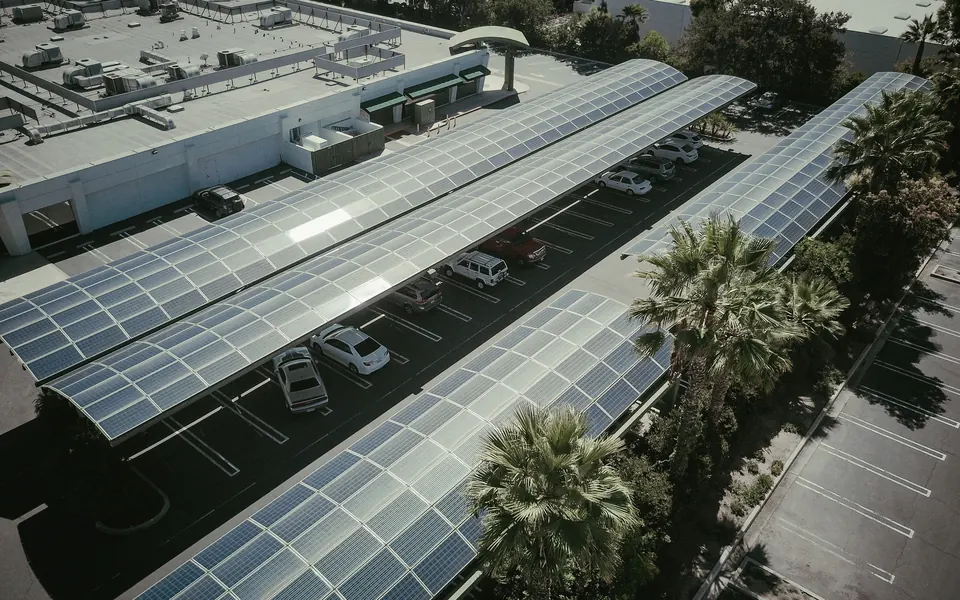
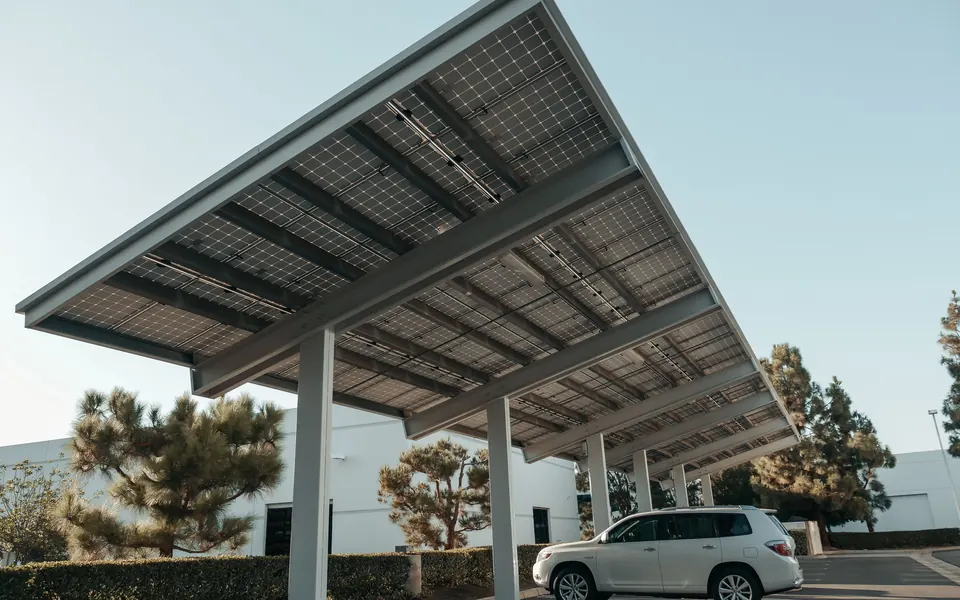
A carport is a supporting structure built over a parking area, with a roof made of solar panels. Among applications for solar panels in Antalya, the carport creates an additional generating surface for businesses whose roof area is not enough. Keeping cars out of the direct summer sun is a comfort everyone notices, too.
In projects for solar energy in Antalya, the main points in carport design are:
- Structural and wind loads: the steel structure is engineered for panel weight and wind load, and ground and foundation conditions are examined on site.
- Height and manoeuvring: if minibuses, shuttle vehicles or vans need access, the structure's height is set accordingly.
- Drainage: rainwater running off the panels must be channelled along a planned line, not between the parked cars.
- Cable routing: the lines from the panels to the inverter and from the inverter to the charging stations are carried inside the structure, protected.
On the production side, a rough preliminary estimate can be made with PVGIS. With a theoretical annual yield of 1,656 kWh per kWp in central Antalya, a 30 kWp carport would theoretically produce 30 × 1,656 = 49,680 kWh/year. Because carport tilt is usually kept below the optimum 33°, the real figure may be lower than this theoretical number. To see how many kilometres that energy represents, use the consumption figure in the technical documents of the vehicles in your fleet. For carport design details, take a look at our article on carports and car park solar energy.
Matching daytime charging and load management
When several stations run at full power at the same time, the building's connection capacity can be exceeded very quickly. Dynamic load management solves this by sharing the power available to the stations according to the building's consumption at that moment. For example, when the air-conditioning load rises around midday, the stations' share is temporarily reduced, then increased again as the load drops.
In systems installed together with solar, load management gains one more layer: prioritising solar surplus. When the panels produce more than the building needs, that surplus can be sent to the charging stations before it goes to the grid. This raises the share of Antalya solar energy production consumed on site, known as the self-consumption rate.
For this scenario to work properly, a monitoring setup that shows production, building consumption and station draw on the same screen is important. On Solar Nexo installations, inverter data is tracked with monitoring devices; once you can see how much energy the stations draw at which hours, the charging policy can be adjusted accordingly.
Battery buffering: when do you need it?
Not every charging station project needs a battery. When most cars charge during the day, panel output flows straight to the stations and a battery investment may not be necessary. A battery makes sense in the following cases:
- Evening and night charging: at residential complexes and hotels, where charging shifts into the evening, part of the energy produced during the day can be stored in the battery and used later.
- Peak shaving: when a DC station's sudden power demand strains the connection capacity, the battery covers that peak and evens out the instantaneous power drawn from the grid.
- Outage resilience: with a hybrid inverter and battery, critical loads can keep running during a power cut.
The TommaTech high-voltage lithium batteries and high-voltage hybrid inverters in the Solar Nexo catalogue can be used for buffering scenarios like these. Lithium batteries come with a warranty of 5 years / 8,000 cycles; inverters carry a 2-, 3- or 5-year factory warranty depending on power rating and model.
Antalya solar energy scenarios for hotels, complexes, malls and workplaces
Hotels and tourism facilities
At facilities where guests leave their cars parked for long periods, AC stations are usually enough. The way solar production lines up with the season is a major plus. For energy planning across the whole property, our article on solar energy for hotels and tourism facilities can guide you.
Residential complexes
In complexes, the stations sit in common areas, so the decision is made together with the management and the flat owners. How usage will be metered and shared should be settled from the start. Our guide to the flat owners' decision makes this process easier.
Shopping centres and retail
For short visits, DC stations improve the customer experience, while AC stations can serve the staff car park. Large open car parks offer good space for carports.
Offices, factories and workplaces
Workplaces where employee and company cars stay parked throughout working hours are among the groups where solar production and charging demand overlap most clearly. A rooftop solar plant and a carport can be planned together; for the overall framework, see our article on solar energy for businesses in Antalya.
Regulations, applications and planning steps
Installing charging stations only for your own staff or guests and selling paid charging services to third parties are different matters. Paid charging services may be subject to separate regulations; for the current rules and licensing requirements as of October 2026, we recommend checking the announcements of EPDK (Turkey's energy market regulator) and seeking legal advice where needed. In Antalya solar energy projects, the grid connection and net metering procedures for the solar system go through Akdeniz EDAŞ (AEDAŞ, the local distribution company).
Planning in this order makes things easier:
- Establish your current connection capacity and your consumption profile for the last 12 months.
- Determine the average parking times and charging needs of the vehicles in the car park.
- Choose the number and mix of AC/DC stations.
- Have the usable area, shading and structural condition of the carport and roof surveyed.
- Build load management and monitoring into the project from the start.
- Assess the need for a battery based on evening charging and peak load scenarios.
As an authorised dealer of TommaTech and CW Enerji, Solar Nexo works with original, invoiced products, and its product catalogue includes TommaTech commercial EV charging stations. The contractual delivery time for installations is 14 working days; for net-metered systems, the official application process takes an additional 8–12 months on average. Manufacturer warranty certificates and technical documents are handed over to you at delivery. Whichever solar installer you talk to, ask for these documents in writing.

Conclusion
When a solar EV charging station in Antalya is planned as one project, the car park becomes both a charging point and a generating site. Cars parked during the day make the most efficient use of solar production; load management protects the connection capacity, and a battery acts as a buffer for special cases such as evening charging and peak loads. A well-designed infrastructure for solar energy in Antalya turns charging into a sustainable line item for your business.
When comparing Antalya solar companies for a project like this, look for experience with both carports and load management. To see how well your car park, roof and connection capacity suit this scenario, request a free site survey from the Solar Nexo team. For an on-site assessment in Antalya and the surrounding area, call +90 540 007 63 96 or reach us through our contact page. As a solar company in Antalya, we will give you a clear picture before any commitment.
Frequently asked questions
Can a solar-powered charging station be installed in a workplace car park?
Yes, it can. Electricity generated by a carport over the car park or by panels on the building's roof can be used to charge cars parked during the day. At workplaces where employees' cars stay parked throughout working hours, solar production and charging demand largely overlap. Before installation, the building's connection capacity, car park layout, shading and number of stations should be examined on site, and load management should be built into the project from the start.
Should a commercial car park choose AC or DC charging stations?
Choose AC if cars stay parked for long periods and DC if fast charging is needed for short stops. With AC stations, the conversion is done by the car's on-board charger; it is an economical solution for employees, hotel guests and residents. DC stations offer higher instantaneous power but require more extensive planning in terms of connection capacity and infrastructure. In mixed-use car parks such as shopping centres, the two can be used together.
How much electricity does a solar carport produce?
Output depends on installed capacity and layout. According to PVGIS 5.3 data, the theoretical annual yield in central Antalya at the optimum tilt facing south is 1,656 kWh per kWp. A 30 kWp carport would therefore theoretically produce about 49,680 kWh a year. Because carport tilt is often kept below the optimum and effects such as shading and soiling are not included, real production may differ from this theoretical value; the exact calculation is made during the site survey.
Does a charging station need a battery?
Not always. If most cars charge during the day, panel output can be sent directly to the stations. A battery makes sense at residential complexes and hotels where charging shifts into the evening, where the sudden power demand of DC stations strains the connection capacity, and where critical loads need to keep running during outages. The lithium batteries supplied by Solar Nexo carry a warranty of 5 years / 8,000 cycles.
What is dynamic load management?
Dynamic load management is a control method that shares the total draw of several charging stations in real time so that it never exceeds the building's connection capacity. When building consumption rises, the power given to the stations is reduced; when consumption falls, it is increased again. In systems with solar panels, production surplus can also be sent to the charging stations as a priority, which raises the share of solar energy consumed on site and reduces the energy drawn from the grid.
Do you need a licence to offer paid charging services?
This depends on the regulations, and the definitive answer must come from the current rules. Installing a station only for your own staff or guests and selling paid charging services to third parties may involve different obligations. For the current regulations and licensing requirements as of October 2026, we recommend reviewing the official announcements of EPDK and seeking legal advice where needed. The solar system's grid connection, meanwhile, goes through Akdeniz EDAŞ.
Which charging stations does Solar Nexo offer?
The Solar Nexo product catalogue includes TommaTech commercial electric vehicle charging stations. As an authorised dealer of TommaTech and CW Enerji, Solar Nexo works with original, invoiced products and hands over the manufacturer warranty certificates together with the technical documents. The station model and number are recommended after the site survey, once the way your car park is used, your connection capacity and your solar integration needs have been assessed.
Sources
Want a clear calculation for your roof?
The Solar Nexo team carries out a free site survey at your address in Antalya and designs the system that suits your roof, consumption and budget.