
Short answer
Antalya solar plant commissioning begins after installation with polarity, string voltage and current, insulation and functional tests. For grid-connected systems, acceptance procedures and metering arrangements with Akdeniz EDAŞ follow. The steps run according to current regulations and distribution company practice; if defects are found, a report is drawn up and a re-inspection is requested once they are fixed.
Key takeaways
- Commissioning is the installer's technical testing; acceptance is the distribution company's formal approval stage.
- Core tests: visual inspection, continuity, polarity, string voltage and current, insulation and functional tests.
- The handover file should contain as-built drawings, test results, serial numbers and warranty certificates.
- In Antalya, connection and acceptance procedures run through Akdeniz EDAŞ under current regulations and practice.
- When defects are found, a cycle of report, correction and re-inspection follows; an internal check saves time.
The panels are on the roof, the inverter is on the wall, the cables are connected. So is the plant ready to generate? Not yet. Antalya solar plant commissioning covers the stage between the moment installation is finished and the moment the plant officially starts feeding energy into the grid. A solar power plant (GES, from the Turkish güneş enerji santrali) first goes through the installation team's electrical tests; for grid-connected systems, the distribution company's acceptance procedures are then completed and the metering is arranged. In this article we explain what the tests measure, the general flow on the Akdeniz EDAŞ side and what happens when a defect is found.
What is Antalya solar plant commissioning, and how does it differ from acceptance?
The two concepts are often confused. Commissioning is the technical stage in which the installation team tests the plant and puts it into operation: connections are checked, measurements are taken, the inverter is configured and safe operation of the system is verified. Acceptance, for grid-connected plants, is the formal stage in which the distribution company inspects the installation and approves its connection to the grid.
Because off-grid systems have no grid connection, there is no distribution company acceptance for them; the electrical tests, however, must be carried out with the same care. In on-grid, hybrid and net metering systems, the two stages follow one another. If the tests are incomplete, the likelihood of problems at the acceptance stage rises. That is why good commissioning is also the preparation for acceptance.
Post-installation electrical tests: what is measured?
The IEC 62446-1 standard is used as the international reference for testing and documenting grid-connected solar plants. It defines which checks are to be carried out after installation and how the results are to be recorded. The main tests carried out on site are:
| Test | What is measured? | What does it reveal? |
|---|---|---|
| Visual inspection | Mounting, cable routing, labels, connectors | Loose connections, crushed cables, missing labels |
| Protective conductor continuity | That the earthing path is uninterrupted | Broken or weak earthing connections |
| Polarity check | Correct positive and negative terminals on each string | A string connected in reverse |
| String open-circuit voltage | The no-load voltage of each string | A missing or wrongly connected panel |
| String current | Short-circuit or operating current | Faulty panel, shading, connection problem |
| Insulation resistance | Resistance between the DC conductors and earth | Damaged cable insulation, moisture ingress |
| Functional tests | Inverter operation, shutdown when the grid is lost, protection devices | Incorrect settings or protection that does not work |
The measured string values are interpreted together with the values on the panel datasheet and the irradiance and temperature conditions at the time of measurement. Strings with the same orientation and tilt are expected to give similar values; a marked difference indicates a problem in that string that needs to be investigated. The insulation test, in particular, catches damage that cannot be seen with the naked eye, such as a cable rubbing against a sharp edge during installation.
Additional checks for hybrid and battery systems
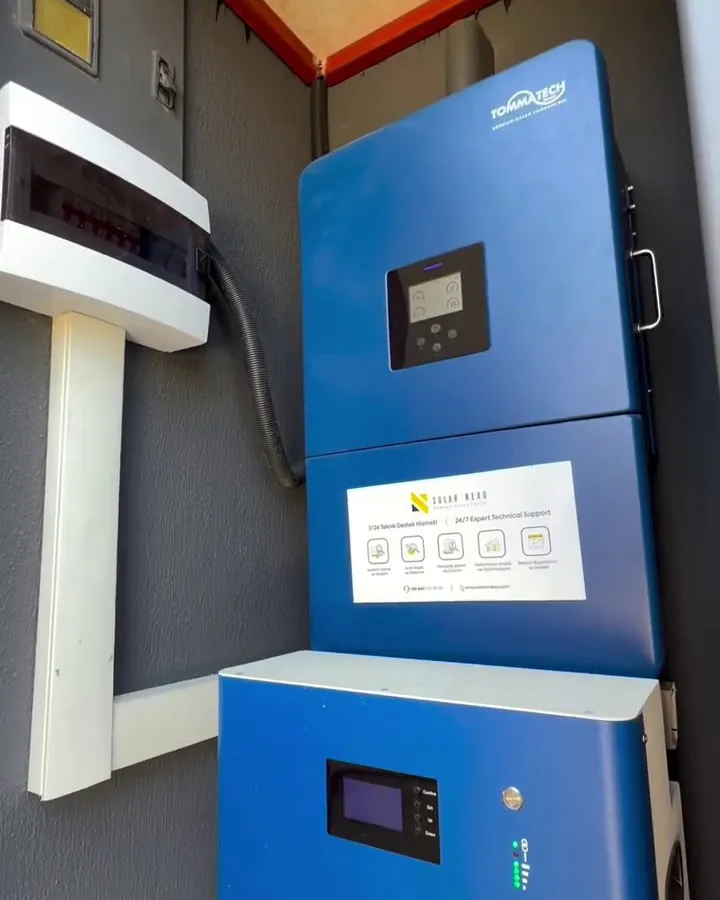
For systems that include a battery, the test list gets a little longer. First, communication between the battery management system (BMS) and the inverter is verified; it must be clear that the inverter correctly reads the battery's state of charge and temperature. Next, settings such as charge and discharge limits, the depth to which the battery will be used and whether charging from the grid is allowed are configured to the user's needs. Finally, an outage scenario is tested: the grid side is disconnected in a controlled way, and it is observed that the loads connected to the backup output continue to be supplied. This test also confirms that the loads meant to keep running during a power cut really are connected to the backup panel. In battery systems, this step is also an opportunity for the user to understand the system correctly from day one.
Test report and handover file
The value of the tests becomes clear once they are recorded. At the end of commissioning, the plant owner should receive a handover file. This file usually contains:
- The layout plan and single-line diagram updated to reflect the as-built installation
- Measurement results per string and insulation test values
- Serial numbers of the panels, the inverter and, if present, the battery
- Manufacturer warranty certificates and user manuals
- Access details for the monitoring system
This file is the first source to consult years later during a fault or maintenance visit. The day-one measurements serve as a reference for comparing panel performance in the future. Solar Nexo hands over the manufacturer warranty certificates for its original, invoiced products at delivery: panels carry a 30-year performance warranty, inverters a factory warranty of 2, 3 or 5 years depending on the model, and lithium batteries a warranty of 5 years or 8,000 cycles. If you are curious about the content of the documents prepared at the design stage, see our article on solar plant design and engineering.
Connection and acceptance with Akdeniz EDAŞ in Antalya
For projects using solar energy in Antalya, the connection and acceptance procedures for grid-connected plants are carried out with Akdeniz EDAŞ, the region's electricity distribution company. The names and order of the steps, and the documents requested, may vary according to current regulations and distribution company practice. As of November 2026, the general flow for a project under the unlicensed generation framework can be summarised as follows:
- Positive outcome of the application: The application is evaluated, and a call letter (çağrı mektubu) is issued for projects found suitable for connection. We explain this document in our article what is a call letter.
- Connection agreement: The connection terms between the plant owner and the distribution company are put in writing.
- Installation and internal tests: The plant is built and the installation team completes the commissioning tests.
- Acceptance application and inspection: An application for acceptance is made to the distribution company; the installation is inspected against the project and the documents.
- Acceptance report and system use: If the inspection is positive, an acceptance report is issued and the procedures for system use are completed.
We have gathered the documents prepared for the application in our article on the documents required for solar plant installation. On timing, it is important to know that Solar Nexo's contracted installation delivery time is 14 working days, while the net metering application process can take an additional 8–12 months on average. A quick installation does not mean that the official procedure will be completed just as fast.
Metering and the start of generation
For a grid-connected plant, the metering must be arranged so that generation is measured correctly. A meter capable of bidirectional measurement is used so that energy fed into the grid by the plant can also be measured. Replacing, programming or sealing the meter is done according to the distribution company's practice; it is not appropriate for the plant to feed energy into the grid before this is complete.
Once acceptance and metering are complete, the plant is energised and generation begins. At this point the installation team checks the inverter's grid parameters one last time, confirms that the monitoring system is sending data and shows the plant owner the first-day readings. We describe in detail how monitoring is set up for plants at operating scale in our article on solar plant remote monitoring.
What happens if a defect or non-conformity is found?
Not everything always goes smoothly at the acceptance inspection. Acceptance may be postponed where the installation differs from the approved project, labelling is missing, there is a shortcoming in earthing or protection devices, or documents are missing. Defects identified are usually recorded in a report; once the plant owner and the installer have corrected them, a re-inspection is requested.
The way to avoid losing time at this stage is to carry out your own internal check before acceptance. Test results, as-built drawings and equipment documents should be complete and ready, and it should be checked that the equipment used on site matches the brand and model stated in the project. If a change was made to the project, you should also ask whether it has been reflected in the documents submitted to the distribution company. Antalya solar plant commissioning relies on the documents and the installation on site confirming each other; every discrepancy means additional correspondence and waiting.
A postponed acceptance does not mean the plant was badly installed; very often the problem is a document that was not updated or a small detail on site. What matters is to obtain the finding in writing, to document the correction with photos and measurements, and to request the re-inspection with these records.
The first weeks after acceptance at a solar power plant in Antalya
Acceptance marks the transition to the plant's operating period, and the first weeks set the reference for the years that follow. During this period it is useful to monitor generation data daily, check the inverter's error log and see whether strings with the same orientation produce similar output. The theoretical PVGIS 5.3 values are a good starting point for evaluating the output of solar power plants in Antalya: for a 1 kWp system in central Antalya, about 1,656 kWh per year, with, for example, 114 kWh/kWp in November and 99 in December. You can make a rough comparison with the monthly value for the month in which acceptance took place, but you should not draw firm conclusions from a single week or from cloudy days. Solar energy in Antalya varies from day to day, and the picture only becomes clear over longer periods.
A frequently asked question in the first months is dust from the installation works remaining on the panels. It helps to leave the panels clean after installation and to check the surface after the first rains. Solar Nexo provides 24/7 technical support for commissioned plants; if you see an unexpected drop in generation, you can contact the support team together with the monitoring data.
Conclusion
Antalya solar plant commissioning runs smoothly when the tests are carried out in full, the results are recorded and the distribution company's inspection is completed on a site that matches its documents. Polarity, string measurements, insulation and functional tests show that the plant is safe; the procedures on the Akdeniz EDAŞ side are carried out according to current regulations and distribution company practice. When defects are found, the cycle of report, correction and re-inspection follows. For the bigger picture of solar energy in Antalya, have a look at our Antalya solar power plant guide, and request a free site survey from Solar Nexo for your project.
Frequently asked questions
Does a solar plant start generating as soon as installation is finished?
A grid-connected plant does not start feeding energy into the grid the moment installation ends. First the installation team completes the electrical tests, then the distribution company's acceptance procedures and the metering arrangements are carried out. It is not appropriate to connect the plant to the grid before these steps are complete. Off-grid systems have no distribution company acceptance, so they can be put into use once the tests are complete.
What is measured during commissioning tests?
Commissioning includes a visual inspection, protective conductor continuity, a polarity check, string open-circuit voltage, string current, insulation resistance and functional tests of the inverter. These tests reveal problems such as a string connected in reverse, a missing panel, damaged cable insulation or a protection device that does not work. The IEC 62446-1 standard is used as the international reference, and the results are recorded in a test report.
Who carries out solar plant acceptance in Antalya?
In Antalya, the connection and acceptance procedures for grid-connected plants are carried out with Akdeniz EDAŞ, the regional electricity distribution company. Which steps acceptance involves, which documents are required and how the inspection takes place are determined by current regulations and distribution company practice. Confirming the current rules with the distribution company before applying and preparing all documents in full speeds up the process.
What happens if defects are found at acceptance?
If defects or non-conformities are identified at the acceptance inspection, acceptance is usually postponed and the findings are recorded. Once the installer and the plant owner have corrected them, a re-inspection is requested. Common reasons include an installation that differs from the approved project, missing labels, shortcomings in earthing or protection, and missing documents. An internal check before acceptance reduces this risk.
How long does the acceptance process take?
The duration of acceptance depends on the project, the preparation of the documents and the distribution company's workload, so quoting an exact number of days would not be accurate. At Solar Nexo, the contracted installation delivery time is 14 working days, while the net metering application process can take an additional 8–12 months on average. Complete tests and documents reduce the need for extra correspondence and re-inspection, helping to shorten the process.
Which documents should the handover file contain?
The handover file should contain the layout plan and single-line diagram updated to the as-built installation, per-string measurement and insulation test results, serial numbers of the panels, inverter and battery, manufacturer warranty certificates, user manuals and access details for the monitoring system. This file is the first source to consult later during a fault, maintenance or warranty claim, and the day-one measurements serve as a reference for performance comparisons.
Sources
Want a clear calculation for your roof?
The Solar Nexo team carries out a free site survey at your address in Antalya and designs the system that suits your roof, consumption and budget.