Short answer
An Antalya solar power plant (GES) is an installation that turns sunlight into electricity with panels; it comes in rooftop, ground-mounted, agricultural and commercial types. According to PVGIS 5.3, a 1 kWp system in central Antalya theoretically generates about 1,656 kWh a year. The right model may be on-grid, hybrid, off-grid or net metering, and it is chosen to fit your consumption profile.
Key takeaways
- A GES, or solar power plant, consists of panels, an inverter, a mounting structure and protection equipment.
- PVGIS 5.3 theoretical values: central Antalya 1,656 kWh/kWp per year, Elmalı 1,719, Alanya 1,615.
- On-grid, hybrid, off-grid and net metering models are chosen according to when electricity is consumed.
- Contracted installation is delivered in 14 working days; a net metering application can take an additional 8–12 months on average.
- Warranties: 30-year performance on panels, 2/3/5-year factory warranty on inverters, 5 years / 8,000 cycles on lithium batteries.
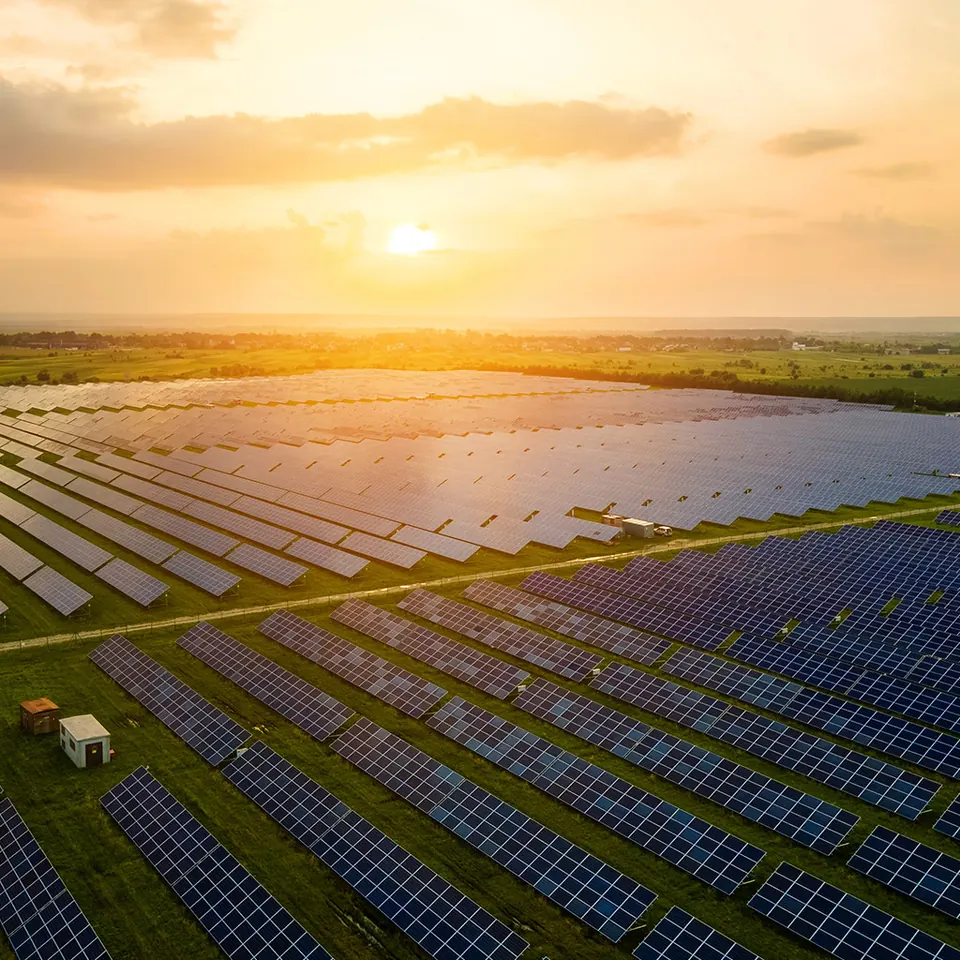
Almost everyone weighing an Antalya solar power plant asks the same first question: where do I start? A solar power plant (GES, short for the Turkish güneş enerji santrali) is an installation that converts sunlight into electricity with photovoltaic panels and delivers that electricity through an inverter to a building or to the grid. A system of a few kilowatts on a villa roof and a much larger plant built on an empty plot of land both fall within this definition from a technical point of view. In this guide we have gathered plant types, the region's generation potential, connection models and the project process on a single page; from each section you can move on to our detailed articles.
What is a GES and what is it made of?
A solar power plant consists of four main components: the panels (modules), the inverter, the mounting structure, and the electrical protection and connection equipment. The panels generate direct current (DC); the inverter converts it into grid-compatible alternating current (AC). The mounting structure holds the panels at the correct tilt and orientation and carries them against wind and snow loads. Cables, fuses, surge protection devices, circuit breakers and earthing keep the whole system operating safely.
Depending on your needs, a battery, a monitoring device and a bidirectional meter can be added to this setup. The size of a plant is expressed in kWp (kilowatt-peak), the combined power of the panels under standard test conditions. For example, 20 panels of 605 W come to roughly 12.1 kWp. Annual generation, on the other hand, is measured in kWh and depends on factors such as location, tilt, orientation, shading and temperature. Put simply, kWp describes installed capacity, while kWh tells you how much work that capacity actually delivers over a year.
Antalya solar power plant types: rooftop, ground-mounted, agricultural and commercial
Plants call for different design decisions depending on where they are built and what they are used for. The table below puts the four types most commonly seen in the region side by side.
| Type | Typical location | Key engineering issue | Connection |
|---|---|---|---|
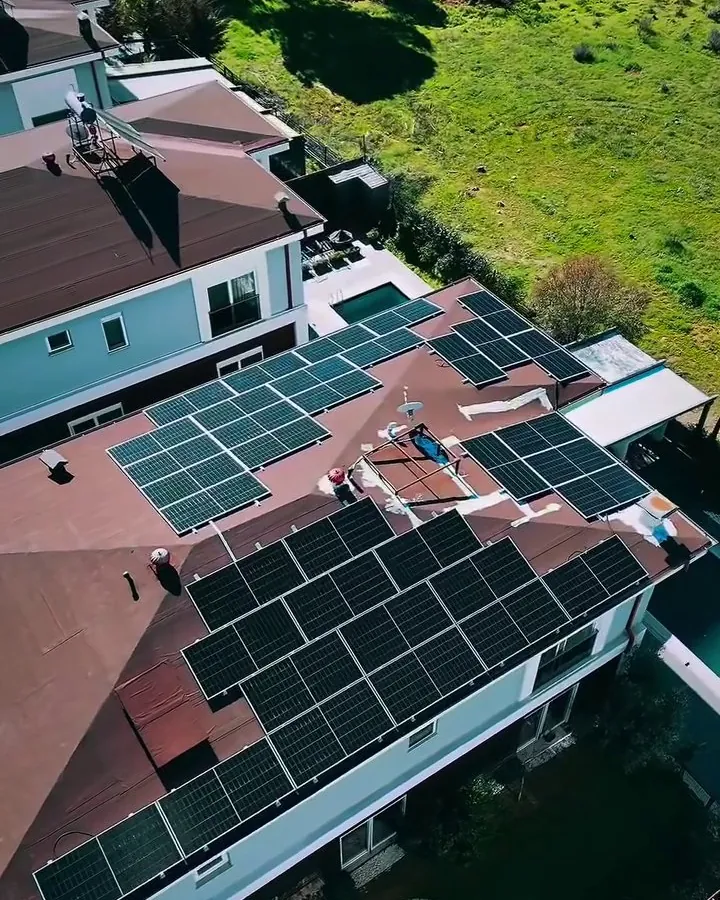
| Residential and villa rooftop GES | Detached houses, villas, apartment roofs | Roof structural capacity, shading, aesthetic layout | On-grid, hybrid or net metering |
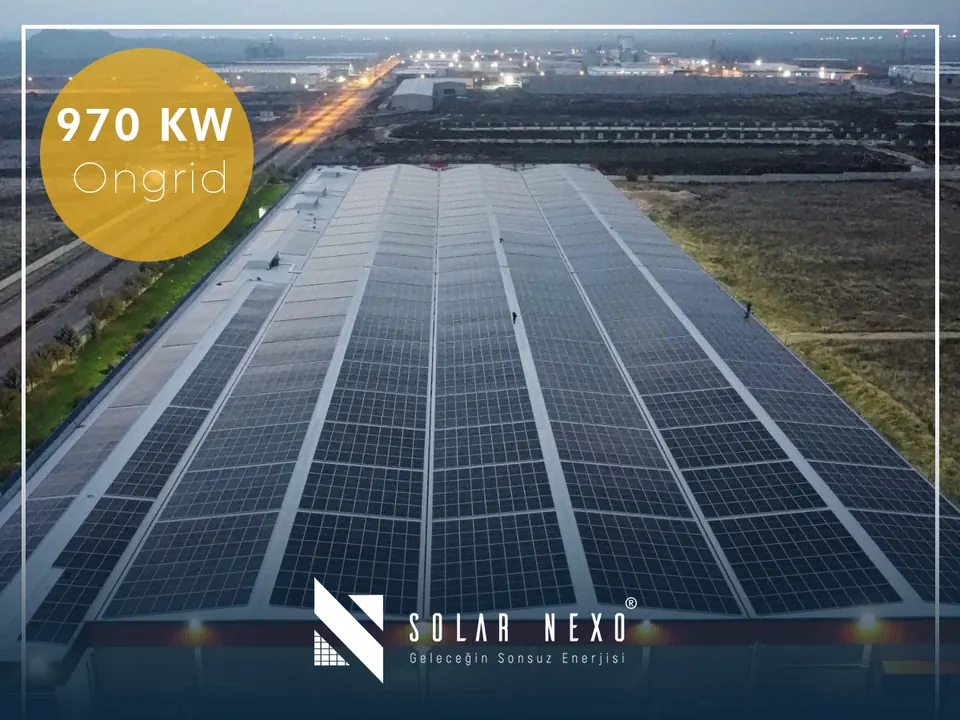
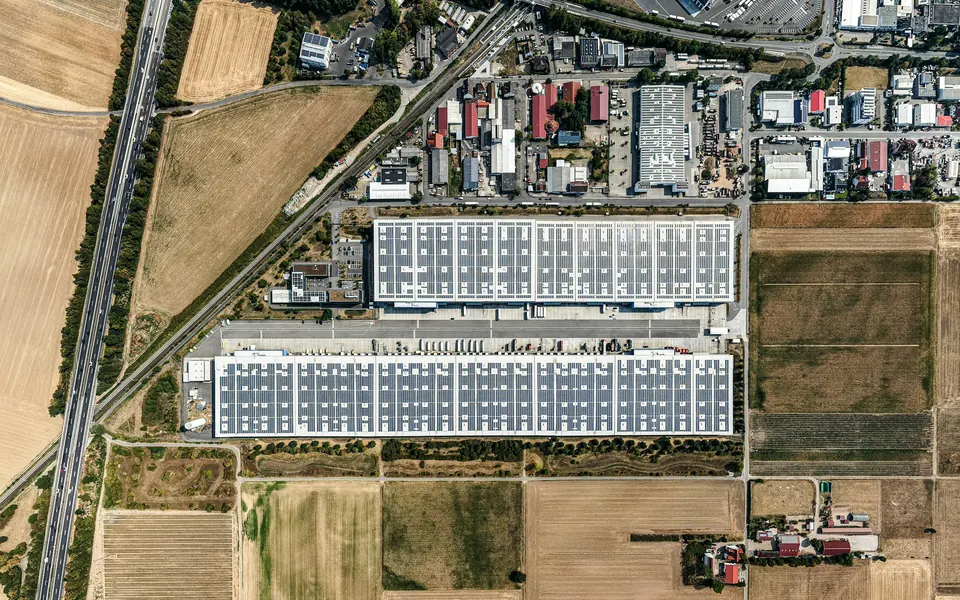
| Commercial and industrial rooftop GES | Factory, hotel, warehouse and store roofs | Matching daytime consumption, roof load, fire safety | Connected to the facility's own consumption point |
| Ground-mounted GES | Vacant land, highland plots, south-facing sloping parcels | Geotechnical survey, access, distance to the grid, permits | Determined by the project and current regulations |
| Agricultural GES | Irrigation wells, greenhouses, farms | Pump power, seasonal consumption | Tied to an irrigation subscription or independent of the grid |
We explain the core differences between rooftop and ground-mounted plants in our article on rooftop vs ground-mounted solar plants. If you are curious about the steps by which a land project is developed, have a look at our ground-mounted solar plant installation guide. Our article on factory solar plant installation, prepared for industrial roofs, covers the consumption profile, roof load-bearing capacity and keeping production running without interruption during the works.
Solar energy in Antalya: what the PVGIS data shows
To estimate in advance how much a plant will generate, engineers widely use PVGIS, the free tool of the European Commission's Joint Research Centre (JRC). In a theoretical PVGIS 5.3 calculation, a 1 kWp system at optimum tilt, assuming 14% system losses, generates about 1,656 kWh per year in central Antalya; the optimum tilt in this calculation comes out at 33°. The districts differ as well: Alanya 1,615, Manavgat 1,649, Kaş 1,664, Korkuteli 1,655 and Elmalı 1,719 kWh/kWp per year.
These figures sum up why solar energy in Antalya attracts so much interest. Still, bear in mind that they are theoretical starting points. The real output of a site is determined by the orientation and tilt of the panels, shading from surrounding trees and buildings, dust build-up, summer heat and the choice of equipment. In the monthly breakdown, July (168 kWh/kWp) and August (167) are the peak months, while December and January (99) are the lowest. Generation continues through winter, but December output is only about 59% of July's. Accounting for this seasonal gap in the design matters, especially for buildings with high winter consumption.
The influence of climate on design is not limited to irradiation. Panel efficiency drops as temperature rises, so during the long, hot summer months it makes sense to leave room for air to circulate behind the panels and to choose models with a low temperature coefficient. In coastal districts, the salty and humid air calls for corrosion-resistant materials in the mounting structure and fasteners. In highland districts such as Korkuteli and Elmalı, snow load and wind are an integral part of the structural calculation. In farming areas, dust and pollen build-up dictates how often the panels need cleaning. That is why the same installed capacity is realised with different material and detailing decisions for a villa in Kaş and for an irrigation site in Elmalı. A sound project interprets the theoretical PVGIS value together with these local site conditions.
Connection models: on-grid, hybrid, off-grid and net metering
How the plant relates to the grid matters just as much as its physical type. There are four basic models:
- On-grid: Connected to the grid, with no battery. The energy produced goes first to the facility's own consumption. When there is a power cut, the inverter shuts down for safety reasons.
- Hybrid: A battery is added to the grid connection. Daytime surplus is stored in the battery, and during an outage selected loads continue to be supplied.
- Off-grid: There is no grid connection. For vineyard houses, mountain homes or places the grid does not reach, panels, inverter and battery are designed together as one system.
- Net metering: Under the unlicensed generation framework, generation and consumption are offset against each other using the distribution company's meter data (mahsuplaşma in Turkish). As of November 2026, under current regulations, the principles of net metering are set by the rules of EPDK, Turkey's energy market regulator, and in Antalya applications are submitted to Akdeniz EDAŞ, the local electricity distribution company.
You can find, step by step, which documents are prepared and how the procedure progresses in our article on the rooftop solar plant application. Because the regulations change from time to time, the current rules should be confirmed through announcements from the distribution company and EPDK before you apply.
Which model for which situation? A decision guide for an Antalya solar power plant
The right model depends on when and where your consumption occurs. A simple approach can be summarised as follows:
| Your situation | Model usually considered |
|---|---|
| Consumption mostly during the day (workshop, office, shop, factory) | On-grid, focused on self-consumption |
| High evening and night consumption, and power cuts are a nuisance | Hybrid, with battery capacity sized to the night load |
| No grid, or the connection point is very far away | Off-grid |
| Generation and consumption occur at different times of the year | Net metering application |
| Well or irrigation pump | Solar irrigation system |
To give examples from the field: the systems built in Manavgat with 20×605 W panels, a 15 kW hybrid inverter and a 15 kWh battery, and in Belek with 24×605 W panels, a 20 kW hybrid inverter and a 15 kWh battery, keep their grid connection while using the battery to support evening consumption. The system in Döşemealtı with 10×605 W panels, an 11 kW off-grid inverter and a 15 kWh battery, by contrast, was designed to run independently of the grid. In Gazipaşa, we took on the replacement of 5 failed inverters at an existing plant built by another company, as a service job.
Building a solar power plant in Antalya step by step
Whatever the type of plant, the process follows a similar sequence. The flow below shows the stages from the site survey to operation.
- Free site survey and consumption analysis: The last 12 months of bills, roof or land dimensions, sources of shading and the electrical panel are examined on site.
- Engineering design: The layout plan, string calculation, single-line diagram and generation simulation are prepared. For details, see our article on solar plant design and engineering.
- Quotation and contract: The equipment brand and model, scope, schedule and warranty terms are put in writing.
- Application: For net metering systems, the application to the distribution company is filed. This procedure can take 8–12 months on average and should be planned separately from the installation period.
- Installation: Our contracted delivery time is 14 working days.
- Testing and acceptance: Electrical tests are carried out, and for grid-connected systems the distribution company's acceptance procedures are completed.
- Monitoring and maintenance: Generation data is tracked, and periodic cleaning and inspections are scheduled.
Equipment selection, warranties and the operating period
Whether a plant runs trouble-free over its lifetime depends largely on where its equipment comes from and how it is documented. Solar Nexo is an authorised dealer of TommaTech and CW Enerji; we use original, invoiced products and hand over the manufacturer's warranty certificates at delivery. On the panel side, TOPCon N-Type models are used, while on-grid, hybrid and irrigation inverters are selected to suit the project.
Warranty terms need to be read correctly. Panels carry a 30-year performance warranty; the product warranty varies by model. Inverters have a factory warranty of 2, 3 or 5 years depending on the model. Lithium batteries are covered for 5 years or 8,000 cycles. You should be able to see in the contract and on the warranty certificate which of these periods applies to which product.
The job does not end when installation is complete. Monitoring generation regularly, comparing it with the expected value and looking for the cause whenever there is a deviation is what keeps a plant performing. We explain how to evaluate your output, with the measurement method, in our article on the solar plant performance ratio. Because soiling such as dust, pollen and bird droppings can affect generation in the region, the cleaning and inspection schedule should be planned from the outset. Solar Nexo provides maintenance and repair not only for the plants it builds but also for systems installed by other companies, and offers 24/7 technical support.
Conclusion
A sound Antalya solar power plant investment starts with choosing the plant type, the connection model and the equipment according to your consumption profile. The PVGIS data shows that the region offers strong generation potential, but only an on-site survey and proper engineering design can reveal what your particular site will produce. For net metering applications you need to follow the current state of the regulations, and once the plant is running you need to keep monitoring its output. For your Antalya solar energy project, you can request a free site survey from Solar Nexo, or follow the links in this guide to the details of each topic. Antalya solar energy has a lot to offer, and a well-planned plant is the way to make the most of it.
Frequently asked questions
What is a GES?
GES is the Turkish abbreviation for a solar power plant, an installation that converts sunlight into electricity with photovoltaic panels. The panels produce direct current, and the inverter converts it into grid-compatible alternating current. The mounting structure, cables, protection equipment and, where needed, a battery and a monitoring device complete the system. Both a small system on a villa roof and a large plant built on open land fall under this definition.
How much electricity does 1 kWp of solar panels generate per year in Antalya?
According to the theoretical PVGIS 5.3 calculation, a 1 kWp system at optimum tilt, assuming 14% losses, generates about 1,656 kWh per year in central Antalya. The figure is 1,615 in Alanya, 1,649 in Manavgat, 1,664 in Kaş, 1,655 in Korkuteli and 1,719 kWh/kWp in Elmalı. Actual output varies with orientation, tilt, shading, soiling and temperature, so a site-specific calculation is made during the on-site survey.
Is a rooftop or a ground-mounted solar plant more suitable?
If your consumption takes place in a building, a rooftop system is usually the first option considered, because the electricity is used where it is produced and no extra land is needed. A ground-mounted plant comes into play when the roof area is not enough or a larger capacity is the goal; the geotechnical survey, access road, distance to the grid and permit procedures shape the project. The decision should be made together with your consumption profile and the site conditions.
What is the difference between a hybrid and an on-grid system?
The key difference is the battery. An on-grid system runs connected to the grid without a battery and shuts down for safety reasons during a power cut. In a hybrid system, the daytime surplus is stored in the battery and shifted to evening consumption, and selected loads continue to be supplied during an outage. The hybrid model is preferred more often in buildings with frequent power cuts or high evening consumption.
How long does a solar plant installation take?
At Solar Nexo, the contracted installation delivery time is 14 working days. For net metering systems, the application to the distribution company and the approval procedure can take an additional 8–12 months on average. When planning the schedule, it is therefore wise to treat the on-site installation and the official application as separate items. Project size, permit requirements and equipment supply can also affect the timeline.
Where do you apply for a net metering solar plant in Antalya?
In Antalya, applications for unlicensed generation and net metering are submitted to Akdeniz EDAŞ, the regional electricity distribution company. As of November 2026, under current regulations, the principles of net metering are set by the rules of EPDK, the energy market regulator. Because the rules are updated from time to time, checking the announcements of the distribution company and EPDK before applying and preparing all required documents in full makes the process smoother.
What are the warranty periods for solar plant equipment?
For the products supplied by Solar Nexo, panels carry a 30-year performance warranty, while the product warranty varies by model. Inverters have a factory warranty of 2, 3 or 5 years depending on the model. Lithium batteries are covered for 5 years or 8,000 cycles. The products are original and invoiced, and the manufacturer's warranty certificates are handed over at delivery; the contract should show which period applies to which product.
Sources
Want a clear calculation for your roof?
The Solar Nexo team carries out a free site survey at your address in Antalya and designs the system that suits your roof, consumption and budget.