
Short answer
An Antalya marina solar power plant is a solar plant installed on the roofs, car parks and ancillary buildings of yacht harbours and boatyards. At facility scale, it covers part of the pontoon lighting, office, restaurant and workshop loads with daytime output. Success depends on mounting and fasteners suited to salty air, wind load calculations, sizing to the load profile and planning the Akdeniz EDAŞ connection process early.
Key takeaways
- Marina consumption is not a single building; it is made up of different load groups such as pontoons, offices, restaurants, workshops and car parks, and these must be separated first.
- The most suitable surfaces for panels are usually the roofs of administration buildings and hangars and carport structures over the car park; installation on pontoons needs a special assessment.
- By the sea, mounting systems, bolts, connectors and distribution boards must be chosen with corrosion risk in mind; inverters should be placed in an enclosed, ventilated room where possible.
- In open coastal areas, wind load and structural checks must be completed before the panel layout is finalised.
- According to PVGIS data, theoretical output in central Antalya is around 1,656 kWh/kWp per year; high summer output matches the seasonal load profile of a marina well.
An Antalya marina solar power plant is a solar power plant (GES) installed on the roofs, car parks and ancillary buildings of a yacht harbour, haul-out yard or boat maintenance facility. Unlike the small panels used to charge a single boat's batteries, the subject here is the facility itself: pontoon lighting, offices, restaurants and cafés, workshops, pumps and security systems all draw power at the same time. In this article we take an engineering look, step by step, at how a marina or boat maintenance business can make the switch to solar energy.
Our caravan and boat solar panel article for individual boat owners focused on portable and small systems. Here we offer a framework for businesses that think at the scale of the administration building, the hangar and the car park.
Why Does an Antalya Marina Solar Power Plant Need Separate Planning?
In energy terms, a marina behaves like a small settlement. Office and restaurant loads run throughout the day, pontoon and perimeter lighting switch on in the evening, and workshop machinery comes into play during the maintenance season. Air-conditioning consumption rises noticeably in summer, while some parts of the facility run more quietly in winter. Sizing a system by looking at a single meter bill is therefore often misleading.
Site conditions also differ from those on an ordinary roof. Salty air, humidity, wind from the open sea, boat traffic and crane movements all have a direct effect on the design. Every solar power plant in Antalya on the coastal strip calls for extra care, and a marina site is one of the places where that care is needed most.
Marina Load Groups: Where Does the Electricity Go?
The first step towards a sound design is to split consumption into groups. Where possible, collect at least one year of billing history, hourly or fifteen-minute meter data and separate measurements from the distribution boards. The table below gives a general summary of typical load groups and how well they match solar output over the day.
| Load group | Typical consumers | Peak hours | Match with solar output |
|---|---|---|---|
| Administration building and offices | Air conditioning, computers, lighting | Daytime | High |
| Restaurant and café | Refrigerated cabinets, kitchen equipment, air conditioning | Midday and evening | Medium |
| Boat maintenance workshop | Compressors, sanders, welding, ventilation | Daytime, depending on the season | High |
| Pontoons and jetties | Lighting, shore power points for boats | Evening and night | Low (storage may be needed) |
| Infrastructure and security | Pumps, cameras, barriers, communications | Continuous | Medium |
| Car park | Lighting, electric vehicle charging | Daytime and evening | Medium |
As the table shows, office and workshop loads line up well with solar generation. Pontoon lighting, on the other hand, runs mostly after sunset. To cover that load you either keep drawing from the grid or use an energy storage system to shift daytime output into the evening. Which option makes sense is assessed separately, depending on the size of the load and the connection model.
Electricity supplied to boats
The electricity supplied to boats from the shore power points on the pontoons can account for a significant share of a marina's total consumption. How this energy is metered and passed on to boat owners depends on the business's own arrangements and on the regulations. As of November 2026, under current regulations, we recommend clarifying this point from both a legal and a technical perspective before installation.
Where Are Panels Installed on a Marina Site in Antalya?
Marinas usually have more usable surface than people expect, but not every surface is equally suitable. The main options are:
- Administration and amenity building roofs: Easy to access, with short cable runs, and practical for maintenance.
- Hangar and warehouse roofs: They offer large, even areas; however, the condition of the roof covering and its load-bearing capacity must always be checked.
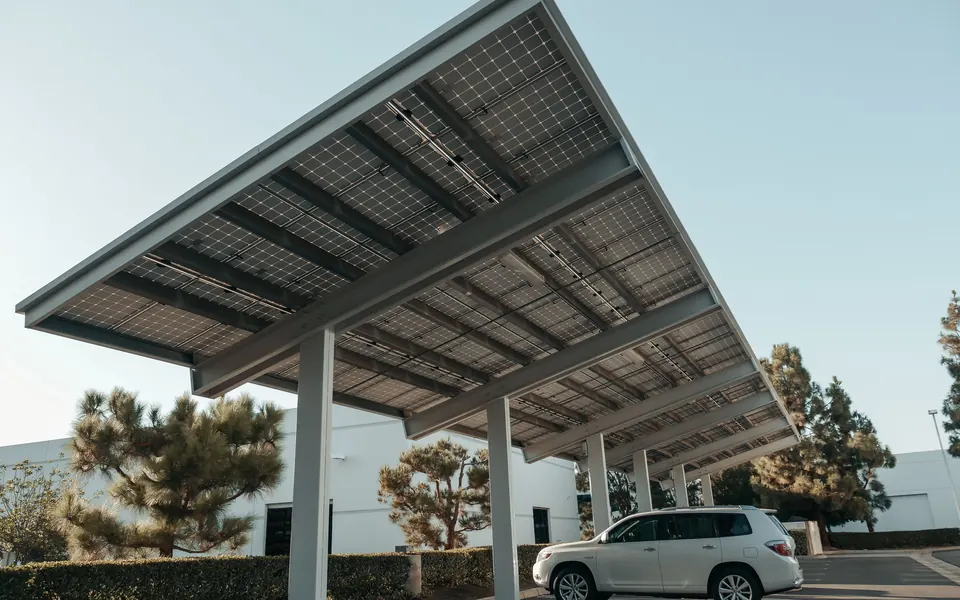
- Car park carport structures: They shade vehicles and create a new generating area at the same time. They can be planned together with electric vehicle charging stations.
- Edges of the haul-out and dry storage areas: Sections outside the working area of cranes and the travel lift can be considered.
- On pontoons and jetties: Because of the moving structure, heavy salt exposure and safety concerns, this is usually not the first choice and should only be considered with a dedicated design.
We covered the design details of car park systems separately in our carport and car park solar energy article. In marina projects, a carport is a frequently chosen solution, both to protect visitors' cars and to create a visible sustainability feature.
Corrosion-Resistant Mounting in a Salty Environment
By the sea, most problems appear at the connection points rather than in the panel itself. When salt crystals combine with moisture, they speed up corrosion on metal surfaces, and the effect can be even more pronounced where different metals touch. For this reason, the bill of materials for a marina project must be prepared more carefully than for an ordinary residential roof.
- Use aluminium or suitably coated galvanised steel for the support profiles, and protect cut edges and drilled holes.
- Use stainless steel for bolts, nuts and clamps, and consider isolating washers where aluminium meets stainless steel.
- Choose connectors from the same manufacturer and of a compatible type; never mate connectors of different brands.
- Cables should be UV- and moisture-resistant solar cable, and conduits and trays should be laid so that water cannot collect in them.
- Inverters and distribution boards should, where possible, be placed in an enclosed, ventilated technical room; if they have to stay outdoors, they need an appropriate ingress protection rating.
We discuss corrosion risk and material choice on the coastal strip in more detail in our Antalya coastal solar plant corrosion article. On a marina site these measures are not optional extras; they are a basic condition for the system's long service life.
Wind Load, Structural Checks and Safe Layout
Wind from the open sea can act more directly on coastal structures than on buildings further inland. Panel arrays behave like sails; uplift is a serious design input, especially on carports and steeply tilted frames. Before the panel layout is fixed, an engineer should therefore assess the structural condition of the building, the anchorage details and the additional loads in the edge zones.
Safe layout on a marina site is not only about wind. Crane and mast movement areas, fire access routes, emergency exits and boat traffic must all be marked on the plan. Lightning protection and earthing are also topics that must not be neglected on coastal structures; we examine them in our solar plant lightning and storm protection article.

Solar Energy in Antalya: Output and the Marina Season
Antalya is very well placed for solar energy. According to PVGIS 5.3, the tool of the European Commission's Joint Research Centre, theoretical annual output in central Antalya is around 1,656 kWh/kWp, assuming 1 kWp of installed capacity, optimum tilt and 14% system losses. For the coastal districts, values of about 1,615 kWh/kWp are calculated for Alanya, 1,649 for Manavgat and 1,664 for Kaş.
The monthly distribution is particularly meaningful for marina operators. In the PVGIS data, July and August are the most productive months of the year at around 167–168 kWh per kWp, while December and January stay at around 99 kWh. During the tourist season, the extra restaurant, air-conditioning and guest loads largely coincide with the period of high solar output, which is one of the strongest arguments for solar energy in Antalya's marinas.
As a theoretical example, a 100 kWp carport and rooftop system under central Antalya conditions has an annual output potential of around 165,600 kWh. This figure is an assumption; actual output varies with orientation, tilt, shading, temperature, soiling and equipment choice. That is why on-site measurement and shading analysis are essential when designing an Antalya solar power plant.
Connection Model and Application for an Antalya Marina Solar Power Plant
Marina facilities usually prefer a grid-connected set-up aimed at covering their own consumption. How surplus energy is handled when output exceeds instantaneous consumption, as well as connection capacity and transformer capacity, depends on the process run with the distribution company. In Antalya this process goes through Akdeniz EDAŞ (AEDAŞ), the local electricity distribution company.
As of November 2026, under current regulations, application requirements, capacity limits and net metering (mahsuplaşma) rules are set within the framework of regulations issued by EPDK, the Turkish energy market regulator. Because these rules can change from time to time, the current texts should be checked at the start of the project. For marinas operating on public land, lease and permit conditions must also be reviewed separately. During the site survey, Solar Nexo goes through these points with you and clarifies which connection model suits the project.
Is storage needed?
If pontoon lighting and night-time security loads make up a significant share, or if there are systems that are sensitive to outages, a combination of a hybrid inverter and lithium batteries can be considered. Storage is not mandatory at every marina, however; the decision should be based on the load profile and on how sensitive the facility is to power cuts.
Antalya Solar Power Plant Maintenance and Monitoring by the Sea
Panels by the sea can get dirty faster from salt and dust. A salt film on the surface reduces output and, if it goes unnoticed, can increase the risk of hot spots. Cleaning frequency should therefore be set according to site observation, using suitable methods rather than chemicals.
With remote monitoring, the output of every inverter and, where possible, every string can be tracked. Sudden drops, connection faults or leakage-current warnings caused by corrosion are noticed early. Solar Nexo provides maintenance and repair not only for the systems it installs but also for plants built by other companies, and offers 24/7 technical support. During periodic inspections, connection points, bolt torques, earthing and the inside of distribution boards should be checked with particular care.
Conclusion
When the challenges of coastal conditions are managed properly, an Antalya marina solar power plant can cover a significant part of a facility's daytime consumption with on-site generation. The keys to success are separating the load groups, choosing suitable surfaces, using materials that withstand salty air, accounting for wind load and planning the connection process from the outset.
If you want to assess the potential of solar energy in Antalya at marina scale, take a look at our Antalya solar power plant guide for the overall framework. As an authorised dealer of TommaTech and CW Enerji, Solar Nexo works with original, invoiced products; with a free site survey we inspect your site in person and prepare an assessment tailored to you. In any solar energy investment in Antalya, the right start is reading the site and the consumption correctly.
Frequently asked questions
Which surfaces can an Antalya marina solar power plant be installed on?
The most suitable surfaces are usually the roofs of administration buildings, amenity buildings, hangars and warehouses, plus carport structures built over the car park. Edges of the haul-out area away from crane movements can also be considered. Installation on pontoons and jetties requires a dedicated design because of the moving structure, heavy salt exposure and safety concerns, so in most projects it is not the first choice.
Does salty air damage solar panels?
Salty air mainly increases the risk of corrosion at metal connection points such as the mounting system, bolts, connectors and distribution boards. With suitable aluminium or coated profiles, stainless fasteners, compatible connectors and protected boards, this risk can be managed to a large extent. A salt film on the panel surface, however, reduces output, so a regular cleaning plan is needed.
What system size does a marina need?
The required capacity is determined by the facility's annual and hourly consumption data, the usable surface area and the connection conditions. The right size cannot be found without examining office, restaurant, workshop and pontoon loads separately. A consumption analysis based on at least one year of billing history and, ideally, meter profile data should therefore be the starting point for sizing.
Can pontoon lighting be supplied by solar energy?
Yes, but because pontoon lighting mostly runs after sunset, a storage system is needed to shift daytime output into the evening. A combination of a hybrid inverter and lithium batteries can be used for this. Alternatively, the system stays connected to the grid and night-time loads are supplied from the grid. Which route suits you depends on the size of the load and how sensitive the facility is to outages.
Why is wind load important on a marina site in Antalya?
In open coastal areas, wind can act more directly on structures, and panel arrays are exposed to uplift forces. On carports and steeply tilted frames in particular, this force is one of the key design inputs. The structure's load-bearing capacity, the anchorage details and the additional loads in the edge zones should be checked by an engineer before installation.
Which authority handles a marina solar plant application?
In Antalya, the grid connection process is handled by Akdeniz EDAŞ, the local distribution company, while the general rules are set by regulations of EPDK, the energy market regulator. As of November 2026, under current regulations, application requirements and capacity limits can change, so the current texts should be checked at the start of the project. For marinas on public land, lease and permit conditions must also be reviewed separately.
How often should a solar plant by the sea be cleaned?
There is no single correct number for cleaning frequency; it should be set according to site observation and monitoring data. By the sea, salt and dust can build up faster than further inland. Unexpected drops in output or a visible salt film on the surface are signs that cleaning is needed. Use the methods recommended by the panel manufacturer instead of chemical detergents.
Sources
Want a clear calculation for your roof?
The Solar Nexo team carries out a free site survey at your address in Antalya and designs the system that suits your roof, consumption and budget.