Short answer
In Antalya coastal solar installations, the main risk is corrosion caused by salty humidity in the mounting hardware, the connectors and the earthing connections. Anodized aluminum rails, A4-grade stainless steel fasteners, insulation between dissimilar metals, matching connectors from the same brand and protected enclosures reduce that risk. Cleaning should be planned from monitoring data, and wind load should be determined by a structural calculation.
Key takeaways
- On the coast, corrosion affects the mounting hardware, fasteners and connectors more than the panels themselves.
- Without insulation between aluminum and stainless steel or copper, galvanic corrosion accelerates.
- According to PVGIS 5.3, theoretical yield is 1,656 kWh/kWp per year in central Antalya, 1,615 in Alanya and 1,664 in Kaş.
- Instead of a fixed cleaning calendar, combine monitoring data with visual checks after storms.
- For seafront projects, edge distances and the number of fixings should be set by a structural calculation.
Antalya coastal solar projects can use the same panels and inverters as installations further inland, but salty humidity, sea spray and coastal winds mean that material selection, connection details and the maintenance plan have to be thought through differently. A solar power plant (GES) spends many years outdoors, whether it sits on a villa roof in Konyaaltı or on a guesthouse in Kaş. On the coast, the most insidious effect of that environment is corrosion: it goes unnoticed in the first years, but over time it shows up as problems in screws, clamps, connectors and earthing connections.
In this article we explain how to design systems for solar energy in Antalya against corrosion along the coastline stretching from Lara to Kemer and from Alanya to Kaş, which materials stand out, and what to watch for when it comes to cleaning and wind load.
Why does Antalya coastal solar call for a separate design approach?
Humid air coming off the sea carries very fine salt particles. These particles settle on the panel frames, the rail system, the bolts and the cable ends. Salt attracts moisture; together with the night-time dew, it forms a thin electrolyte film on metal surfaces. Corrosion progresses precisely in this film, through the electrochemical reaction of the metals.
Distance from the shore, the prevailing wind direction, whether the building faces the sea and the obstacles around it all determine how severe the effect will be. A hotel roof right on the seafront and an apartment block a few streets inland do not experience the same conditions. That is why the first step in Antalya coastal solar design is to examine carefully, during the site survey, where the site sits in relation to the sea and whether the existing metalwork shows signs of rust. Old air-conditioning brackets, railings or water tanks on the roof often give the most honest clue about the corrosion character of a site.
What does salty humidity do to panels and metal hardware?
Because the panel itself is made of glass and encapsulated cells, the parts most directly affected by salt are usually the frame, the junction box and the connectors. The real risk, however, lies in the structure that carries the panel. The main problems encountered on the coast are:
- Surface corrosion: Rust appears on steel parts with weak coatings, and white, powdery oxidation appears on aluminum.
- Galvanic corrosion: When dissimilar metals touch each other in a humid environment, the more active metal wears away quickly.
- Crevice corrosion: Hidden wear that progresses in narrow gaps where water and salt are trapped, such as under clamps and between washers.
- Electrical connection problems: Contact resistance rises at oxidized connectors and terminals, which can lead to heating and lost generation.
When choosing panels, it is worth checking the manufacturer's datasheet for a statement of compliance with salt mist corrosion testing (IEC 61701). This shows that the panel has been tested for coastal conditions; on its own, however, it is not enough if the mounting and connection details are not designed correctly.
Solar energy in Antalya: the potential of the coastal districts
The risk of corrosion is no reason to give up on a solar power plant in Antalya on the coast. The potential of solar energy in Antalya is high in the coastal districts as well. The figures below are theoretical annual yields calculated with the PVGIS 5.3 tool, assuming 1 kWp of installed capacity, optimum tilt and 14% system losses.
| Area | Theoretical annual yield (kWh/kWp) | Note on coastal conditions |
|---|---|---|
| Central Antalya (Konyaaltı, Lara, Muratpaşa) | 1,656 | Salt exposure is noticeable at residential complexes and hotels close to the sea |
| Manavgat (Side coast) | 1,649 | Dense with tourism facilities and seaside villas |
| Alanya | 1,615 | Wind exposure can be higher for buildings on hillsides |
| Kaş | 1,664 | On the rocky shoreline, spray and wind should be assessed together |
For coastal areas not listed here, such as Kemer, we run a separate PVGIS calculation with the project coordinates during the site survey. Actual generation may differ from these theoretical values depending on factors such as shading, panel orientation, soiling and temperature. You can find the region's overall potential in more detail in our article on the solar energy potential of Antalya.
Choosing materials for Antalya coastal solar mounting
On the coast, the key to a long service life is a mounting system made of mutually compatible, corrosion-resistant materials. We covered rail and clamp options in general terms in our article on solar panel mounting systems; the points that matter most by the sea are these:
Aluminum and stainless steel
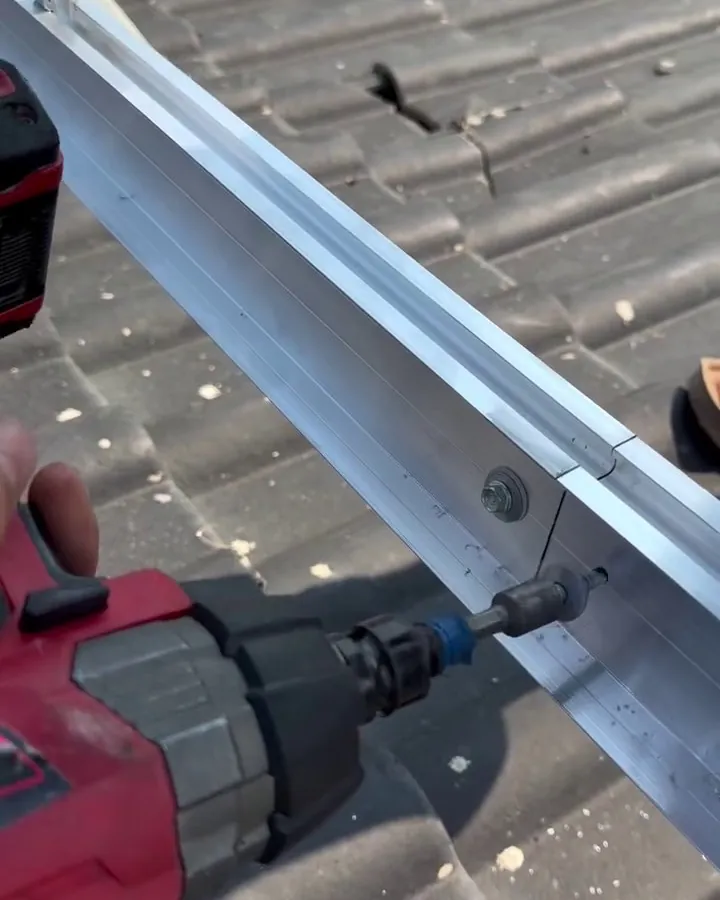
Anodized aluminum rails and clamps are a frequent choice for coastal installations thanks to their low weight and natural oxide layer. Stainless steel is used for the fasteners; in a marine environment, A4 (316) grade stainless steel, which is more resistant to chlorides, is generally a safer choice than A2 (304). In ground-mounted or carport projects that require a steel structure, hot-dip galvanizing and re-protecting every cut or drilled point with a coating are important.
Preventing galvanic corrosion
When aluminum comes into direct contact with stainless steel or copper in a humid, salty environment, the aluminum side starts to corrode. To prevent this, insulating washers or EPDM spacers are placed between dissimilar metals, and suitable bimetallic terminals are used for aluminum-to-copper transitions in earthing connections. Using a single manufacturer's compatible fastening set reduces this risk noticeably compared with a system completed from random parts.
Points of contact with the roof
Tile hooks, trapezoidal sheet connections and feet on concrete roofs are also affected by salt. Every drilled point must be sealed with the correct sealing material, both for waterproofing and for corrosion protection.
Protecting connectors, cables and electrical components
One of the most common faults in coastal solar projects in Antalya is oxidized or water-damaged connectors. The basic rule is to use male and female connectors from the same manufacturer, never to mate different brands, and to crimp and tighten with the correct tool. Cables should be UV-resistant solar cable, should not be left taut under the panels and should not rub against sharp edges. For details, see our article on solar cables and connectors.
- Cable trays and conduits should be made of UV-resistant material.
- DC and AC enclosures should have an IP rating suited to the site, and cable entries should be closed with glands.
- Where possible, the inverter should be mounted in a shaded, well-ventilated spot that does not receive direct sea spray.
- Earthing and surge protection connections must always be checked during periodic inspections.
A loose or oxidized connection in the earthing circuit does not affect generation at first glance; in the event of lightning or a leakage current, however, it weakens the protection system.
Cleaning and maintenance for Antalya coastal solar
On the coast, a thin layer of salt settles on the panel surface along with the dust. This layer reduces output and can also leave permanent stains along the edges. Rather than a fixed cleaning calendar, we recommend combining generation data from the monitoring system with visual checks. It is a good habit to inspect the panel surface especially after southerly winds and storms, or during summer months with no rain for long periods.
- Use soft or treated water for cleaning where possible; hard water can leave marks on the surface.
- Avoid high-pressure washing, abrasive brushes and chemical detergents.
- Clean early in the morning or in the late afternoon so you do not pour cold water on hot glass.
- If there is no safe access to the roof, do not clean the panels yourself; the risk of falling always comes first.
Periodic maintenance should cover not only the panel surface but also bolt tightness, the areas under the clamps, cable trays and the inside of enclosures. For the right cleaning methods, see our article on solar panel cleaning.
Wind load and storm resistance on the coast
The storms that hit the Antalya coast in winter put panel systems under strain, especially on hillside or tall buildings. Wind gets under the panels and creates uplift; roof edges and corners are the most critical zones in this respect. For seafront projects, panel layout, edge distances, rail spans and the number of fixings should therefore be determined by a structural calculation based on the applicable standards.
Corrosion and wind load are not independent of each other. A fastener that thins over time may no longer provide the strength calculated at the design stage. We cover storm and lightning measures separately in our article on lightning and storm protection for solar plants.
Building a coastal Antalya solar power plant with Solar Nexo
Solar Nexo installs on-grid, hybrid and off-grid systems on villa, hotel, guesthouse and business roofs in Antalya's coastal districts. During the site survey we assess the site's position relative to the sea, the condition of existing metalwork and the wind exposure, and recommend mounting materials accordingly. As an authorized dealer of TommaTech and CW Enerji, we supply original, invoiced products and hand over the manufacturer warranty documents at the end of the installation. We also provide corrosion checks and maintenance and repair services for coastal systems installed by other companies. For an overview of the process, see the Antalya solar power plant guide.
Conclusion
Antalya coastal solar projects require managing a high solar resource alongside salty humidity and coastal winds. Compatible aluminum and stainless steel fasteners, insulation against galvanic corrosion, correct connector and cable practice, cleaning based on monitoring data and mounting based on a structural calculation are the foundation of a system that runs without trouble for many years. If you would like a material and layout assessment for your coastal roof, you can request a free site survey from the Solar Nexo team.
Frequently asked questions
Can solar panels be installed on a house near the sea?
Yes, solar panels can readily be installed on houses near the sea; the materials and connection details simply need to be chosen for coastal conditions. With anodized aluminum rails, stainless steel fasteners, insulation between dissimilar metals and protected connectors, the system can operate for many years. During the site survey, the site's position relative to the sea, the prevailing wind direction and any rust on existing metalwork must be assessed.
Does salty air reduce solar panel output?
Salty air can reduce output by depositing a thin layer of salt together with dust on the panel surface. This effect is usually removed with appropriate cleaning. The real long-term risk, however, is less about output and more about corrosion developing in the mounting hardware, connectors and earthing connections. That is why periodic checks on the coast should not be limited to cleaning the surface.
What is galvanic corrosion and how is it prevented?
Galvanic corrosion is the rapid wear of the more active metal when dissimilar metals touch each other in a humid, salty environment. In solar energy systems it typically occurs between aluminum rails and stainless steel bolts or copper earthing. Using insulating washers, EPDM spacers and bimetallic terminals, and choosing a single manufacturer's compatible fastening set, reduces this risk.
Which grade of stainless steel should be used by the sea?
In a marine environment, A4 (316) grade stainless steel fasteners are generally preferred. This grade is more resistant to chlorides than A2 (304). Even so, choosing the right material is not enough on its own; contact points with aluminum parts should be insulated, and installation should be completed in line with the manufacturer's torque and fastening instructions.
How often should seaside panels be cleaned?
For seaside panels, decide when to clean based on generation data from the monitoring system and visual checks rather than a fixed calendar. It is useful to inspect the surface after storms and during summer months with no rain for long periods. Use soft water for cleaning, avoid high pressure and abrasive brushes, and work during the cooler hours of the day.
Where should the inverter be mounted on the coast?
On the coast, the inverter should, where possible, be mounted in a shaded, well-ventilated spot that does not receive direct sea spray or sunlight. An enclosed plant room, a covered car park or a sheltered wall can be suitable options. The unit's IP rating should suit the site, cable entries should be closed with glands, and enough clearance should be left around it for cooling.
How much solar energy is generated in Alanya and Kaş?
According to PVGIS 5.3 data, assuming 1 kWp of installed capacity, optimum tilt and 14% losses, the theoretical annual yield is about 1,615 kWh/kWp in Alanya, 1,664 in Kaş and 1,656 in central Antalya. These values are theoretical; actual generation varies with factors such as shading, panel orientation, soiling and temperature.
Sources
Want a clear calculation for your roof?
The Solar Nexo team carries out a free site survey at your address in Antalya and designs the system that suits your roof, consumption and budget.