
Short answer
Solar panels for rental villas in Antalya should be designed to cover peak-season air-conditioning and pool loads with daytime production, protect guest comfort during grid outages and stay visible remotely while the villa is empty. That is why most rental villas use a hybrid inverter with a LiFePO4 battery; winter surplus can be credited under net metering once the proper application is approved.
Key takeaways
- Demand in a rental villa depends on the season and occupancy; size the system for the daytime load of the summer weeks, not for the annual average.
- A hybrid inverter with a battery keeps selected critical circuits running during a grid outage and reduces the risk of guest complaints.
- According to PVGIS 5.3, 1 kWp in central Antalya theoretically produces 1,656 kWh a year; even in December and January output is 99 kWh/kWp per month.
- The real Belek installation uses 24×605 W TommaTech panels, a 20 kW hybrid inverter and a 15 kWh LiFePO4 battery.
- A remote monitoring app lets the villa owner or manager see production, battery status and faults without being on site.
A villa let to holiday guests uses electricity very differently from a home its owner lives in. Guests are on holiday: air conditioners run all day, the pool pump stays on for hours, and the washing machine and dishwasher are reloaded at every changeover. With solar panels for rental villas in Antalya, the goal is not only a lighter bill; protecting guest comfort in the busiest weeks of the season and managing the system remotely while the villa stands empty are part of the design too.
This article covers system choice, battery sizing, winter surplus and remote monitoring for holiday homes and rental villas. As a worked example, we use a real hybrid installation the Solar Nexo team completed in Belek.
Why a Rental Villa in Antalya Has a Different Energy Profile
A permanently occupied home has a fairly even consumption pattern through the year. A rental villa has two distinct periods: the busy season with guests, and the stretch when the villa is largely empty. During the season, consumption peaks in the daytime because air conditioning, pool filtration and irrigation all run at once. Out of season, only small but constant loads remain: the fridge, the modem, security cameras and the pool's maintenance filtration.
That pattern suits solar well: the highest demand falls in the months and hours when the sun is strongest. Solar energy in Antalya reaches its peak exactly in this period. According to PVGIS 5.3, the European Commission JRC solar calculator, 1 kWp of capacity in central Antalya theoretically produces 168 kWh in July and 167 kWh in August. The production curve and the rental-season demand curve therefore overlap to a large extent.
What is different is that the user does not know the system. A guest does not think about which appliance to run at what time, so the design has to work automatically rather than rely on user behaviour.
Which Loads Should Solar Panels for Rental Villas in Antalya Cover?
Correct sizing starts with the villa's real consumption. Past electricity bills, especially those from the summer months, are the most reliable starting point. The loads are then split into three groups:
- Seasonal loads: air conditioners, the pool pump, the irrigation pump and garden lighting. These loads concentrate in summer daytime hours.
- Changeover loads: washing machine, tumble dryer, dishwasher and electric kettle. On guest changeover days they create short but high consumption peaks.
- Critical loads: fridge, internet modem, cameras, gate automation, basic lighting and sockets. These are the circuits that must keep running even during an outage.
We explain how to cover air-conditioning demand with solar in our article on air-conditioning consumption and solar panels, and how to shift pool filtration into production hours in our guide to solar energy for pool pumps. When sizing Antalya solar panel capacity, roof area, shading and orientation also come into play; however large the demand, the number of panels the roof can hold sets the upper limit.
Guest Comfort and Outage Risk: Hybrid System with Battery
For a rental villa, a power cut is not just a nuisance for the owner; it directly affects guest satisfaction. Losing air conditioning and Wi-Fi on a hot summer evening can easily turn into a negative review. That is why rental villas usually get a hybrid system rather than a purely grid-tied (on-grid) one.
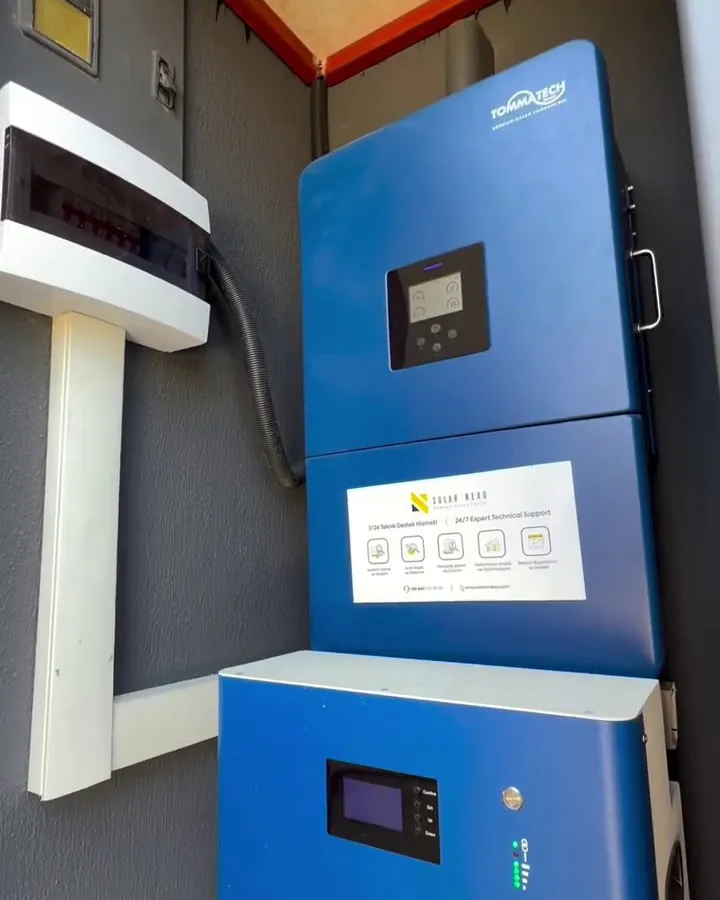
A hybrid inverter sends solar energy first to the household loads, then to the battery, and can export whatever is left to the grid. When the grid fails, the circuits connected to the inverter's backup output keep running from the battery. Which circuits go on that output is decided during the site survey; separating the critical loads instead of backing up the whole villa makes the battery last considerably longer.
For a rough estimate of backup time, divide the usable battery capacity by the average power of the critical loads. For example, with 15 kWh of usable capacity and an average critical load of 1.5 kW, the theoretical runtime is about 10 hours. The real figure depends on the depth-of-discharge setting, inverter losses and whether the panels are producing at the time. During a daytime outage the panels keep generating, so the runtime gets longer.
The TommaTech lithium batteries used in Solar Nexo installations come with a 5-year warranty and 8,000 cycles; warranty certificates and technical documents are handed over to the customer. For more on hybrid design, see our article on the hybrid solar energy system.
The Belek Example: How an Antalya Solar Panel System Was Built on Site
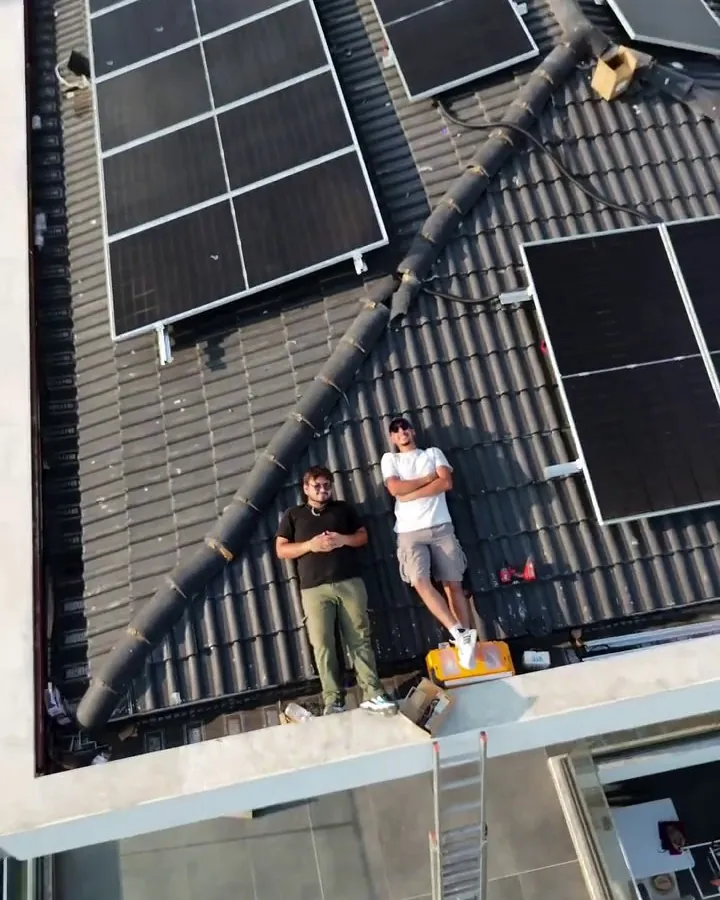
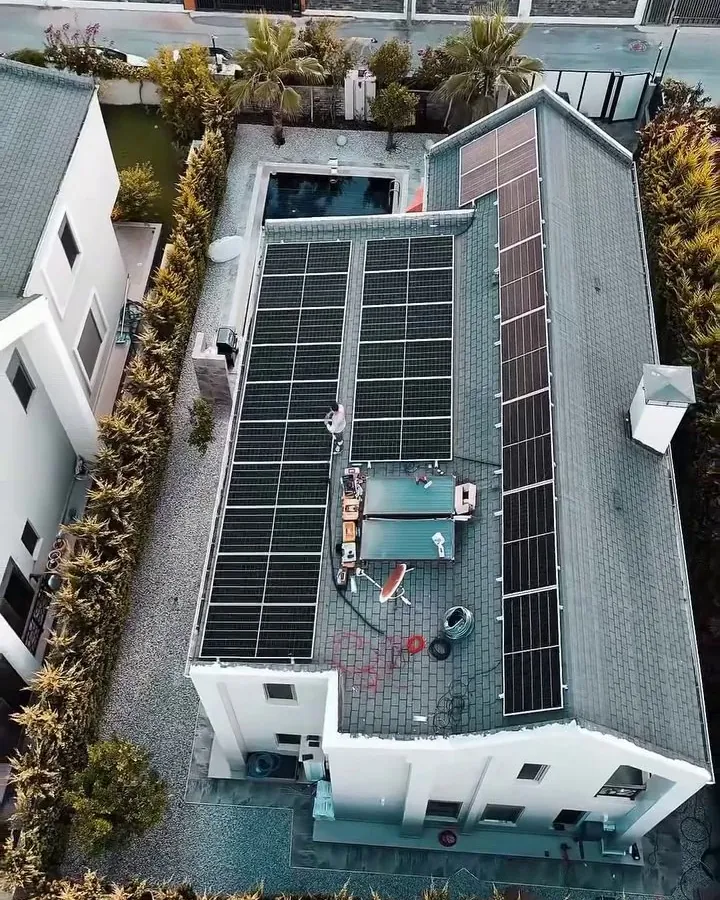
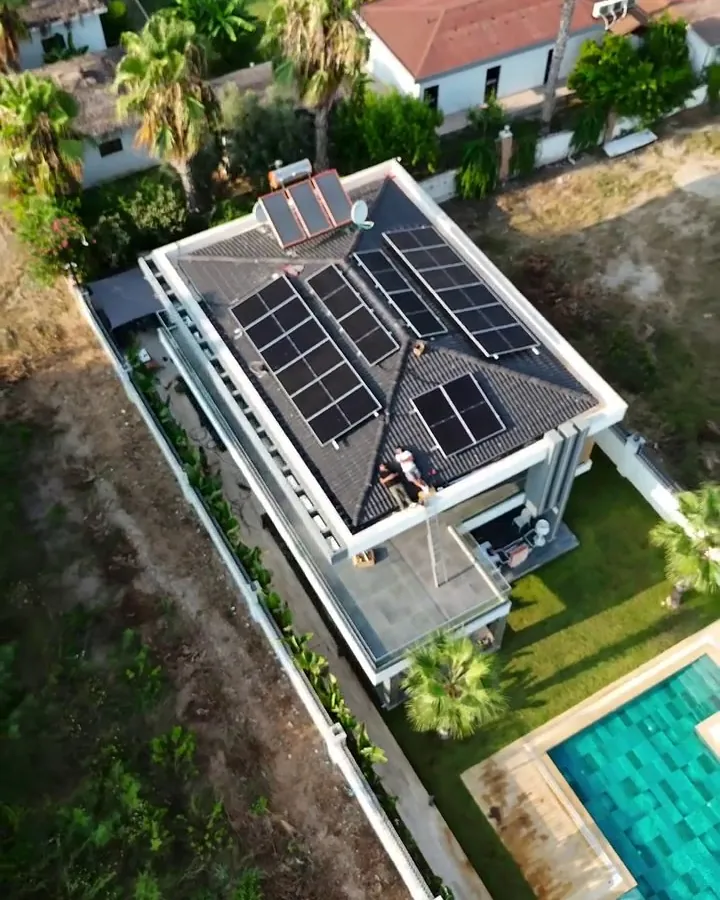
On the Belek villa project, the Solar Nexo team installed 24 TommaTech 605 W panels, a 20 kW hybrid inverter and a 15 kWh LiFePO4 battery. Total array power is 24 × 605 W = 14.52 kWp. The hybrid inverter rating was chosen with the villa's simultaneous loads and possible future panel additions in mind.
Using central Antalya values as an approximate reference, since there is no separate PVGIS figure for Belek here, we can expect a theoretical annual output of about 14.52 kWp × 1,656 kWh/kWp ≈ 24,045 kWh. This assumes optimum tilt and a south-facing array; shading, soiling and the actual roof orientation are not included. The seasonal breakdown looks like this:
| Season | Months | PVGIS (kWh/kWp) | Theoretical output for 14.52 kWp (kWh) |
|---|---|---|---|
| Winter | December, January, February | 99 + 99 + 108 = 306 | ≈ 4,443 |
| Spring | March, April, May | 142 + 150 + 157 = 449 | ≈ 6,519 |
| Summer | June, July, August | 159 + 168 + 167 = 494 | ≈ 7,173 |
| Autumn | September, October, November | 155 + 137 + 114 = 406 | ≈ 5,895 |
| Annual | PVGIS annual value | 1,656 | ≈ 24,045 |
Because the monthly values are rounded, the seasonal totals may differ from the annual figure by a few kWh. The key message of the table is this: summer output is about 1.6 times winter output, and that difference moves in the same direction as the rental villa's seasonal demand. For other projects of this kind in the area, see our page on solar panels in Belek and Serik.
Winter Surplus and Net Metering
Most rental villas stand empty or are used less in winter. Solar production does not stop, though: according to PVGIS, even in December and January central Antalya yields 99 kWh per kWp per month. An empty villa consumes little of this energy, so what happens to the surplus once the battery is full is an important design question.
Grid-connected hybrid systems can export surplus to the grid. With the proper application, this energy can be offset against consumption under net metering (mahsuplaşma). As of October 2026, the period and conditions under which net metering applies should be checked against the current regulation for the relevant subscriber group and connection type. Applications are handled through Akdeniz EDAŞ (AEDAŞ, the local distribution company), and tariffs are set by EPDK, Turkey's energy market regulator. The official application process can take 8–12 months on average, so it pays to start planning well before the season.
You will find the basics in our article what is a net metering system. Being able to export winter surplus lets an Antalya solar energy investment keep generating value all year round, especially for villas that are only used seasonally.
Remote Monitoring: Keeping Track When You Are Not at the Villa
Most rental villa owners do not live in the villa; some are based in another city, others abroad. Monitoring then becomes a necessity rather than a luxury. Monitoring devices connected to hybrid inverters show production, consumption, battery state of charge and grid status in real time through a mobile app.
With monitoring, you can answer these questions without visiting the villa:
- Did the panels produce as expected today, or is one string underperforming?
- Was consumption normal during the guest stay, or was an appliance left running?
- When the grid failed, did the battery take over, and how long did it last?
- Has the inverter shown an error code?
When a problem shows up, Solar Nexo's 24/7 technical support line can be reached by phone or WhatsApp. The villa manager or caretaker can also be given app access to carry out the first check on site. Our article on solar energy monitoring systems explains the available options.
Solar Energy in Antalya: A Checklist for Villa Owners
Before you sign with a solar company in Antalya for a rental villa, clarifying the following points helps you avoid surprises in the middle of the season:
- Scheduling the installation: the contractual delivery time is 14 working days. Timing the installation for a period without guests makes the roof work and the short power interruption much easier to handle.
- Critical circuit list: decide together with the villa manager which circuits will run during an outage.
- Pool and irrigation timing: scheduling the pumps to run during daylight hours increases self-consumption.
- Guest information: a short note in the villa explains that only selected circuits work during an outage.
- Documents: the products should be original and invoiced, and your solar installer must hand over the manufacturer warranty certificates.
- Maintenance plan: panel cleaning and a general check before the season protect output.
A common mistake with Antalya solar panel investments is sizing the system as if it were a home that is also lived in throughout the winter. For a rental villa, the deciding factors are the summer daytime load and the level of comfort expected during outages. Conditions for solar energy in Antalya suit both needs at the same time, provided the design rests on real data.
Which System Type Suits a Holiday Home or Rental Villa in Antalya?
There is no single right answer for every villa. Where grid outages are rare and budget is the priority, an on-grid system may be enough. Where outage sensitivity is high and guest satisfaction is critical, a hybrid system stands out. For mountain homes where a grid connection is difficult or impossible, an off-grid system is the option to consider. A careful solar installer makes this choice based on the consumption data gathered during the survey and on the way the villa is actually used.
As an authorised dealer for TommaTech and CW Enerji, Solar Nexo installs all three system types. The choice takes into account the villa's rental calendar, its pool and air-conditioning loads, and future needs such as electric vehicle charging.
Conclusion
Solar panels for rental villas in Antalya are one of the rare investments where seasonal demand and solar production line up. Properly designed, the system covers summer air-conditioning and pool loads with daytime output, protects guest comfort during outages with a hybrid inverter and battery, and gives you the option of crediting winter surplus under net metering. Request a free site survey, and we will review your villa's consumption data with you and work out the setup that fits.
Frequently asked questions
Does it make sense to install solar panels on a rental villa?
In most cases, yes, because a rental villa's highest consumption falls in summer daytime hours, which is also when solar production peaks. According to PVGIS, a 1 kWp system in central Antalya theoretically produces 168 kWh in July. To make a firm decision, past bills, roof area and shading should be assessed together during the site survey.
Should a rental villa have an on-grid or a hybrid system?
Villas where guest comfort and sensitivity to outages matter usually get a hybrid system. When the grid fails, a hybrid inverter keeps powering the critical circuits connected to its backup output from the battery. Where outages are rare and the priority is a simpler initial investment, an on-grid system can be enough; the choice should be based on consumption data.
How long can the battery power the villa during a power cut?
Runtime depends on the battery's usable capacity and the total power of the critical loads running at that moment. For example, with 15 kWh of usable capacity and an average load of 1.5 kW, the theoretical runtime is about 10 hours. The depth-of-discharge setting, inverter losses and continued daytime solar production change the real figure, which is why critical circuits are defined during the survey.
What happens to the electricity produced when the villa is empty in winter?
Once the battery is full, grid-connected systems can export surplus to the grid. With an approved application, this energy can be offset against consumption under net metering. As of October 2026, net metering conditions should be checked against the current regulation; applications go through Akdeniz EDAŞ (AEDAŞ) and the official process can take 8–12 months on average. So if you are considering net metering, it makes sense to apply before the season.
How can I monitor the system when I am not at the villa?
Monitoring devices connected to hybrid inverters let you see production, consumption, battery charge and error codes in real time in a mobile app. You can also give your villa manager access so they can carry out the first check on site. When you notice a problem, Solar Nexo's 24/7 technical support line is available by phone or WhatsApp, so a minor fault can be found and fixed before the next guests arrive.
Will the installation disrupt the rental season?
Not if it is planned properly. At Solar Nexo the contractual delivery time is 14 working days, and we recommend scheduling the installation for a period without guests. For net-metered systems the official application process can take an additional 8–12 months on average, so if you want that type of system, starting early gives you an advantage. Installation days and short power interruptions should also be shared with the villa manager in advance.
How much electricity does the Belek example system produce per year?
The Belek installation has 24 TommaTech 605 W panels, for a total of 14.52 kWp. Taking the central Antalya PVGIS value of 1,656 kWh/kWp as an approximate reference, the theoretical annual output is about 24,045 kWh. This assumes optimum tilt and south orientation; shading, soiling and the actual roof orientation will change the real output.
Sources
Want a clear calculation for your roof?
The Solar Nexo team carries out a free site survey at your address in Antalya and designs the system that suits your roof, consumption and budget.