
Short answer
An Antalya solar panel layout starts with calculating row spacing for the low sun angle at the winter solstice. PVGIS gives an optimum tilt of about 33° for Antalya, but tilt, row spacing, portrait or landscape orientation, terrain slope and maintenance corridors must be assessed together. The exact values come from project-specific simulation; the goal is a balance between land use and energy yield.
Key takeaways
- The key input for row spacing is the solar elevation at the winter solstice; in Antalya the noon sun stands at roughly 30° on that date.
- Row pitch follows the logic d = L × cos β + (L × sin β × cos γ) / tan α; the exact value is confirmed by simulation.
- The PVGIS optimum tilt for central Antalya is about 33°, but the tilt actually used is chosen together with row spacing.
- Portrait or landscape orientation changes how a module behaves under shading, depending on its cell structure.
- North-facing slopes lengthen shadows; no layout decision should be made without a topographic survey.
- Maintenance corridors and service roads make fault response easier over the long operating life of the plant.
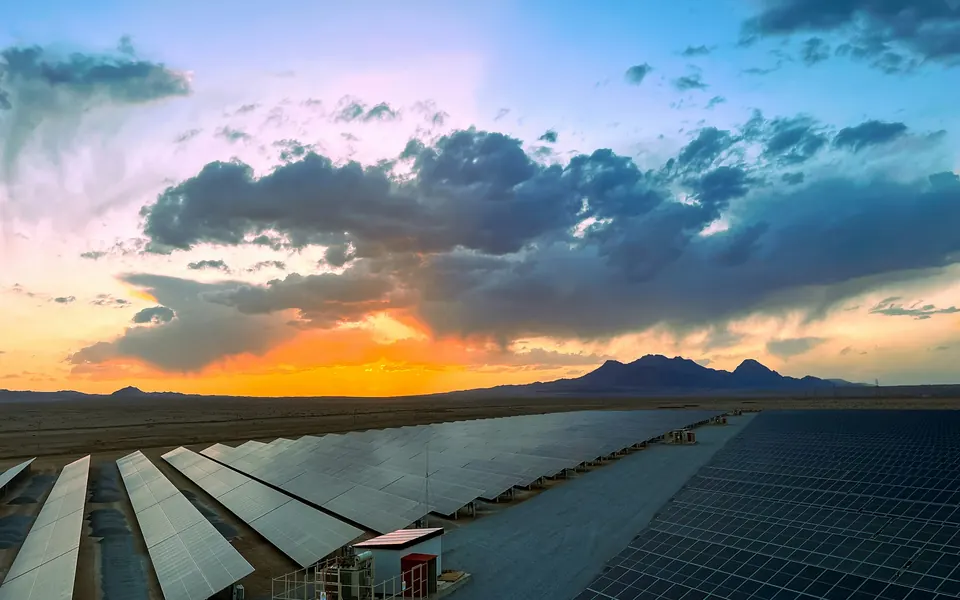
On a ground-mounted solar power plant (GES), the way the panels are arranged on site determines output just as much as the number of panels. An Antalya solar panel layout is a design task in which row spacing, table tilt, portrait or landscape module orientation, the slope of the land itself and maintenance corridors are all considered together. In this article we do not hand out fixed distances in metres; instead we explain the reasoning engineers use to make these decisions and what you should look for when you assess a project.
Why does an Antalya solar panel layout directly affect output?
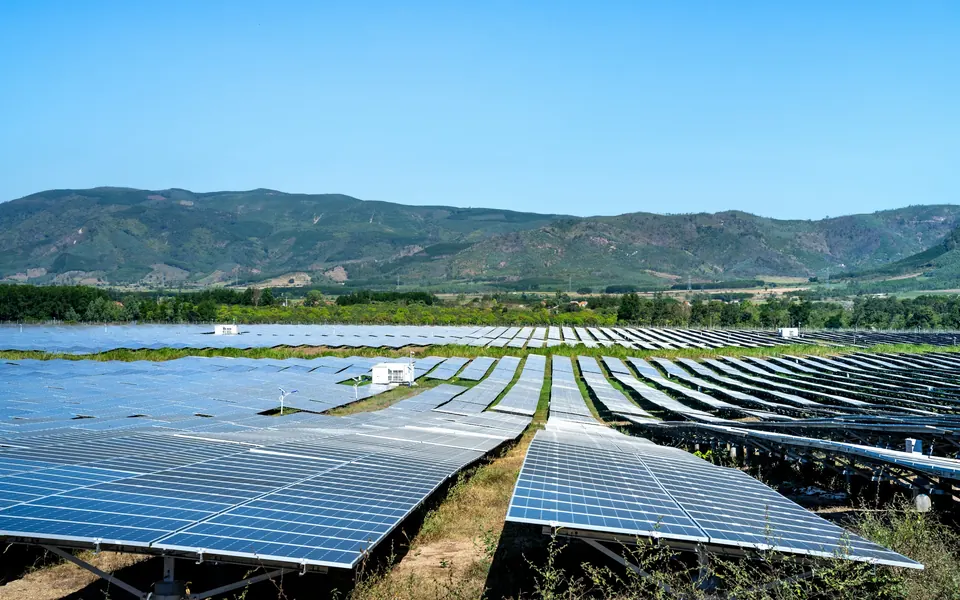
On a fixed-tilt ground plant, panels are arranged in rows running east to west, facing south. Every row casts a shadow on the row behind it when the sun is low. If the rows are packed too tightly, more kWp fits on the same plot, but shading losses rise, especially on winter mornings and late afternoons. If the rows are spread too far apart, shading drops, but the cost of land, cabling and mounting per kWp goes up.
Antalya is in a fortunate position when it comes to solar energy: according to PVGIS 5.3, a 1 kWp system installed at the optimum tilt in central Antalya has a theoretical annual yield of about 1,656 kWh. That figure, however, is calculated for a single unshaded module at the optimum tilt. Real output on site depends on how closely the layout can approach that theoretical value. In other words, a good layout is the bridge that carries the potential of solar energy in Antalya onto the actual site.
The winter solstice and the logic of the shading angle
The starting point for row spacing is the day on which the sun runs lowest in the sky: the winter solstice, around 21 December. On that date the solar elevation at noon is approximately 90° − latitude − 23.44°. Central Antalya lies at about 36.9° north, so at the winter solstice the noon sun stands roughly 30° above the horizon. In the morning and evening the angle is lower still.
Here the designer has to make a choice: "During which time window should the rows cast no shadow on each other at all?" Designing for the noon moment only gives the densest layout; choosing a wider window that also covers the morning and afternoon increases the spacing. This window is set according to the size of the land, the grid connection capacity and the investor's priorities. It is worth remembering that winter output is low anyway: in the PVGIS monthly data for Antalya, December and January are the weakest months of the year at about 99 kWh/kWp. For this reason, accepting a few hours of limited shading in winter can be a sensible compromise on an annual basis in some projects.
The row spacing formula and a theoretical example
Row pitch is the horizontal distance from the front edge of one row to the front edge of the next. The basic geometry is set up as follows:
- L: The length of the table along its slope (for example, the combined length of two modules mounted in portrait).
- β: The table tilt angle.
- α: The solar elevation at the design moment.
- γ: The deviation of the solar azimuth from due south at that moment.
The horizontal projection of the table is L × cos β, and the height of its rear edge above the ground is L × sin β. The component of the shadow cast northwards by that height, measured perpendicular to the rows, is (L × sin β × cos γ) / tan α. The row pitch is the sum of the two: d = L × cos β + (L × sin β × cos γ) / tan α.
Theoretical example (assumption): Take a tilt of 33° and a design moment at noon on the winter solstice (α ≈ 30°, γ = 0). This gives d ≈ 0.84 L + 0.95 L ≈ 1.8 L. In other words, just to keep the noon moment free of shading, the row pitch needs to be about 1.8 times the table length. If you also want to cover the morning and afternoon hours, α becomes smaller, γ grows and the ratio rises. This example only illustrates the reasoning; in a real project the calculation is done in simulation software together with module dimensions, table height, terrain slope and the chosen time window.
Another indicator widely used in the industry is the ground coverage ratio (GCR): the ratio of table length to row pitch. In the theoretical example above it comes to about 0.56. A higher GCR means the plot is used more densely, but the risk of mutual shading increases.
Choosing the tilt in Antalya: the 33° optimum and alternatives
PVGIS gives about 33° as the fixed tilt that maximises annual yield for central Antalya. On ground plants, though, the optimum tilt is not always the tilt that gets built. As the tilt increases, the table gets taller, the shadow gets longer and the rows have to move apart. Lowering the tilt by a few degrees reduces the annual yield per module slightly, but it can allow tighter rows and therefore more capacity on the same land. Lower tables can also reduce wind loads and structural cost.
That is why, when an Antalya solar panel layout is designed, the tilt is never decided on its own but together with the row spacing. Several tilt and spacing combinations are simulated for the same plot, and installed capacity, annual yield and yield per kWp are compared for each. Values also differ by district: PVGIS shows theoretical results of about 1,719 kWh/kWp/year in Elmalı, 1,655 in Korkuteli and 1,649 in Manavgat. On high ground in the upland districts, snow and wind conditions also feed into the tilt choice, which means solar energy in Antalya has to be read district by district. If you are curious about tilt and orientation at rooftop scale, take a look at our guide to solar panel tilt and orientation.
Portrait or landscape? How module orientation affects shading behaviour
Modules can be mounted on the table with their long side running up the slope (portrait) or with their long side horizontal (landscape). Common configurations on site include two modules in portrait (2P) or four in landscape (4L). This choice changes not only the look of the plant but also how a module behaves when it is shaded.
Inside a module, cell groups are separated by bypass diodes. In a conventional full-cell module these groups run along the long side of the module. In portrait orientation, a shadow falling on the bottom edge of the row affects all groups at once; in landscape orientation the shadow first affects only the lowest group and the rest of the module keeps working. In half-cut modules, the module is split into an upper and a lower half, so the effect of bottom-edge shading is limited even in portrait orientation. We cover this in detail in our article on half-cut cell technology.
| Criterion | Portrait (e.g. 2P) | Landscape (e.g. 4L) |
|---|---|---|
| Response to bottom-edge shading | Depends on module type; limited with half-cut modules | Shading first affects the lowest cell group |
| Mounting parts and clamps | Usually fewer parts | May need more rails and fixing points |
| Table height | Similar at the same tilt, varies by configuration | Similar at the same tilt, varies by configuration |
| Cable routing | String cables can be kept short | String planning needs more care |
| Suitable when | Installation speed and simple materials are the priority | Dense layouts that accept limited winter shading |
Which orientation works better is decided by looking at the cell structure of the chosen module, the design of the mounting system and the row spacing together. Generalisations such as "landscape is always better" are simply not true. Solar Nexo bases the orientation decision on the cell and bypass diode layout given in the datasheet of the module that will actually be used.
How do terrain slope and topography change the layout?
The formula assumes flat land. In inland Antalya and on hillside plots, however, the ground is rarely flat. On a south-facing slope the rear row already sits higher than the one in front, which shortens the shadow and lets the rows move closer together. On a north-facing slope the opposite happens: the rear row sits lower, the shadow lengthens and the spacing has to open up. For this reason, north-sloping plots are generally used less efficiently for a ground-mounted solar power plant in Antalya.
A slope in the east–west direction creates a different problem. When the ground level changes along a row, the tables are either stepped or their post lengths are adjusted. This can produce unexpected shading between neighbouring rows in the morning and evening. That is why a topographic survey is always carried out on site and the layout is checked on a digital terrain model. Horizon obstacles such as trees, power poles, neighbouring buildings and hills are assessed in the same model. If you want to know how shading affects output, our article on the effect of shading on solar panels is a good place to start.
Maintenance corridors, access and site arrangement
Row spacing matters not only for shading but also for operating the plant over many years. Cleaning equipment, grass mowers and service vehicles need to pass between the rows. In Antalya, long dry spells in summer bring dust build-up and spring brings a heavy pollen load, both of which soil the panel surface and make regular cleaning necessary. On a site packed too tightly, cleaning and maintenance slow down.
The main elements considered in the site arrangement are:
- Main service roads and vehicle turning areas,
- Access to equipment such as inverters, transformers and switchboards,
- Cable trench routes and crossings,
- Open corridors for firefighting access,
- A safety and shading distance between the perimeter fence and the first row,
- Rainwater draining beneath the tables without causing erosion.
These corridors take part of the plot out of production, but during operation they shorten fault detection and response times. You will find the whole process of building a ground plant in our article on Antalya ground-mounted solar plant installation.
Balancing land use and energy yield: the decision on an Antalya solar power plant
At its core, layout design balances two goals. Land efficiency describes how much installed capacity is placed per unit of land; energy efficiency describes how much electricity each installed kWp produces per year. A dense layout raises land efficiency and lowers energy efficiency; a wide layout does the reverse.
| Criterion | Dense layout (high GCR) | Wide layout (low GCR) |
|---|---|---|
| Installed capacity on the plot | Higher | Lower |
| Annual yield per kWp | Lower because of winter shading | Closer to the theoretical value |
| Maintenance access | More restricted | Easier |
| Cabling and mounting | Less cable length per kWp | Longer routes |
| Suitable when | Land is limited, connection capacity is high | Land is ample, connection capacity is limited |
Which side wins is very often decided by the grid connection capacity. If the connection capacity is fixed and there is enough land, opening up the rows to raise yield per kWp makes sense. If land is limited, a denser layout with an acceptable shading loss may be preferred. On every Antalya solar power plant this decision should be made using PVGIS data, a topographic survey and simulation results, while also taking into account connection and permitting procedures under current regulations as of November 2026.

At Solar Nexo we inspect the site in person during a free site survey for ground projects, compare layout options in simulation and present them to you with the reasoning behind each one. To understand the regional data behind solar energy in Antalya, our Antalya solar power plant guide brings all the topics together in one place.
Conclusion
An Antalya solar panel layout looks simple on paper, yet it is a decision that affects output for the entire life of the plant. The low solar angle at the winter solstice is the key input for row spacing; tilt, module orientation, terrain slope and maintenance corridors shape the calculation. The right answer is not a single "ideal distance" but a comparative simulation based on the conditions of the land and the connection capacity. If you would like your solar power plant in Antalya assessed along these lines, get in touch with the Solar Nexo engineering team.
Frequently asked questions
How is row spacing calculated on a ground-mounted solar plant?
Row spacing is calculated as the sum of the table's horizontal projection and the length of the shadow cast by its rear edge. The formula uses the table length, the tilt angle, the solar elevation at the design moment and the sun's deviation from due south. The design moment is usually a time window around the winter solstice. In a real project, the calculation is done in simulation software together with terrain slope, horizon obstacles and module dimensions.
What tilt should a ground-mounted solar plant in Antalya use?
The starting point is the optimum tilt, which PVGIS gives as about 33° for central Antalya. On ground plants, however, tilt is never chosen in isolation. Lowering it slightly may reduce output per module, but it allows tighter rows and more capacity on the same land. That is why several tilt and row spacing combinations are simulated and the decision is made by comparing annual yield and installed capacity.
Why is the winter solstice used as the reference?
Because the sun reaches its lowest path of the year around the winter solstice, and shadows are at their longest. If the rows do not shade each other on that date, they will not do so in the chosen time window for the rest of the year either. In Antalya the noon sun stands at roughly 30° elevation on that date. Since winter output is low anyway, some projects deliberately accept limited morning and evening shading.
Should panels be mounted in portrait or landscape?
There is no single right answer; the decision depends on the module's cell structure and the density of the layout. With a conventional module, landscape orientation means a shadow on the bottom edge affects only one cell group. With half-cut modules, that effect is limited in portrait orientation too. Portrait mounting usually needs fewer mounting parts and is quicker to install. The choice should be made alongside simulation and mounting design.
How does the slope of the land affect the panel layout?
The slope of the land changes row spacing directly. On a south-facing slope the rear row sits higher, so shadows are shorter and rows can be placed closer together. On a north-facing slope shadows lengthen and spacing has to increase. If there is a level difference in the east–west direction, tables are stepped or post lengths are adjusted. That is why a sound layout cannot be designed without a topographic survey.
Don't maintenance corridors reduce output?
Corridors take part of the plot out of production, but they pay off over the long operating life of the plant. When cleaning equipment, mowers and service vehicles can move freely on site, faults are found and fixed faster. Because dust and pollen in Antalya make regular cleaning necessary, easy access matters. Open roads are also needed for firefighting and equipment access.
How does Solar Nexo support layout design on ground projects?
Solar Nexo inspects the site in person during a free site survey and assesses topography, horizon obstacles and access conditions. Different tilt and row spacing options are then compared in simulation, and the installed capacity and annual yield of each option are presented with the reasoning behind them. Connection and permitting procedures are planned separately in line with current regulations as of November 2026.
Sources
Want a clear calculation for your roof?
The Solar Nexo team carries out a free site survey at your address in Antalya and designs the system that suits your roof, consumption and budget.